Is CMMC Required to Bid on a Contract?
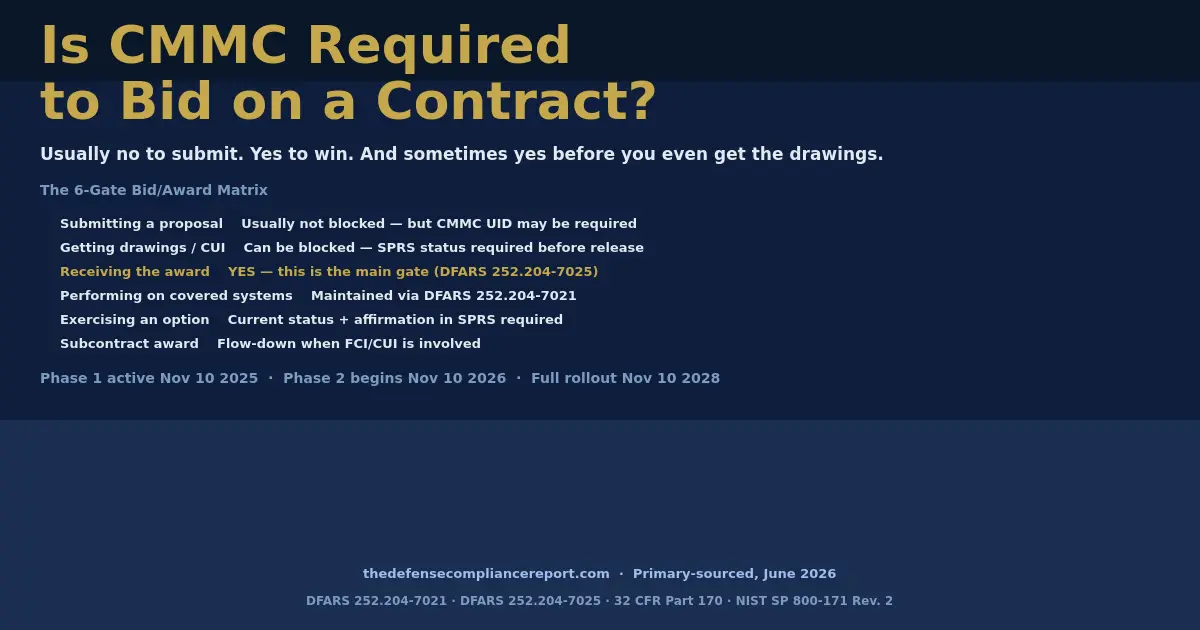
Short version: in most cases, CMMC is not required just to submit a proposal — but it is a condition of award, and that gap is where contractors get hurt.Whether CMMC is required to bid on a contract depends entirely on which “bid” you actually mean: clicking submit, getting the drawings you need to price the job, winning the award, performing the work, exercising an option, or taking a subcontract from a prime. Each one is a separate gate — controlled by the solicitation language, the DFARS clauses in effect, and your CMMC status in SPRS.
Which gate do you mean by “bid”? The CMMC Bid/Award Gate Matrix
“CMMC required to bid” is really six different questions. Under the DFARS CMMC clauses effective November 10, 2025, CMMC is enforced primarily as a condition of award — DFARS 252.204-7025 makes an offeror ineligible for award without the required CMMC status and affirmation reflected in SPRS (the Supplier Performance Risk System). But CMMC can also block earlier steps. The table below separates each gate. Last verified: .
| If by “bid” you mean… | Can CMMC block it? | What controls it | What has to be in place | Who’s blocked if it’s missing | Primary source |
|---|---|---|---|---|---|
| Submitting a proposal | Sometimes | DFARS 252.204-7025 | When the provision applies, your proposal must report the CMMC UID(s) for each system that will handle FCI/CUI | Offeror — without the required CMMC UID, DoD can’t verify your award eligibility for that system | DFARS 252.204-7025 |
| Getting drawings, technical data, or CUI to price the bid | Yes, in some solicitations | The solicitation’s data-access terms + CUI handling | The required CMMC status reflected in SPRS before the controlled data is released to you | Any offeror who needs the data to build a credible price | 32 CFR Part 170; solicitation terms |
| Receiving the award | Yes — this is the main gate | DFARS 252.204-7025; DFARS 252.204-7021 | Current CMMC status at the required level and a current affirmation of continuous compliance, reflected in SPRS for each applicable system | Offeror | DFARS 252.204-7025 |
| Performing on covered systems | Yes | DFARS 252.204-7021 | CMMC status maintained for every system that processes, stores, or transmits FCI/CUI | Contractor during performance | DFARS 252.204-7021 |
| Exercising an option or extending performance | Yes | DFARS 252.204-7021 | Current status + affirmation kept live in SPRS | Incumbent contractor | DFARS 252.204-7021 |
| Subcontract award | Yes, when FCI/CUI flows down | DFARS 252.204-7021 (flow-down) | The subcontractor’s status/affirmation for its applicable systems, verified by the prime before subcontract award | Subcontractor/supplier | DFARS 252.204-7021 |
| COTS-only contract | No, if solely COTS | DFARS 204.75 clause prescription | Confirm the work is solely for commercially available off-the-shelf items and that no FCI/CUI handling is triggered | Offeror, if it’s not truly COTS-only | DFARS 204.75 |
The row most people miss is the second one. You can be fully eligible to submit a proposal and still be unable to buildone, because the drawings, technical data package (TDP), or CUI you need to price the work won’t be released to a contractor without the required CMMC status in SPRS. On paper that isn’t a “bidding requirement.” In practice, it ends your bid just as completely.
Not sure which gate your solicitation is actually enforcing?
That’s the first thing to nail down before you spend a dollar on tools, assessors, or an enclave. Use The Defense Compliance Report’s Find My CMMC Path tool— tell us your required level, whether FCI or CUI is involved, your assessment type, and your timeline, and we’ll map your situation to the right provider category. It routes you to a category, not a named provider. Educational routing only — not legal or compliance advice.
Find My CMMC Path →Is CMMC required to bid on a DoD contract, or only before award?
The clean rule is that CMMC is an award-and-performance requirement, not a universal bar on clicking submit. DFARS 252.204-7025 states that an offeror is not eligible for award without the required current CMMC status and a current affirmation of continuous compliance reflected in SPRS for each applicable system, and that proposals must report the relevant CMMC UID(s). So if the clause is in your solicitation and you don’t have the status, you can often still submit — you just can’t win.
That “you can submit but can’t win” line sounds like good news. Three things collapse it back into a hard requirement:
- The proposal itself may demand your CMMC UID. When DFARS 252.204-7025 applies, you have to report the CMMC UID for each system that will process, store, or transmit Federal Contract Information (FCI — information provided by or generated for the Government under a contract, not for public release) or Controlled Unclassified Information (CUI — government information that’s unclassified but protected by law, regulation, or policy). No record, nothing to report — and DoD can reject the proposal as non-responsive. See also: FCI vs. CUI explained.
- Award eligibility is checked, not assumed. The contracting officer verifies your status in SPRS before award. DFARS Subpart 204.75directs that the contracting officer shall not award — or exercise an option, or extend performance — without the required current CMMC status. A statement of intent or “we’re working on it” doesn’t satisfy a contractual requirement.
- The drawings gate can hit before any of that.As the matrix showed, some solicitations won’t release the controlled data you need to price the work until your CMMC status is in SPRS. That’s a pre-submission problem, not an after-award one.
The one hard truth we won’t sugarcoat
If your proposal is due in two weeks, you genuinely handle CUI, and you have no System Security Plan (the SSP — the document describing how you protect that data), no score in SPRS, and no defined boundary around where CUI lives in your environment, then no consultant, software platform, or C3PAO can make you award-eligible in time for that bid. Anyone who tells you otherwise is selling something.
Now the part that matters more: that almost never means defense work is closed to you. It means this onedeadline may not be winnable on an honest CMMC basis — and the smartest move is to find out fast whether the requirement bites at submission, at document access, or only at award, because the answer changes your whole play. There’s often more room than the panic suggests. A self-assessment path (where the contract allows it), conditional status with up to 180 days to close the POA&M, or scoped remediation can all change the math — but only if you’re honest about where you actually stand.
Match your real deadline to a realistic move
Stop thinking in one deadline and split it into the deadlines that actually exist — proposal due date, document-access date, expected award date, option date, subcontract date. Then match the nearest one to a path you can actually execute.
| Your nearest deadline | The honest read | Best next move | Likely category |
|---|---|---|---|
| Proposal due in 1–7 days | You can’t fix a weak environment before submission | Read the clause; ask the CO/prime whether status is required at submission, document access, or award; make a clear bid / no-bid call | Contracts counsel + RP/RPO consult |
| Award expected in under 30 days | High risk if required status is missing | Verify your SPRS status, affirmation, and CMMC UID; determine whether conditional status is even possible | RP/RPO + an executive go/no-go |
| Award expected in 30–90 days | A self-assessment path may be reachable — only if controls and evidence are mostly in place | Gap check, SSP/POA&M, SPRS prep, scope confirmation | RPO/RP, vCISO, MSP/MSSP |
| Award expected in 90–180 days | Enough time for focused remediation if scope is controlled | Build evidence, close gaps, isolate CUI if needed | MSP/MSSP + GRC/evidence platform |
| Award expected in 6+ months | Time to build a real program instead of a scramble | CUI scoping, SSP, remediation roadmap, readiness assessment | RPO/RP + MSP/MSSP + possible enclave |
If a deadline is bearing down and you need to triage what’s realistic, start self-serve
Get the CMMC Readiness Checklist— it maps the work to the 14 control families in NIST SP 800-171 Revision 2 so you can see in an afternoon what’s achievable before your bid date, and what isn’t.
How to check your own solicitation in 10 minutes
The fastest way to answer “is CMMC required to bid on this contract” is to read the clause language yourself. Open the solicitation, the attachments, Sections L and M, and any cybersecurity or controlled-document instructions, and search for the CMMC provisions and the words that signal which gate applies. The clause text controls — not the headline of the opportunity, and not what a competitor told you.
Copy and paste these into your search bar, one at a time:
252.204-7025— the CMMC notice provision (tells you the required level and the award-eligibility rule)252.204-7021— the CMMC contract clause (status, maintenance, flow-down)CMMCandCMMC UIDSPRSandaffirmationprior to awardFederal Contract Information/FCIControlled Unclassified Information/CUIdrawings/technical data/TDP/JCPsubcontractor/flow downLevel 1/Level 2 Self/Level 2 C3PAO/Level 3
What DFARS 252.204-7025 means.This is the solicitation provision (the “Notice of CMMC Level Requirements”). It names the required CMMC level for the work and states that an offeror is not eligible for award without the required current CMMC status and a current affirmation in SPRS for each applicable system, and that the proposal must report the relevant CMMC UID(s). If you see -7025, the level it names is the level you have to hit to win.
What DFARS 252.204-7021 means.This is the contract clause (the “Contractor Compliance with the CMMC Level Requirements”). It requires the contractor to have and maintain the required CMMC status for the life of the contract, to process/store/transmit FCI or CUI only on systems with that status, to keep an annual affirmation current, to close out any POA&M when on conditional status, and to flow the requirement down to subcontractors that will handle FCI/CUI. If -7021 is in the contract, CMMC isn’t a one-time gate at award — it’s a standing obligation through every option year.
If anything is ambiguous, put it to the contracting officer in writing before you spend. Here’s a copy/paste starting point:
Reference: [Solicitation No. ___]. To confirm our approach, we’d appreciate clarification on the cybersecurity requirements: (1) Does this solicitation include DFARS 252.204-7025, and what CMMC level and assessment type are required? (2) Is the required CMMC status needed at proposal submission, before access to drawings/CUI, before award, or at performance? (3) Are a Conditional CMMC status and a POA&M acceptable for this procurement? (4) Are any drawings or technical data restricted to offerors that already hold a current CMMC status in SPRS? Thank you.
The answers tell you which gate you’re actually facing — and whether this bid is reachable.
What CMMC level does your contract require to bid?
Your required level is set by the contract clause and the sensitivity of the information you’ll handle — not by a checklist you choose. FCI generally points to Level 1 (the 15 basic safeguarding requirements from FAR 52.204-21). CUI generally points to Level 2 (the 110 requirements in NIST SP 800-171 Revision 2, organized into 14 control families). The most sensitive CUI can require Level 3 (Level 2 plus 24 selected requirements from NIST SP 800-172, assessed by the Government). The DoD’s CMMC program documentation defines all three.
| Your situation | Likely CMMC level | Assessment type | The mistake to avoid |
|---|---|---|---|
| You’ll handle FCI only | Level 1 | Annual self-assessment | Don’t buy a third-party assessment you don’t need |
| You’ll handle CUI, lower-risk contract | Level 2 | Self-assessment if the solicitation allows it | Don’t assume every Level 2 contract permits self-assessment |
| You’ll handle CUI, prioritized/critical contract | Level 2 | C3PAO certification assessment | Don’t assume a self-assessment satisfies a C3PAO requirement |
| Highest-sensitivity CUI / advanced-threat programs | Level 3 | DCMA DIBCAC assessment | Don’t start at Level 3 — a Final Level 2 (C3PAO) for the same scope is a prerequisite |
A quick vocabulary note, because these terms get blurred constantly. A C3PAO (Certified Third-Party Assessment Organization) is a firm authorized by the Cyber AB to conduct official Level 2 certification assessments. DIBCAC (the Defense Industrial Base Cybersecurity Assessment Center, part of DCMA) conducts Level 3 assessments. An RPO/RP (Registered Provider Organization / Registered Practitioner) advises and prepares you — it does not certify you. The rules keep those roles separate on purpose.
Self-assessment vs C3PAO: which one lets you bid?
Both Level 2 paths map to the same 110 requirements in NIST SP 800-171 Revision 2, but they are not interchangeable for bidding. Level 2 (Self) means you assess your own environment, post the result in SPRS, and affirm annually. Level 2 (C3PAO) means an authorized third party conducts the assessment, with results flowing through eMASS to SPRS — and self-assessment is not an option when the solicitation requires C3PAO. The solicitation decides which one applies to your bid.
Why this matters to your wallet: a contractor on a self-assessment path needs help implementing controls, building evidence, and writing an SSP — not a six-figure assessment invoice. A contractor on a C3PAO path needs readiness work first, and then a clean separation between the firm that helped them prepare and the firm that assesses them.
That separation isn’t a nicety — it’s a conflict-of-interest rule. Under the Cyber AB’s CMMC Assessment Process and conflict-of-interest rules, a C3PAO cannot provide you readiness, consulting, implementation, or remediation help and then assess that same work, and it cannot give advice or recommendations during the assessment. A firm that helped you prepare generally cannot serve as your certifying assessor for three years. We verified this against the Cyber AB’s published ecosystem and assessment-process guidance — and it’s the reason we never route a readiness lead to a C3PAO as if one firm can do both ends of the same job.
One scheduling reality to plan around: a C3PAO assessment isn’t a one-week event you book on short notice. Between scoping, evidence prep, the assessment itself, and any POA&M closeout, the cycle commonly runs months. Confirm first that your contract still contains a written C3PAO requirement after the July 13, 2026 suspension. (For how to vet and choose one, see our guide to selecting a CMMC Level 2 C3PAO.)
Once you know your level and assessment type, the next question is who helps you get there
Need controls implemented and evidence built? That’s a readiness/MSP/MSSP conversation. CUI sprawled across email and file shares? That’s a CUI enclave conversation. Already buttoned-up and the contract requires it? That’s a C3PAO conversation.
Compare provider categories →Can you use Conditional status or a POA&M to win an award?
Sometimes — but it’s narrower than “we’ll fix it after we win.” Under 32 CFR § 170.17, a Level 2 (C3PAO) assessment that lands with an allowable POA&M can earn a Conditional status, giving you up to 180 days to close the POA&M and reach Final. You must already hold that Conditional status at award. Level 1 has no conditional status — it must be Final at award.
The rules around what can sit on a POA&M are strict, so don’t treat it as a safety net. Only lower-weighted requirements are eligible, certain requirements can’t be deferred at all, and you generally need a passing score before a POA&M is even on the table. Most important for bidding: a Conditional status only helps if you’ve already earned it. If your conditional status expires without closeout, the status lapses — and you become ineligible for further awards that require that level until you earn a new one. Conditional status buys time. It doesn’t forgive the work.
When CMMC blocks the drawings or CUI you need to price the bid
Some opportunities make CMMC feel like a bidding requirement because you can’t get the drawings, technical data package, or CUI needed to price the work unless you already hold the required CMMC status in SPRS.That’s a different mechanism than a proposal-submission bar, but the practical result is identical: no access, no credible bid. Technical data can be CUI when it’s marked or identified that way, and if the data is CUI, the systems that process, store, or transmit it fall inside the CMMC protection framework under 32 CFR Part 170.
This trips up shops that assumed CMMC was purely an after-award problem. Two access gates can stand between you and the data you need:
- The long-standing one: militarily critical and export-controlled technical data has been gated for years behind the U.S./Canada Joint Certification Program (JCP) and DD Form 2345. That’s separate from CMMC and predates it.
- The newer one: when controlled data qualifies as CUI, a solicitation can condition its release on your holding the required CMMC status in SPRS — so the cybersecurity gate now sits in front of the bid, not behind the award.
Some solicitations condition access to controlled data on CMMC or SPRS status; others don’t. The only way to know is to read yours — search your opportunity for the drawings, technical data, and JCP terms above. If you find access-conditioning language, treat document access as a gating milestone with its own deadline — earlier than the proposal due date — and plan backward from it.
Do subcontractors need CMMC to bid?
Yes — when the subcontractor will process, store, or transmit FCI or CUI in performing the work. DFARS 252.204-7021requires prime contractors to flow the CMMC requirement down and to ensure subcontractors and suppliers have the required status/affirmation before subcontract award. A sub that won’t touch FCI or CUI generally isn’t subject to CMMC under that contract.
The dynamic on the ground is often blunter than the regulation. Primes are increasingly asking suppliers for proof of CMMC status before the government award is even made — because the prime carries the flow-down risk and wants to field a compliant team. For a large share of the Defense Industrial Base, that prime pressure is the real forcing function, arriving well ahead of any phase deadline.
One operational wrinkle: primes generally can’t pull your SPRS record directly. SPRS protects each entity’s own data, so you’ll likely be asked to share a screenshot or your affirmation. Decide in advance what proof you’ll provide and how, without exposing sensitive internal detail — and ask the prime what form of proof it can accept.
What to ask your prime before you spend anything:
- What CMMC level are you flowing down — and is it Level 2 (Self) or Level 2 (C3PAO)?
- What systems and data are actually in scope for our piece of the work?
- Are we receiving FCI, CUI, drawings, a TDP, or export-controlled data?
- Do you need proof before quote, before subcontract award, or before any CUI is transferred?
- What form of proof will you accept?
Which clause applies now? What changed on February 1, 2026
For bid and award eligibility, the two controlling clauses are DFARS 252.204-7021 and DFARS 252.204-7025 — both unchanged. But on February 1, 2026, the DoD’s Revolutionary FAR Overhaul renumbered several neighboring cybersecurity clauses and consolidated them under new FAR Part 40and DFARS Part 240. These are class deviations pending formal rulemaking, so you’ll see both old and new numbers in live solicitations during the transition.
Here’s the crosswalk worth saving. Last verified: .
| Requirement | Number you’ll still see | Deviation-path number (Feb 1, 2026) | What changed | Still required? |
|---|---|---|---|---|
| FCI basic safeguarding (15 controls) | FAR 52.204-21 | FAR 52.240-93 | Renumbered only; text identical | Yes |
| Notice of NIST 800-171 self-assessment | DFARS 252.204-7019 | Not used in the new structure | Removed as redundant with CMMC | Self-assessment obligation now flows through CMMC (32 CFR 170 / -7021) |
| DoD (Medium/High) assessment requirements | DFARS 252.204-7020 | DFARS 252.240-7997 | Renumbered; the standalone “Basic” self-assessment was removed; Medium/High DIBCAC assessments remain | Yes (Medium/High) |
| CMMC contract clause | DFARS 252.204-7021 | DFARS 252.204-7021 | No change | Yes |
| CMMC notice provision (proposal UID; award eligibility) | DFARS 252.204-7025 | DFARS 252.204-7025 | No change | Yes |
| Safeguarding CDI + 72-hour incident reporting | DFARS 252.204-7012 | DFARS 252.204-7012 | No change | Yes |
Two things not to misread. First, the removal of DFARS 252.204-7019 did not end self-assessment obligations — those responsibilities now flow through the CMMC framework under -7021, while the separate safeguarding and incident-reporting duties under DFARS 252.204-7012 remain in force unchanged. Several headlines got that wrong. Second, on the standard itself: NIST SP 800-171 Revision 3 now supersedes Revision 2 in NIST’s own catalog, but CMMC Level 2 still maps to Revision 2under 32 CFR Part 170, and will until DoD amends the rule. If you build your evidence to Rev. 3 thinking it’s the CMMC baseline, you’ll waste effort.
Was November 10, 2026 a universal CMMC deadline?
No — and it’s no longer operative. The July 13, 2026 implementation suspension paused the Phase II transition (originally set for November 10, 2026) with no replacement date announced. CMMC remains in Phase 1. CMMC becomes required when the clause appears in your specific solicitation — not on a blanket calendar date. The original phase schedule was set in 32 CFR § 170.3(e).
The “everyone must be certified by November 2026” framing was always wrong — and the July 13, 2026 suspension made it doubly so. Here’s the original schedule set in the program rule, retained for historical reference:
Original 32 CFR phased schedule before the July 13, 2026 suspension
| Phase | Begins | What can be required as a condition of award |
|---|---|---|
| Phase 1 | Nov 10, 2025 (active) | Level 1 (Self) and Level 2 (Self); Level 2 (C3PAO) at DoD discretion. Phase 1 remains active following the July 13, 2026 suspension. |
| Phase 2 | Nov 10, 2026 (suspended) | Would have added Level 2 (C3PAO); suspended July 13, 2026; no replacement date announced. |
| Phase 3 | Nov 10, 2027 (suspended) | Would have broadened Level 2 (C3PAO) and introduced Level 3 via option exercises. |
| Phase 4 | Nov 10, 2028 (suspended) | Full implementation across all applicable contracts. |
So why does everyone treat November 2026 as a wall? Because the readiness math forces the issue. As reported at the Cyber AB’s March 2026 Town Hall, the ecosystem had roughly 103 authorized C3PAOs and about 759 Certified CMMC Assessors, and only about 1,000 organizations had achieved Level 2 certification — a sliver of the tens of thousands of contractors expected to need it. With industry readiness timelines commonly running 6 to 18 months, the contractor who waits for a deadline to appear in a solicitation is already behind it. (Ecosystem counts move every month — check the current figures on the Cyber AB Marketplace.)
What does it cost — and how long — to become eligible?
The DoD’s official cost estimate in the CMMC Program Rule (32 CFR Part 170) is roughly $6,000 for a Level 1 self-assessment and affirmation, $34,277 for a Level 2 self-assessment, and $101,752 for a Level 2 (C3PAO) certification assessment plus initial affirmation for a small entity ($104,670 over three years with annual affirmations). Critically, those figures assume you’ve already implemented the underlying security requirements — they cover proving compliance, not achieving it. Industry readiness timelines commonly run 6 to 18 months.
That last sentence is the trap inside the official numbers. The DoD’s cost analysis assumes you’ve been meeting NIST SP 800-171 since 2017 (a DFARS 252.204-7012 obligation), so it excludes the part that actually hurts: remediation, an enclave build, an SSP, technology, and labor.
| Path | DoD official estimate (anchor, small entity) | What the estimate does not include |
|---|---|---|
| Level 1 (Self) | ~$6,000 | Internal labor; fixing any missing basic safeguards |
| Level 2 (Self) | $34,277 initial / ~$37,196 over 3 years | NIST 800-171 remediation, SSP quality, evidence, architecture |
| Level 2 (C3PAO) | $101,752 initial / $104,670 over 3 years | Full remediation, enclave, MSP/MSSP work, tooling, failed-assessment risk |
| Level 3 (DIBCAC) | Level 2 prerequisite + selected NIST SP 800-172 work | Specialized high-sensitivity engineering and program requirements |
Treat these as government planning anchors, not market quotes. Independent industry reporting and provider pricing put realistic all-in first-year Level 2 spend far higher — commonly $100,000 to $300,000 depending on starting maturity, scope, environment, evidence quality, and CUI footprint. The biggest lever you control is scope: isolating CUI in a defined enclave can sharply reduce both the cost and the risk of the assessment, because everything CUI touches falls in scope. (For the full breakdown, see our CMMC certification process and cost guide.)
Shortcuts that get contractors disqualified
The most damaging CMMC mistakes aren’t technical — they’re decision errors made under deadline pressure.Treating SPRS as a checkbox, confusing Level 2 (Self) with Level 2 (C3PAO), hiring an assessor to fix your controls, posting a status you can’t defend, or moving CUI into out-of-scope systems can each cost you an award — or create False Claims Act risk when a cybersecurity representation is tied to a government contract or payment.
| The shortcut | Why it backfires | The safer move |
|---|---|---|
| “We’ll bid now and figure CMMC out after we win.” | Award is blocked if the required status/affirmation isn’t in SPRS. | Confirm the award timing and required status first. |
| “We’ll self-assess even though the clause says C3PAO.” | The wrong assessment type doesn’t satisfy the clause. | Read the exact required path in -7025. |
| “We’ll have the C3PAO help us fix our controls.” | Conflict-of-interest rules prohibit it for the firm that assesses you. | Use readiness help first, then a separate assessor. |
| “Put every company system in scope.” | Scope sprawl multiplies cost and failure risk. | Define your CUI boundary; consider an enclave. |
| “Our SPRS score is enough.” | CMMC status, affirmation, and CMMC UID may all be required. | Verify exactly what the solicitation asks for. |
| “Our prime says we need CMMC, so we need Level 2 (C3PAO).” | Flow-down is often misread. | Ask the prime for the exact level, type, and timing. |
One that deserves its own line: posting or affirming a cybersecurity status you can’t defend. The U.S. Department of Justice’s Civil Cyber-Fraud Initiative has pursued contractors under the False Claims Act for cybersecurity misrepresentations and unmet control requirements. An affirmation is a formal statement; treat it like one.
Which provider category fits — and what to do next
The right next step depends on your required level, your FCI/CUI handling, your assessment type, your environment, and your timeline — which is exactly why a generic “best vendor” answer is useless here. If you’re not assessment-ready, a C3PAO is not your first call. The Defense Compliance Report’s CMMC Path Framework maps your situation to a provider category — readiness, enclave, GRC, managed compliance, or assessment — never to a ranked list of names.
| Your situation | Usually start with | Why | What not to buy yet |
|---|---|---|---|
| Clause says Level 1 (Self) | RP/RPO or internal compliance support | You need a self-assessment, evidence, and an SPRS affirmation | A C3PAO assessment |
| Clause says Level 2 (Self) | RPO/RP + MSP/MSSP, GRC if helpful | You need NIST 800-171 evidence and SPRS readiness | A C3PAO assessment |
| Clause says Level 2 (C3PAO), controls not ready | RPO/RP + MSP/MSSP before any C3PAO | Assessing too early invites failure and wasted cost | The C3PAO — until you’re ready |
| Clause says Level 2 (C3PAO), evidence is ready | C3PAO | You’re assessment-ready | More tooling you don’t need |
| CUI spread across email/file shares | CUI enclave / secure collaboration strategy | Shrinking scope often matters more than any checklist | An enterprise-wide assessment |
| Evidence is scattered | GRC / evidence platform (a supporting layer) | You need defensible, trackable evidence — software alone is not compliance | A platform sold as “instant CMMC” |
| You’re a sub under prime pressure | RP/RPO + flow-down interpretation | You need the exact requirement and a clean proof package | Anything before you confirm the flowed-down level |
Need help deciding what type of CMMC provider you need?
Tell us your level, scope, and timeline, and we’ll match you with source-checked CMMC provider options.
Find My CMMC Path →What we actually verified
- CMMC Program Rule — 32 CFR Part 170, effective December 16, 2024; phased rollout in § 170.3(e); Level 2 conditional/180-day rules in § 170.17.
- DFARS CMMC clauses — 252.204-7025 (proposal CMMC UID; not eligible for award without current status and affirmation) and 252.204-7021 (maintain status; flow-down); effective November 10, 2025. Award/option verification in DFARS Subpart 204.75.
- February 1, 2026 Revolutionary FAR Overhaul — DFARS 252.204-7019 removed; DFARS 252.204-7020 → 252.240-7997; FAR 52.204-21 → 52.240-93; -7021 and -7025 unchanged. (FAR Overhaul materials, Acquisition.gov)
- Levels — Level 1 = 15 requirements (FAR 52.204-21); Level 2 = 110 requirements across 14 families (NIST SP 800-171 Rev. 2); Level 3 = Level 2 plus 24 selected requirements from NIST SP 800-172, with a Final Level 2 (C3PAO) prerequisite. (DoD CMMC program documentation)
- Standard pinning — NIST SP 800-171 Rev. 3 supersedes Rev. 2 in NIST’s catalog, but CMMC Level 2 remains on Rev. 2 under 32 CFR Part 170.
- Cost anchors — Level 1 self ≈ $6,000; Level 2 self = $34,277 initial / ~$37,196 over three years; Level 2 (C3PAO) = $101,752 initial / $104,670 over three years (small entity), excluding implementation. (CMMC Regulatory Impact Analysis, 32 CFR Part 170)
- Ecosystem — roughly 103 authorized C3PAOs, ~759 CCAs, and ~1,000 Level 2 certifications, as reported at the Cyber AB’s March 2026 Town Hall. Counts change monthly — verify on the Cyber AB Marketplace.
- Conflict-of-interest rule — a C3PAO cannot provide readiness/consulting/implementation to an organization it assesses, and a firm that prepared you generally cannot assess you for three years. (Cyber AB CMMC Assessment Process and conflict-of-interest rules)
Frequently asked questions
Can you bid on a DoD contract without CMMC?
Usually the binding gate is award, not pressing submit — but the solicitation controls. When DFARS 252.204-7025 applies, the offeror is not eligible for award without the required current CMMC status and affirmation reflected in SPRS, and the proposal must report the relevant CMMC unique identifiers. Confirm with the contracting officer whether the requirement applies at submission, document access, or award.
Is CMMC required before proposal submission?
Sometimes. When DFARS 252.204-7025 applies, the proposal must report the CMMC UID for each system that will handle FCI or CUI, so you need a CMMC record to report. Read the provision before assuming CMMC is only an after-award issue.
Is CMMC required before award?
Yes, when the solicitation includes a CMMC requirement. DFARS Subpart 204.75 directs that the contracting officer shall not award, exercise an option, or extend performance without the required current CMMC status reflected in SPRS.
Can CMMC block access to drawings before I bid?
It can. When drawings or technical data are CUI, a solicitation can condition their release on the offeror holding the required CMMC status in SPRS, which means you cannot price the work without it. Search your solicitation for the words drawings, technical data, TDP, and JCP.
Do subcontractors need CMMC?
Yes, when the subcontractor will process, store, or transmit FCI or CUI for the covered work. DFARS 252.204-7021 requires prime contractors to flow the requirement down and to verify a subcontractor’s status before subcontract award.
Does a NIST 800-171 SPRS score by itself count as CMMC?
Not on its own. SPRS still matters, but depending on the level and solicitation you may also need a current CMMC status, a current affirmation of continuous compliance, and a CMMC unique identifier. Verify exactly what is being asked.
What is a CMMC UID?
A CMMC Unique Identifier is tied to the assessment scope for the systems that process, store, or transmit FCI or CUI. DFARS 252.204-7025 requires offerors to report the relevant CMMC UID(s) in their proposals so DoD can verify the required assessment in SPRS.
Can I use a POA&M and still get the award?
For Levels 2 and 3, an allowable Plan of Action and Milestones can support a Conditional CMMC status with up to 180 days to reach Final under 32 CFR § 170.17. Level 1 has no conditional status and must be Final at award. You must already hold the Conditional status at the time of award.
Do I need a C3PAO to bid?
Only if the solicitation requires a Level 2 third-party (C3PAO) assessment or Level 3, or if you are assessment-ready and pursuing certification. Level 1 and some Level 2 contracts are self-assessment paths.
Can one firm prepare us and also assess us?
No. Under the Cyber AB’s conflict-of-interest rules, a C3PAO cannot provide readiness, consulting, or implementation help to an organization it assesses, and a firm that prepared you generally cannot serve as your certifying assessor for three years. Keep readiness and assessment in separate hands.
Does CMMC apply to every federal contract?
No. CMMC is implemented through DoD procurement under the DFARS clauses; it is not a universal requirement across all civilian-agency contracts. COTS-only contracts are generally excluded.
What should I do today if my bid is due this week?
Search the solicitation for the CMMC clauses and the gate keywords above. Then ask the contracting officer or prime whether the requirement applies at proposal, at document access, at award, or at performance — and decide whether to chase this bid or position for the next one based on the answer.
Disclosure
Keep going
- CMMC certification process and cost guide — the four assessment paths, steps, and budget reality
- How to choose a CMMC Level 2 C3PAO — for when you’re assessment-ready
- NIST SP 800-171 requirements checklist — the 110 requirements across 14 families
- CMMC Level 3 requirements — the DIBCAC path and the NIST SP 800-172 additions
- CMMC Levels explained
- FCI vs. CUI — what you handle determines your level
- CMMC vs. NIST SP 800-171
- Find My CMMC Path — map your level, scope, and timeline to the right provider category
- CMMC Waiver: Can You Get One, and What It Won't Do (2026)