CMMC Non-Compliance Penalties: What Actually Happens If You’re Not Ready
If a defense contract requires CMMC and you can’t prove you have it, the government doesn’t mail you a fine. It does something quieter and, for most companies, worse: it stops doing business with you.
That’s the part most articles about CMMC non-compliance penaltiesget wrong. They picture a fine schedule that doesn’t exist. The real penalties come from two completely separate directions — and the more dangerous one isn’t triggered by being behind on your controls. It’s triggered by saying you’re compliant when you’re not.
CMMC non-compliance penalties fall into two buckets. The first is lost eligibility: under DFARS 204.7503, a contracting officer must check SPRS and shall not award you a contract, exercise an option, or extend your period of performance without the CMMC status your contract requires. The second is legal liability: if you knowingly misrepresent your cybersecurity compliance, you can face the False Claims Act — treble (3×) damages plus a civil penalty of $14,308 to $28,619 per claim— and, potentially, criminal exposure under 18 U.S.C. 1001. Which bucket lands on you depends on one question: are you simply not certified yet, or have you already claimed a status you can’t back up?
Two days before we last updated this page, the Justice Department handed us the cleanest example we’ve ever seen of that second bucket — a contractor that posted a perfectscore it didn’t have. We’ll get to it. First, the map.
| Bucket 1 — Lost eligibility | Bucket 2 — Legal liability | |
|---|---|---|
| What triggers it | Not holding the CMMC status your contract requires | Knowinglymisrepresenting your compliance — a false SPRS score, a false affirmation, billing while knowingly non-compliant |
| Who acts | The contracting officer, and your prime | The Department of Justice (civil, and potentially criminal); the contracting officer (contract remedies) |
| What happens | No award; no option exercise; no extension; removal from a prime’s supply chain | Treble damages + $14,308–$28,619 per claim; possible criminal exposure under 18 U.S.C. 1001; contract remedies; possible suspension or debarment |
| Primary source | DFARS 204.7503(b)–(c); 32 CFR 170.3 | False Claims Act (31 U.S.C. 3729); 28 CFR 85.5; 18 U.S.C. 1001; FAR Subpart 9.4 |
| Is there a “DoD fine”? | No — it’s an eligibility gate, not a citation | No DoD fine — the money flows through DOJ, not a penalty notice from the Pentagon |
| The relief valve | Achieve required status before award; Levels 2 and 3 can take a Conditional status with a 180-day window to finish | Accuracy and documented good faith; voluntary self-disclosure has earned real cooperation credit |
The Defense Compliance Report is the independent trade publication and decision resource for CMMC and Defense Industrial Base compliance — explaining the CMMC Final Rule with primary-source citation on every claim and mapping a contractor’s level, CUI scope, assessment type, and timeline to the right provider category, so DIB contractors choose the right CMMC path before they spend six figures.
First, the honest part: there is no CMMC “fine schedule”
There is no published list that says “fail this CMMC control, pay this dollar amount.” We’ve read the rules, and that schedule doesn’t exist. Anyone handing you a precise “CMMC fine” number is guessing — because the real financial exposure depends on facts that only your contract, your claims, and (if it ever gets that far) a court can settle. That’s the truth, and we’d rather tell you than sell you a scary number.
Here’s why that matters, and why it’s good news for you. CMMC non-compliance is not a parking ticket with a fixed price. The consequence depends on the clause in your contract, the level it requires, your assessment type, the accuracy of your SPRS record, what information you handle, what stage your contract is at, and — this is the hinge — what your company knewwhen it made a representation to the government. Get the framing right and most of the panic drains out, because you stop bracing for a fine that isn’t coming and start triaging the risk that actually applies to you.
What we cangive you is the part nobody else has assembled in one place: the exact consequence by trigger, the primary source behind it, what it means in practice, and the first safe move. That’s the rest of this page.
Which CMMC non-compliance penalties actually apply to you? (Start here)
The fastest way to calm a CMMC scare is to figure out which bucket you’re in, because a stale affirmation, a missing certificate, an expired conditional status, an inflated SPRS score, and a knowingly false claim are different problems with different next steps. Find your row below before you do anything else — and before you call a single vendor.
| Your situation | Which bucket | What’s likely | Primary source |
|---|---|---|---|
| Behind on controls, no required status yet, contract requires one | Eligibility | Non-responsive proposal; no award or option | DFARS 204.7503; 32 CFR 170.3 |
| Conditional Level 2/3 status is past its 180-day closeout window | Eligibility first; representation risk if later statements are unsupported | Status expires; a renewed or later affirmation that still claims support can create legal risk | DFARS 204.7502; 32 CFR 170.21–170.22 |
| You posted an inflated or unsupported SPRS score | Representation risk | Possible False Claims Act exposure if the score was knowingly false and material to award, payment, or an option decision | DFARS 252.204-7019/-7020; 31 U.S.C. 3729 |
| You signed or re-signed an affirmationyou can’t support with evidence | Legal / representation risk | Possible FCA “reckless disregard” exposure; possible 18 U.S.C. 1001 exposure if the statement was knowingly and willfully false | 32 CFR 170.22; 18 U.S.C. 1001 |
| Subcontractorcan’t show the required status to a prime | Eligibility | Cut from the supply chain; lost subcontract | DFARS 252.204-7021; 32 CFR 170.23 |
| Prime that shared FCI/CUI with a non-compliant sub | Both | Your own eligibility and liability risk | DFARS 252.204-7012; 252.204-7021 |
Notice the pattern. Almost everything in the “eligibility” rows is fixable on your own timeline. The rows that cross into “legal” all share one ingredient — a representation that doesn’t match reality, made knowingly. Being behind is not, by itself, a False Claims Act case. Saying you’re not behind when you are is where the real exposure begins. That distinction runs through this entire page.
The right next step also isn’t the same for every contractor. The category you need — a C3PAO (Certified Third-Party Assessment Organization), an RPO (Registered Provider Organization), an MSSP (Managed Security Service Provider), a GRC platform, or a CUI enclave — depends on your required CMMC level, whether you handle FCI (Federal Contract Information) or CUI (Controlled Unclassified Information), your assessment type, your cloud and IT environment, and your contract timeline.
Find My CMMC Path
The right CMMC provider isn't the same for every contractor. The category you need — a C3PAO, an RPO, an MSSP, a GRC platform, or a CUI enclave — depends on your required CMMC level, whether you handle FCI or CUI, your assessment type, your cloud and IT environment, and your contract timeline. (The contract clause sets your level, not a checklist.) Because a general answer can't resolve those for you, use The Defense Compliance Report's Find My CMMC Path tool to map your situation to the right provider category before you request quotes.
- What it asks: your required CMMC level, FCI vs CUI handling, assessment type, IT/cloud environment, and contract timeline
- What you get: the provider category that fits your situation and the readiness steps to get there, with the questions to ask before requesting quotes
- Educational triage only: free · 2-minute assessment · no obligation · do not submit CUI, drawings, or sensitive contract details
Bucket 1: How CMMC non-compliance costs you contracts
The most common CMMC penalty isn’t a fine — it’s disqualification. When a solicitation requires a CMMC level, DFARS 204.7503(b) directs the contracting officer to check SPRS and not awarda contract, task order, or delivery order to an offeror that lacks a current CMMC status at the required level, or higher, for each system that will handle FCI or CUI. It’s an eligibility gate, not a citation: you either have the status posted in SPRS or you don’t, and if you don’t, the rule directs the officer not to award.
We pulled the regulatory text from Acquisition.gov so we could quote it precisely rather than paraphrase a vendor’s summary. The clause does three things that should reshape how you think about “penalties”:
It blocks awards. Under DFARS 204.7503(b), the contracting officer “shall check SPRS and not award” without your current status posted at the required level for each CMMC unique identifier. No status, no award.
It blocks renewals.This is the one incumbents miss. DFARS 204.7503(c) says the contracting officer “shall check SPRS and not exercise an option or extend the period of performance” unless your current status is posted at the required level. A contract you already hold can stall at the option date if your status lapsed during performance.
It flows downhill.If your prime’s contract carries CMMC requirements and you handle FCI or CUI, the requirement flows down to you (DFARS 252.204-7021; 32 CFR 170.23). Primes don’t wait for the government to act. To protect their own eligibility, they cut suppliers who can’t show the required status — and in a consolidating supply base, “we’re working on it” loses to “we’re done.”
The 180-day relief valve (Levels 2 and 3 only)
You are not automatically locked out the moment you’re imperfect. For CMMC Levels 2 and 3 only, DFARS 204.7502 (mirroring 32 CFR 170.21) permits an award with a Conditional CMMC status for up to 180 daysfrom the conditional date, while you close remaining items on a Plan of Action and Milestones (POA&M). Two cautions: Level 1 cannot use a POA&M at all, and the rule sets a minimum assessment score plus a list of higher-weight requirements that cannotbe deferred — so “we’ll POA&M it” is not a universal escape hatch. Treat the 180 days as a hard clock with proof attached to every closed item.
When the eligibility risk turns on for you
CMMC is phasing into contracts on a published schedule. The 48 CFR CMMC Acquisition Rule took effect November 10, 2025, and the program rolls out over four phases under 32 CFR 170.3(e). DoD built real discretion into the early phases, so read this as the outer envelope of what a contract can require:
| Phase | Begins | What a contract can require |
|---|---|---|
| Phase 1 | Nov 10, 2025 | Level 1 (Self) or Level 2 (Self) as a condition of award. DoD may, at its discretion, require Level 2 (C3PAO) instead, and may attach a Level 1/2 self-assessment to an option exercise. |
| Phase 2 | Nov 10, 2026 | Adds Level 2 (C3PAO) certification as a condition of award. DoD may delay the C3PAO requirement to an option period and may begin including Level 3 (DIBCAC). |
| Phase 3 | Nov 10, 2027 | Level 2 (C3PAO) for award and to exercise options on contracts awarded after the rule’s effective date; Level 3 (DIBCAC) at award (DoD may delay Level 3 to an option period). |
| Phase 4 | Nov 10, 2028 | Full implementation across all applicable contracts, including option periods on contracts awarded before Phase 4. |
The takeaway: even if your current solicitations are quiet, the clause is coming. The pool of authorized C3PAOs is small relative to the number of companies that will eventually need one, and scheduling is expected to tighten as the Phase 2 deadline approaches. That’s a real calendar pressure, not a marketing countdown.
- Does the solicitation include CMMC language (DFARS 252.204-7021 / -7025)?
- Which level does it require — Level 1, Level 2 self, Level 2 C3PAO, or Level 3?
- Which of your systems process, store, or transmit FCI or CUI under this contract?
- Is your affirmation current, not just your assessment?
- Does your posted scope actually match the contract’s scope?
Bucket 2: How the False Claims Act turns non-compliance into money owed
The False Claims Act (31 U.S.C. 3729) is where cybersecurity non-compliance can become a financial penalty — and it does not require a data breach. Liability attaches when a contractor knowinglysubmits or causes a false claim, or makes a false statement material to one. The price tag is steep: treble (3×) the government’s damages, plus a civil penalty of $14,308 to $28,619 for every false claim. “Knowingly” is broader than most executives assume — it includes reckless disregard and deliberate ignorance, so “we didn’t look too closely” is not a defense.
We verified the penalty figures against the Department of Justice’s codified table at 28 CFR 85.5. The band — $14,308 minimum to $28,619 maximum per claim — has been in effect for penalties assessed since July 3, 2025 and remains current in 2026, on top of treble damages. Because penalties apply per claim, and a single contract can generate dozens of invoices and affirmations, totals climb into the millions fast.
No breach required.DOJ’s Civil Cyber-Fraud Initiative targets three things: knowingly providing deficient cybersecurity products or services, knowingly misrepresenting cybersecurity practices or protocols, and knowingly violating obligations to monitor or report. None of those requires that information was actually stolen. In the Georgia Tech settlement, for example, the government alleged no data breach at all. You can be fully un-breached and still exposed.
Your own employees can file.The FCA’s qui tam provision (31 U.S.C. 3730) lets a private citizen — usually a current or former insider — sue on the government’s behalf and collect a share of the recovery: generally 15–25% when the government intervenes, and up to 30% when it doesn’t. In the cybersecurity cases, the whistleblowers have been engineers, security leads, and compliance officers. The person who knows your real posture is often the person with the strongest incentive to report it.
Counsel belongs before a vendor. If your exposure is in this bucket, the first call is a qualified federal-contracts attorney, not a remediation quote. We say more about sequencing below.
Is an SPRS score the same as CMMC status?
No — and conflating them is how good companies stumble into bucket two. An SPRS score reflects your NIST SP 800-171 DoD self-assessment under DFARS 252.204-7019/-7020. CMMC status is the separate verification layer required under DFARS 252.204-7021/-7025 when a solicitation calls for it. The affirmation is a third thing: a senior official’s signed attestation in SPRS that the organization meets its requirements. You can have a posted score, a CMMC status, and an affirmation that don’t all line up — and the gap between them is exactly what enforcement looks for.
In plain terms: the score is a number you self-report; the status is what DoD verifies (by self-assessment or by a C3PAO); the affirmation is a person putting their name behind both. Keep them distinct, because the penalties attach differently. A missing status is an eligibility problem. An inflated score paired with continued billing is a representation problem — the LOGZONE and MORSECORP cases below turn on exactly that.
The affirmation trap: your personal — and criminal — exposure
Under 32 CFR 170.22, a senior official your company designates as the Affirming Official must attest in SPRS that the organization has implemented and will maintain all applicable CMMC requirements — at certification, every year after, and at POA&M closeout. The affirmation language warns that misrepresenting that status may result in criminal prosecution under 18 U.S.C. 1001, civil liability under the False Claims Act, and contract remedies. Each annual affirmation is a fresh, individually signed legal certification. This is the part of CMMC that reaches past the company and touches a person.
We read 32 CFR 170.22 in the eCFR and verified the affirmation warning text from publicly posted CMMC affirmation materials. The government’s own warning is blunt:
“Misrepresentation of this CMMC compliance status to the Government may result in criminal prosecution, including actions under section 1001, Title 18 of the United States Code, civil liability under the False Claims Act, and contract remedies as determined appropriate by the contracting officer.”
Three exposure paths, named in one screen, signed by one person. The Affirming Official is typically a C-level executive or director. Delegating the click to someone who hasn’t been briefed on the real posture doesn’t reduce the exposure; it just adds an unbriefed signature. And because the affirmation is annual, the exposure renews every cycle, whether or not your posture actually held.
What does 18 U.S.C. 1001 mean in practice? It’s the federal false-statements statute: a knowingly and willfullyfalse statement to the government can carry fines and imprisonment of up to five years. Nobody at your company should sign or re-sign an affirmation they can’t personally support with evidence.
If a representation may already be wrong, slow down before you make another one.
Preserve the record first. If a claim, invoice, SPRS score, or affirmation may be inaccurate, talk to qualified federal-contracts counsel beforeyou correct, re-file, or re-attest — the order of operations matters here. Once the legal question is triaged, use the Find My CMMC Path tool to identify the remediation category you likely need. No CUI in the form.
Find My CMMC Path →Has anyone actually been penalized? (Yes — and here’s the proof)
Yes. Since the Justice Department launched its Civil Cyber-Fraud Initiative in October 2021, it has resolved a steady run of cybersecurity False Claims Act matters against defense contractors, universities, and their owners. The nine defense and federal cybersecurity settlements below total more than $47 million — and across DOJ’s entire False Claims Act docket, FY2025 recoveries exceeded $6.8 billion. The newest cyber case, settled June 18, 2026, is the clearest illustration yet of how a false score becomes a federal penalty.
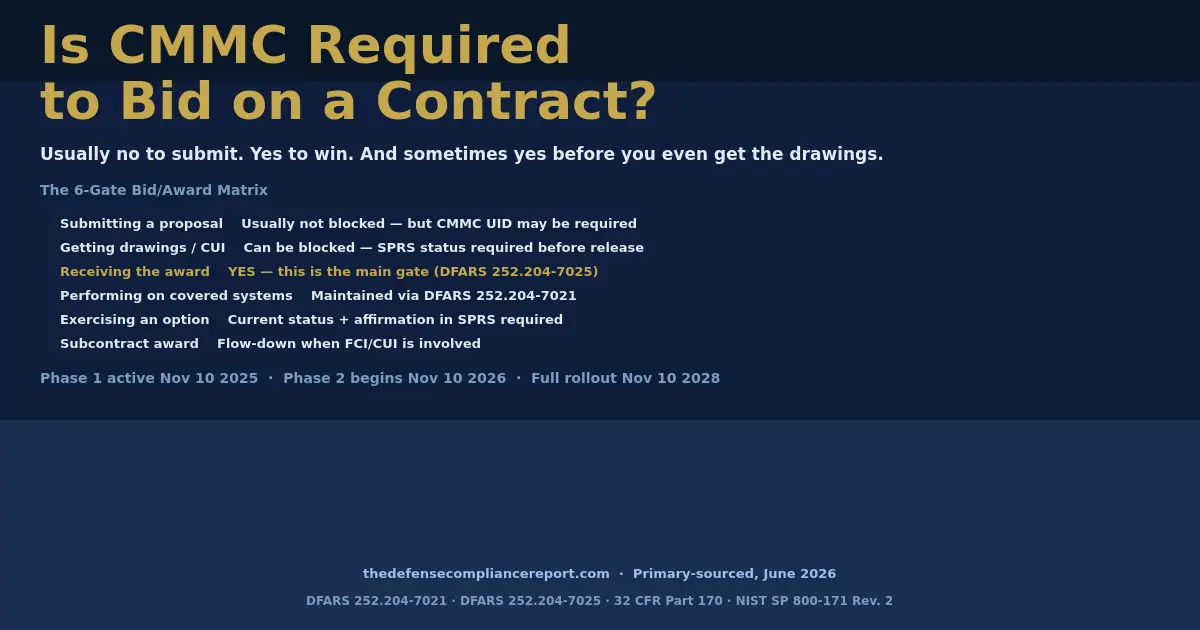
The case that proves the thesis: LOGZONE (June 2026)
In October 2021, Huntsville, Alabama defense contractor LOGZONE Inc. posted a perfect self-assessment score of 110in SPRS for its NIST SP 800-171 implementation on two Navy contracts. When the Defense Industrial Base Cybersecurity Assessment Center (DIBCAC) reviewed the company’s actual implementation, it scored −170— near the bottom of the methodology’s range of −203 to 110. The government alleged LOGZONE kept invoicing the Navy from 2021 through March 2025 despite the gap. On June 18, 2026, LOGZONE agreed to pay $507,144 to resolve its False Claims Act liability. (The settlement resolves allegations only; there was no determination or admission of liability.)
Read that scoreboard again: claimed 110, actually −170. LOGZONE wasn’t penalized for being behind on controls — plenty of companies are behind. It was penalized for the distance between what it said and what was true, and for continuing to bill against it. That is bucket two in a single fact pattern.
And it isn’t a one-off: MORSECORP (March 2025)
A year earlier, DOJ settled with Massachusetts defense contractor MORSECORP on nearly identical facts. MORSE posted a score of 104 in SPRS. In July 2022, a third-party consultant told the company its real score was −142. MORSE didn’t correct the SPRS record until June 2023 — three months after the United States served it with a subpoena. MORSE paid $4.6 million and admittedresponsibility for using unsecured third-party email, failing to implement NIST SP 800-171 controls, lacking a consolidated system security plan, and failing to correct its score until after the subpoena. The whistleblower — MORSE’s own head of security — received $851,000.
Two cases, same shape: a high posted score, a deeply negative real score, and continued government billing in between. If you take one thing from this page, take that pattern.
The broader enforcement ledger
| Settlement | Announced | Amount | Core allegation (abridged) |
|---|---|---|---|
| Aerojet Rocketdyne | Jul 2022 | $9,000,000 | Misrepresented compliance with DoD/NASA cybersecurity requirements |
| Pennsylvania State University | Oct 2024 | $1,250,000 | Failed NIST SP 800-171 controls; misrepresented SPRS scores (whistleblower share $250,000) |
| Health Net Federal Services / Centene | Feb 2025 | $11,250,000 | Falsely certified compliance on a DoD TRICARE contract; scanning, access-control, and patching failures |
| MORSECORP Inc. | Mar 2025 | $4,600,000 | Posted 104; actual score −142; didn’t correct until after a subpoena (whistleblower share $851,000) |
| Raytheon / RTX / Nightwing | May 2025 | $8,400,000 | Non-compliance across 29 DoD contracts (whistleblower share $1,512,000) |
| Aero Turbine / Gallant Capital | Jul 2025 | $1,750,000 | NIST SP 800-171 failures + unauthorized foreign access; self-disclosed |
| Illumina Inc. | Jul 2025 | $9,800,000 | Sold federal agencies software with cybersecurity vulnerabilities |
| Georgia Tech Research Corp. | Sep 2025 | $875,000 | No system security plan; no anti-virus on a DoD/DARPA research lab (whistleblower share ~$201,250) |
| LOGZONE Inc. | Jun 2026 | $507,144 | Posted 110; actual DIBCAC score −170; kept invoicing |
The counter-move that actually helps: self-disclosure
When Aero Turbine and its private-equity owner Gallant Capital discovered their problems — NIST SP 800-171 gaps and improper foreign access to sensitive defense data — they made multiple written self-disclosures, cooperated, and remediated. DOJ explicitly credited that cooperation in the $1.75 million resolution. As the Assistant Attorney General put it, contractors “can mitigate the consequences by making timely self-disclosures, cooperating with investigations, and taking prompt remedial measures.” Translation: hiding it makes it worse; surfacing it — with counsel — can make it materially better.
What happens if you fail a CMMC assessment?
Failing a CMMC assessment usually creates an eligibility problem, not an automatic False Claims Act problem. You either don’t receive a status, or — for Levels 2 and 3 — you may receive a Conditional status with 180 days to close your POA&M (DFARS 204.7502). The legal risk rises only when the result is misrepresented, ignored in a later affirmation, or contradicted by claims, invoices, or SPRS records. A failed assessment, handled honestly, is a project plan. A failed assessment, papered over, is the start of a bucket-two problem.
The practical sequence after a miss: confirm whether you qualify for Conditional status, build a POA&M with proof attached to each item, and make sure your SPRS record and any affirmation reflect reality — not the score you wish you had. Do not re-attest to a status you didn’t achieve. That single discipline keeps a bad assessment from becoming a legal one. See also: what to do after a CMMC gap assessment.
CMMC penalties by level: what changes at Level 1, 2, and 3
The consequence of non-compliance scales with the level your contract requires and the assessment type that goes with it. Level 1 covers FCI and is self-assessed annually; Level 2 covers CUI and uses the 110 NIST SP 800-171 Rev. 2 requirements (self-assessed or C3PAO-assessed, depending on the contract); Level 3 adds 24 enhanced requirements selected from NIST SP 800-172 — 134 in total — and is assessed by DIBCAC. Don’t build your plan around NIST SP 800-171 Rev. 3: under the current CMMC Final Rule, Level 2 maps to Rev. 2.
| Required level | Standard / source | Assessment type | Main non-compliance consequence | Don’t confuse it with |
|---|---|---|---|---|
| Level 1 | 15 safeguarding requirements (FAR 52.204-21) | Annual self-assessment + annual affirmation | Missing status/affirmation blocks award where required; no POA&M allowed | Level 1 is for FCI only — not a CUI environment |
| Level 2 (Self) | 110 requirements, NIST SP 800-171 Rev. 2 | Triennial self-assessment + annual affirmation | A wrong score or affirmation can block award and create FCA risk | Same controls as Level 2 C3PAO — different validation path |
| Level 2 (C3PAO) | 110 requirements, NIST SP 800-171 Rev. 2 | C3PAO assessment + annual affirmation | No current certificate blocks award/options where required | Your readiness help and your assessor should be separate |
| Level 3 | Level 2 + 24 selected NIST SP 800-172 requirements (134 total) | DIBCAC assessment | Higher scrutiny; no Level 3 status blocks eligible work | Level 3 is for the most sensitive CUI — not “Level 2 plus” |
Two specifics that are easy to get wrong: the 110 Level 2 requirements sit across 14 control families and are assessed using the objectives in NIST SP 800-171A (320 of them) — so “we did most of it” is not the same as “we pass.” And the DoD assessment scoring methodology runs from −203 to 110, which is how a company can sincerely believe it’s close while sitting deep in the negatives. See also: CMMC Level 2 requirements explained and the NIST 800-171 checklist.
Is CMMC non-compliance the same as DFARS 252.204-7012 non-compliance?
No. DFARS 252.204-7012 created the underlying duties — safeguard covered defense information and report cyber incidents within 72 hours — years before CMMC existed. CMMC (32 CFR Part 170, implemented by DFARS 252.204-7021) adds a verification and status layer on top. You can carry DFARS 7012 obligations today even if a specific CMMC status requirement hasn’t appeared in your contract yet. “CMMC isn’t in my contract” does not mean “no cyber obligation.”
| Clause / provision | What it requires | What gets posted to SPRS | When it bites |
|---|---|---|---|
| DFARS 252.204-7012 | Safeguard covered defense information; report cyber incidents within 72 hours; flow down | Incident reports to DoD | The bedrock duty — applies whether or not CMMC is in the contract |
| DFARS 252.204-7019 / -7020 | Perform the NIST SP 800-171 DoD assessment; post the score; allow a DoD-led assessment | Your NIST SP 800-171 self-assessment score | A wrong score here is what created the LOGZONE and MORSE cases |
| DFARS 252.204-7021 | Hold and maintain the required CMMC status; submit the annual affirmation | Your CMMC status and affirmation | Blocks award/option without current status (via DFARS 204.7503) |
| DFARS 252.204-7025 | Solicitation provision making CMMC status a condition of award eligibility | Status checked at evaluation | At the proposal gate |
Penalties for subcontractors and primes
Subcontractors face the eligibility penalty most directly: if you can’t show the required status for the FCI or CUI you’ll handle, the prime can refuse to flow work to you — and increasingly, they will, to protect their own contract. Primes carry a two-sided risk: they must verify their subs’ status before sharing covered information, and they inherit exposure when they don’t.
What level does a subcontractor actually need? It depends on the data — not on the prime’s level by default. Per 32 CFR 170.23 and DoD’s CMMC guidance:
| If the subcontractor will… | Minimum CMMC status |
|---|---|
| Process, store, or transmit only FCI (not CUI) | Level 1 (Self) |
| Process, store, or transmit CUI | Level 2 (Self), at minimum |
| Process, store, or transmit CUI, and the prime contract requires Level 3 | Level 2 (C3PAO), at minimum — not automatically Level 3, unless the contract requires more |
| Not touch FCI or CUI at all | No CMMC assessment requirement for that subcontract |
For subcontractors, the move is to prepare a clean evidence package — your level, scope, status, and affirmation — that you can share withouttransmitting CUI. For primes, the move is a verification process that requests proof (status in SPRS, certificate details) rather than relying on a vendor’s verbal “we’re compliant.” Neither side should ever route CUI, drawings, or sensitive contract details into a generic form or questionnaire.
What to do first if you discover you’re not compliant
Don’t start with a vendor quote. Start by establishing the facts, in order: identify the clause, confirm whether you handle FCI or CUI, verify your current status in SPRS, preserve the evidence trail, and decide whether counsel is needed before you change anything. The single most expensive mistake we see is “fixing” the paperwork before understanding the facts — because a hasty correction or a fresh affirmation can convert a quiet eligibility gap into a documented false statement.
- Find the clause. Is DFARS 252.204-7021 (and -7025) in the solicitation or contract, and what level does it require?
- Confirm the data. FCI, CUI, both, or genuinely unclear? This sets your level — the clause and the data do, not a checklist.
- Verify status in SPRS. What does your record actually say today, and does its scope match the contract?
- Freeze the evidence.Preserve contracts, SPRS submissions, assessment records, affirmations, SSP versions, POA&Ms, and any internal communications about known gaps — before anyone edits them.
- Triage legal exposure. If claims, invoices, scores, or affirmations may already be inaccurate, talk to qualified federal-contracts counsel before correcting or re-attesting.
- Route the remediation to the right provider category based on your scope and stage (next section).
- Schedule a C3PAO only when you’re assessment-ready— not as step one. See: CMMC Level 2 assessment preparation.
Ready to route the fix, not the panic?
Once you know your bucket and your facts, share your level, scope, assessment type, environment, and timeline — without submitting CUI — and we’ll match you with source-checked provider options in the category your situation calls for. Use the Find My CMMC Path tool to point you to the right one.
Find My CMMC Path →What NOT to do after you find a problem
Do not backdate evidence, “correct up” an SPRS score you can’t support, sign a fresh affirmation to paper over gaps, keep billing while knowingly non-compliant, or send CUI into a vendor form. Each of these can turn a manageable eligibility issue into a False Claims Act or false-statement problem. When in doubt, preserve the record, get the legal question triaged, and separate the legal track from the technical track. This is the cheapest advice on this page, and the most ignored.
- Don’t “fix” the paperwork before you understand the facts.A correction made without counsel can read as an admission — or create a new false statement.
- Don’t treat a POA&M as “implemented.” An open item is an open item; affirming otherwise is the trap.
- Don’t send CUI to vendorsbefore you’ve verified their environment and authorization to receive it.
- Don’t have the firm that will assess you also remediate the same environment. Assessors must manage impartiality; mixing readiness and assessment in one contract is the flag, not the convenience.
- Don’t let sales urgency outrun counselwhen there’s any chance a prior representation was false.
Before anyone touches the paperwork, get the record straight.
The CMMC Readiness Checklistcovers what to capture, in what order, so a future correction is defensible instead of damaging. No CUI, no obligation — just the list.
Get the CMMC readiness checklist →Which provider category fits — and why your assessor usually shouldn’t be your fixer
The right first move depends on your risk type, not on whoever calls first. If false-claim exposure is on the table, start with counsel. If the problem is scope, readiness, or implementation, an RPO, MSSP, or managed-compliance provider fits. If it’s evidence and workflow, a GRC platform supports the others. If CUI is sprawled across email and endpoints, a CUI enclave can shrink your scope. A C3PAO comes last — and only when you’re assessment-ready. A core independence principle runs through all of this: the organization that helps you get ready generally should not be the one that formally assesses you.
| Your situation | Start here | Why | What this category can’t do |
|---|---|---|---|
| Possible inaccurate claims, invoices, SPRS score, or affirmation | Federal-contracts attorney | Legal exposure must be triaged before any sales conversation | Can’t make a knowingly false representation “go away” — only the facts and disclosure choices do |
| You don’t know your level, scope, or FCI/CUI boundary | RP/RPO (or the Find My CMMC Path tool) | Scope errors cause wrong provider selection | Can’t issue your CMMC certificate |
| Level 2 applies but controls aren’t implemented | CMMC-focused MSSP / readiness provider | Remediation has to happen before assessment | Can’t also serve as your C3PAO for that assessment |
| Evidence exists but is scattered | GRC platform / documentation workflow | Evidence organization is often the real bottleneck | Software alone doesn’t make you compliant — it organizes the work |
| CUI is spread through email, endpoints, or commercial cloud | CUI enclave / secure collaboration | Scope reduction can lower cost and assessment complexity | Doesn’t cover requirements outside the enclave’s boundary |
| You’re ready for a formal Level 2 certification | Authorized C3PAO | Assessment follows readiness, never the reverse | Can’t guarantee a passing result; can’t give you remediation advice for the same engagement |
If a single vendor offers to both fix and certify the same environment, treat it as a flag, not a convenience. See also: CMMC provider categories.
All guides in this topic: Legal risk & enforcement
- Can You Get Sued for False CMMC Certification? FCA Risk
- CMMC Affirming Official Personal Liability: What's Real
- CMMC Annual Affirmation Legal Liability: What to Verify
- DoD Cybersecurity Whistleblower / CMMC Qui Tam Risk (2026)
- DOJ Civil Cyber Fraud: FCA Risk for Defense Contractors 2026
- Does Cyber Insurance Require CMMC? No — Check 3 Documents
- False Claims Act CMMC Risk: SPRS & DOJ Cases (2026)
- Cyber Insurance for Defense Contractors: Cost & DFARS Gaps
Find My CMMC Path
The right provider category — a C3PAO, an RPO, an MSSP, a GRC platform, or a CUI enclave — depends on your required CMMC level, FCI vs CUI handling, assessment type, IT/cloud environment, and contract timeline. Use The Defense Compliance Report's Find My CMMC Path tool to map your situation to the right provider category before you request quotes. Educational triage only: free · 2-minute assessment · no obligation · do not submit CUI, drawings, or sensitive contract details.
Find My CMMC Path →What we verified for this page
We don’t ask you to take our word for the numbers here. For this update (last reviewed June 20, 2026), here is what we checked and where:
- The eligibility consequence— read directly from DFARS 204.7503(b)–(c) and 204.7502 on Acquisition.gov (the “shall not award” / “shall not exercise an option” language and the 180-day Conditional-status rule for Levels 2 and 3).
- The FCA penalty figures— confirmed against 28 CFR 85.5; the $14,308–$28,619 per-claim band applies since July 3, 2025 and remains current.
- The affirmation requirement and personal exposure— read from 32 CFR 170.22 in the eCFR; the affirmation warning text verified from publicly posted CMMC affirmation materials.
- The enforcement record— compiled from DOJ press releases and settlement agreements; every amount in the ledger links to its DOJ announcement, including the LOGZONE settlement announced June 18, 2026.
- The phased rollout and subcontractor flow-down— verified against 32 CFR 170.3(e) and 170.23.
- The rule baseline— Level 2 maps to NIST SP 800-171 Rev. 2; assessments use NIST SP 800-171A objectives.
Where something is editorial analysis drawn from the sources above, we’ve labeled it accordingly. See our editorial standards and corrections policy.
Frequently asked questions
Most CMMC penalty questions trace back to one misunderstanding: people expect a single fine. The real answer depends on your clause, level, assessment type, SPRS accuracy, CUI scope, contract stage, and whether a representation was knowingly false. Short, sourced answers below.
Does the DoD fine you for not being CMMC compliant?
No. There is no DoD-issued CMMC fine. Non-compliance costs you eligibility — under DFARS 204.7503, the contracting officer can’t award, exercise an option, or extend without your required status in SPRS — and knowingly misrepresenting compliance can trigger False Claims Act and criminal liability (31 U.S.C. 3729; 18 U.S.C. 1001).
How much are the False Claims Act penalties for CMMC non-compliance?
Treble (3×) the government’s damages plus a civil penalty of $14,308 to $28,619 per claim, current in 2026 (28 CFR 85.5). Because penalties apply per claim, totals can reach the millions.
Can a small business or subcontractor really be penalized?
Yes. Subcontractors lose eligibility and supply-chain position under flow-down (DFARS 252.204-7021; 32 CFR 170.23), and DOJ has settled cyber FCA cases against mid-size firms, a logistics contractor, and universities — not only large primes.
What happens if you fail a CMMC assessment?
You receive no status, a Conditional status if eligible (Levels 2/3, 180 days), or you remediate and reassess. Failing an assessment is not itself a False Claims Act violation — misrepresenting the result would be.
What happens if my conditional status expires?
Conditional status is current for up to 180 days (DFARS 204.7502; 32 CFR 170.21). If you miss the closeout, the status lapses for award and option purposes, and a later or renewed affirmation that still claims support can create legal risk.
Can a wrong SPRS score create False Claims Act risk?
It can, depending on the facts. The risk rises when the score was knowingly false and material to award, payment, or an option decision — which is precisely the LOGZONE and MORSE pattern: a high posted score, a deeply negative real score, and continued billing in between.
Who signs the CMMC affirmation, and what exposure can a false affirmation create?
The Affirming Official — the named senior official who submits the affirmation in SPRS under 32 CFR 170.22 — attests to the company’s compliance. A knowingly and willfully false affirmation may create personal exposure under 18 U.S.C. 1001, along with civil False Claims Act and contract consequences, depending on the facts.
Does CMMC Level 2 use NIST SP 800-171 Rev. 2 or Rev. 3?
Rev. 2. Under the current CMMC Final Rule, Level 2 maps to the 110 requirements in NIST SP 800-171 Rev. 2; DoD would need to amend the rule to adopt a later version.
Should I call a C3PAO if I’m not compliant?
Usually not first. A C3PAO performs the assessment; readiness and remediation should be handled separately to preserve assessment integrity and avoid a conflict of interest under the Cyber AB CMMC Assessment Process.
Should I talk to a lawyer before fixing CMMC issues?
If inaccurate claims, invoices, scores, or affirmations may already exist, yes — consult qualified federal-contracts counsel before making corrections or new representations.
Need help deciding what type of CMMC provider you need?
Tell us your level, scope, and timeline, and we’ll match you with source-checked CMMC provider options. Do not submit CUI, drawings, or sensitive contract details.
Find My CMMC Path →- What is CMMC?
- CMMC levels explained (Level 1 vs. 2 vs. 3)
- CMMC Level 2 cost (2026)
- The CMMC certification process
- CMMC Level 2 assessment preparation
- NIST 800-171 requirements checklist
- What to do after a CMMC gap assessment
- CMMC implementation phases (Phase 1 and Phase 2)
- Cyber Insurance for Defense Contractors: Cost & DFARS Gaps