DFARS 252.204-7021 in My Contract: What It Means and What to Do Next
The Defense Compliance Report is the independent trade publication and decision resource for CMMC and Defense Industrial Base compliance — explaining the CMMC Final Rule with primary-source citation on every claim and mapping a contractor’s level, CUI scope, assessment type, and timeline to the right provider category, so DIB contractors choose the right CMMC path before they spend six figures.
If you found DFARS 252.204-7021 in your contract, your contract now carries a binding Cybersecurity Maturity Model Certification (CMMC) obligation:you have to hold and keep a “current” CMMC status at the exact level your contracting officer specified, affirm it every year in SPRS, and flow it down to subcontractors who touch the same information. The level — and whether you can self-assess — is set by the contract, not by a checklist.
Here’s the part that trips up almost everyone, and the reason a lot of pages you’ll read are quietly out of date: this clause has been through two very different versions, and the one most websites still describe is the old one. We’ll show you how to tell which version is in your contract in about thirty seconds — and why it changes what you owe.
Quick reference: what your contract package tells you
| If your contract package shows… | What it means right now | Your first move |
|---|---|---|
| 252.204-7025 in a solicitation | The notice that tells you the required CMMC level before award | Find the level the contracting officer filled in |
| 252.204-7021 in a solicitation, contract, task/delivery order, or subcontract | You must reach and keep that CMMC status, affirm it, and flow it down | Check your SPRS status, CMMC UID, and affirmation date |
| Level 1 (Self) | FCI-only path; annual self-assessment | Confirm no CUI touches your systems |
| Level 2 (Self) | NIST SP 800-171 Rev. 2 path you can self-assess | Confirm it doesn’t say Level 2 (C3PAO) |
| Level 2 (C3PAO) | Formal third-party certification required | Validate readiness before scheduling an assessment |
| Level 3 (DIBCAC) | Highest path; needs Final Level 2 (C3PAO) first | Confirm with your CO or prime before spending |
A note before you spend a dollar:Don’t panic-buy a third-party assessment yet. A “Level 2 (Self)” requirement and a “Level 2 (C3PAO)” requirement are completely different buying decisions. First, read the clause. Then decide.
DFARS 252.204-7021 in my contract — what does it actually require?
DFARS 252.204-7021 is the contract clause that makes CMMC a binding term of performance. It requires you to have and keep a current CMMC status at the level your contracting officer inserts, keep federal contract information (FCI) and controlled unclassified information (CUI) only on systems that meet that status, file an annual affirmation of compliance in the Supplier Performance Risk System (SPRS), and flow the requirement down to applicable subcontractors. (48 CFR 252.204-7021, eCFR.)
DFARS — the Defense Federal Acquisition Regulation Supplement — is the rulebook the Department of Defense (DoD) uses to govern how contractors do business with it. The clause numbered 252.204-7021 is the piece that turns CMMC from a future plan into something you’re contractually on the hook for, for the life of the award.
Two distinctions matter from the start, because mixing them up is where money gets wasted:
- 7021 is the contract clause. It governs what you must do during performance. Under DFARS 204.7504, it can appear in solicitations and in resulting contracts, task orders, or delivery orders — so you may see it before award, not only after.
- 7025 is the solicitation provision. DFARS 252.204-7025 (Notice of CMMC Level Requirements) is where the contracting officer writes down the required CMMC level before award. If you’re looking at a solicitation, 7025 usually tells you the level; 7021 then enforces it. (DFARS 204.7504, eCFR.)
And the single most important sentence on this page: the contract clause sets your level — a checklist on someone’s website does not.The contracting officer fills in a blank inside the clause. That blank is the answer to “what do I actually need.” Everything else is verification.
The obligation attaches to your contractor information systems — the ones that process, store, or transmit FCI or CUI in performance of the contract. But here’s a trap worth flagging now: “no CUI is stored on this box” does not automatically mean “this box is out of scope.” CMMC scope also reaches the assets that protect or connect tothat environment. We map exactly what’s in and out further down — and getting that right is the biggest lever you have over cost.
Wait — is the version in your contract the current one? (Jan 2023 vs. Nov 2025)
You may run into two very different versions of this clause number, and the difference is not cosmetic. The current, controlling version is “Contractor Compliance With the CMMC Level Requirements (NOV 2025),” which became effective November 10, 2025. The older “Cybersecurity Maturity Model Certification Requirements (JAN 2023)” was a placeholder from the 2020 interim rule. (48 CFR 252.204-7021 revision timeline, eCFR.)
We flag this first because it reframes everything below it. When we read the clause text directly on the eCFR — the continuously updated electronic Code of Federal Regulations — the page showed the current codified version dated (NOV 2025), with an amendment history confirming the change took effect November 10, 2025, and Title 48 last amended May 7, 2026. The September 10, 2025 Federal Register notice (DFARS Case 2019-D041) is the rulemaking that put it there.
| Old version: JAN 2023 | Current version: NOV 2025 | |
|---|---|---|
| Title | Cybersecurity Maturity Model Certification Requirements | Contractor Compliance With the CMMC Level Requirements |
| Where it came from | 2020 interim-rule placeholder | Final acquisition rule, effective Nov 10, 2025 |
| Core obligation | “Have a current CMMC certificate at the required level” | Maintain a current CMMC status at the inserted level; annual SPRS affirmation; CMMC UIDs; close out POA&Ms to reach Final; flow down per 32 CFR 170.23 |
| Defines CMMC statuses? | No | Yes — seven statuses covering Level 1, Level 2 (Self and C3PAO, Conditional and Final), and Level 3 |
| How to tell which you have | — | Read the date in parentheses in your contract’s clause heading. If it says (NOV 2025), you’re on the current clause. If it says (JAN 2023), confirm with your contracting officer, because the codified text today is the November 2025 version. |
That last row is the thirty-second check we promised. Open your contract, find the 252.204-7021 heading, and look at the month-and-year in parentheses. It tells you which set of obligations you’re actually living under.
Why this matters in the real world:plenty of older contract templates, prime flow-down packages, and pre-final-rule explainers still show the JAN 2023 language. The current Acquisition.gov clause page and the eCFR both show the NOV 2025 version. If the parenthetical in your contract and the codified version don’t line up, that’s a question for your contracting officer — not a guess for a vendor to make on your behalf.
Where do I find the required CMMC level — in 7021 or 7025?
Look for DFARS 252.204-7025 first, because that’s the solicitation notice where the contracting officer inserts the required CMMC level and assessment type before award. DFARS 252.204-7021 then enforces that level during performance. If 7025 isn’t filled in, the level still has to be specified somewhere in the package — and if it isn’t clear, you ask. (DFARS 252.204-7025 and 204.7504.)
The level isn’t always where you’d expect. Check these places in the contract or solicitation package:
- The clauses themselves: 252.204-7025 (solicitation) and 252.204-7021 (solicitation or contract)
- Section H — special contract requirements
- Section L — instructions to offerors
- Section M — evaluation criteria
- The Statement of Work (SOW) or Performance Work Statement (PWS)
- CDRLs (Contract Data Requirements Lists)
- DD Form 254, if one is attached
- A prime flow-down letter or teaming agreement
- Purchase order terms and conditions
- Option-year or modification documents
- Any CUI marking guide or security classification guide provided
What if 252.204-7021 shows up in a solicitation before award?
That’s normal, not an error. DFARS 204.7504 directs contracting officers to use the clause in solicitations as well as in contracts, task orders, and delivery orders during the phase-in, so seeing 7021 in an RFP or RFQ means CMMC will be a condition of the resulting award. (DFARS 204.7504, eCFR.) Eligibility for award generally requires the proper CMMC status in SPRS at the required level or higher, plus a current affirmation. Confirm the timing and any phase-in treatment with the contracting officer. Also see: CMMC Level 2 required in solicitation and do I need CMMC to win my contract?
If 7025 is missing, blank, or ambiguous, do this: ask the contracting officer (or your prime) to identify the required CMMC level and assessment type in writing; ask whether the requirement applies at award, at option exercise, at extension, or before subcontract award; and ask what FCI or CUI you’ll be expected to process, store, or transmit. One safety rule, no exceptions: do not put CUI, drawings, or sensitive contract details into a public form or intake toolwhile you’re sorting this out.
What’s actually in scope under DFARS 252.204-7021?
Your CMMC scope is broader than “the computers that store CUI.” It includes the assets that process, store, or transmit FCI or CUI and the assets that provide security protection to that environment. Other categories — like specialized equipment and assets you manage by risk — still have to be documented even when they aren’t fully assessed. (32 CFR 170.19 and the DoD CMMC Level 2 Scoping Guide.)
This is where contractors lose money in both directions — over-scoping (assessing the whole company) or under-scoping (missing assets that count). Here’s the plain-English version of how the CMMC Level 2 scope categories work:
| Asset category | What it is | How it’s treated in scope |
|---|---|---|
| CUI Assets | Systems that process, store, or transmit CUI | In scope; assessed against the applicable Level 2 requirements |
| Security Protection Assets | Assets that provide a security function to your in-scope environment (e.g., SIEM, VPN, MSP tooling) — even if they never touch CUI | In scope; assessed against the requirements relevant to the protection they provide |
| Contractor Risk Managed Assets | Assets that can but are not intended to handle CUI, kept out by your policies and practices | Documented in your asset inventory, SSP, and network diagram; managed by your risk-based approach; may get a limited assessor check |
| Specialized Assets | Government property, IoT/OT, test equipment, restricted systems | Documented in your asset inventory, SSP, and network diagram; managed under your risk-based policy; not assessed against the other requirements |
| Out-of-Scope Assets | Cannot handle CUI and provide no protection to in-scope assets | Not part of the assessment scope |
One more wrinkle that catches small shops: External Service Providers (ESPs) — managed service providers, cloud services, and the like — carry scoping implications if they handle CUI or provide your security protection. A cloud service that stores or processes CUI generally needs FedRAMP Moderate authorization (or equivalent). The single biggest cost lever here is scope reduction: isolating CUI into a defined boundary, often a CUI enclave, shrinks both the controls in play and the price of the whole effort.
What should I do in the first 48 hours after finding DFARS 252.204-7021?
The first 48 hours are about triage, not buying.Before you contact a single provider, pin down the required level, the assessment type, the systems and assets in scope, what FCI or CUI is involved, your current SPRS status, your CMMC UID, your affirmation date, your subcontractor exposure, and whether any of the work is solely commercial-off-the-shelf (COTS). Get those nailed and your buying decision becomes obvious — and far cheaper.
This is the checklist we’d hand a contracts lead who walked into our office holding a contract with this clause in it:
| # | What to check | Who owns it | Evidence to capture |
|---|---|---|---|
| 1 | Is this a solicitation, award, subcontract, PO, option, or mod? | Contracts | The full clause package |
| 2 | Is 252.204-7025 present and filled in? | Contracts | The inserted CMMC level |
| 3 | What level and assessment type are required? | Compliance / Contracts | Level 1 (Self), Level 2 (Self), Level 2 (C3PAO), or Level 3 (DIBCAC) |
| 4 | What FCI or CUI will you process, store, or transmit? | Program + Security | Data-flow notes, CUI markings, SOW references |
| 5 | Which systems and assets are in scope? | IT / Security | System and asset inventory, SSP boundary, network diagram |
| 6 | What does SPRS show? | SPRS admin / affirming official | CMMC status, UID, affirmation date |
| 7 | Are subcontractors involved? | Supply chain | Flow-down list |
| 8 | Is any work solely COTS? | Contracts | Product/service classification |
| 9 | What deadline actually matters? | Capture / Contracts | Award, option, extension, subcontract award |
| 10 | Which provider category do you need? | Executive owner | Readiness/MSP, GRC, enclave, C3PAO, or legal |
Notice that buying decisions don’t appear until step 10 — on purpose. The contractors who overspend on CMMC almost always reversed this order: they hired before they scoped. See also: what to do after a CMMC gap assessment.
You found the clause. You know the level, your scope, and what SPRS has to show. The last move that saves the most money: decide who to call before you call them. The Defense Compliance Report’s Find My CMMC Path toolmaps your level, CUI scope, assessment type, environment, and timeline to the right provider category — before you request a single quote.
Match me to the right CMMC provider category →What we actually verified
- 48 CFR 252.204-7021 (NOV 2025) on the eCFR — the current clause text, the seven CMMC statuses, the “Current” definitions, the annual affirmation and CMMC UID requirements, and flow-down to 32 CFR 170.23. The eCFR showed Title 48 last amended and the clause amended effective .
- DFARS 204.7504 and DFARS 252.204-7025— the clause prescription (used in solicitations and contracts) and the solicitation notice that sets the level.
- The Federal Register final rule (DFARS Case 2019-D041), published , effective .
- 32 CFR Part 170 on the eCFR — the CMMC Program Rule (effective ), including the level structure, the scope categories in 170.19, the Level 2 eligibility and conditional-status consequences in 170.16–170.17, and the cost estimates in the Regulatory Impact Analysis.
- The DoD CIO CMMC page — Phase 1 dates (November 10, 2025 – November 9, 2026) and the reminder to submit affirmations with assessments in SPRS.
- NIST SP 800-171 Revision 2 (110 requirements, 14 control families) and NIST SP 800-172 (Level 3 enhanced subset).
- SPRS documentation for the CMMC UID and affirmation-visibility rules, and the Cyber AB CMMC Assessment Process for the conflict-of-interest requirements.
Frequently asked questions
Does DFARS 252.204-7021 in my contract mean I need CMMC immediately?
It means your contract includes a binding CMMC obligation, but the level, timing, and assessment type depend on the contract package. Check the inserted CMMC level, the SPRS status requirements, and whether the obligation applies before award, option, extension, subcontract award, or performance. (48 CFR 252.204-7021, eCFR.)
Does DFARS 252.204-7021 always mean Level 2?
No. The contracting officer can require Level 1 (Self), Level 2 (Self), Level 2 (C3PAO), or Level 3 (DIBCAC). The level is contract-specific and is written into the clause. (48 CFR 252.204-7021(d)(1)(i), eCFR.)
What is the difference between DFARS 252.204-7021 and 252.204-7025?
DFARS 252.204-7025 is the solicitation provision that identifies the required CMMC level before award. DFARS 252.204-7021 is the contract clause that requires you to maintain that CMMC status, file annual affirmations, report CMMC UIDs, and flow the requirement down to applicable subcontractors. (DFARS 204.7504, eCFR.)
Can I self-assess for CMMC Level 2 under DFARS 252.204-7021?
Sometimes. The clause lets the contracting officer require Level 2 (Self), which is a valid CMMC status, so whether you can self-assess depends on what your specific contract specifies. If it says Level 2 (C3PAO) or Level 3 (DIBCAC), an independent assessment is required. (48 CFR 252.204-7021(d)(1)(i), eCFR.)
Can I bid if I don’t have the required CMMC status?
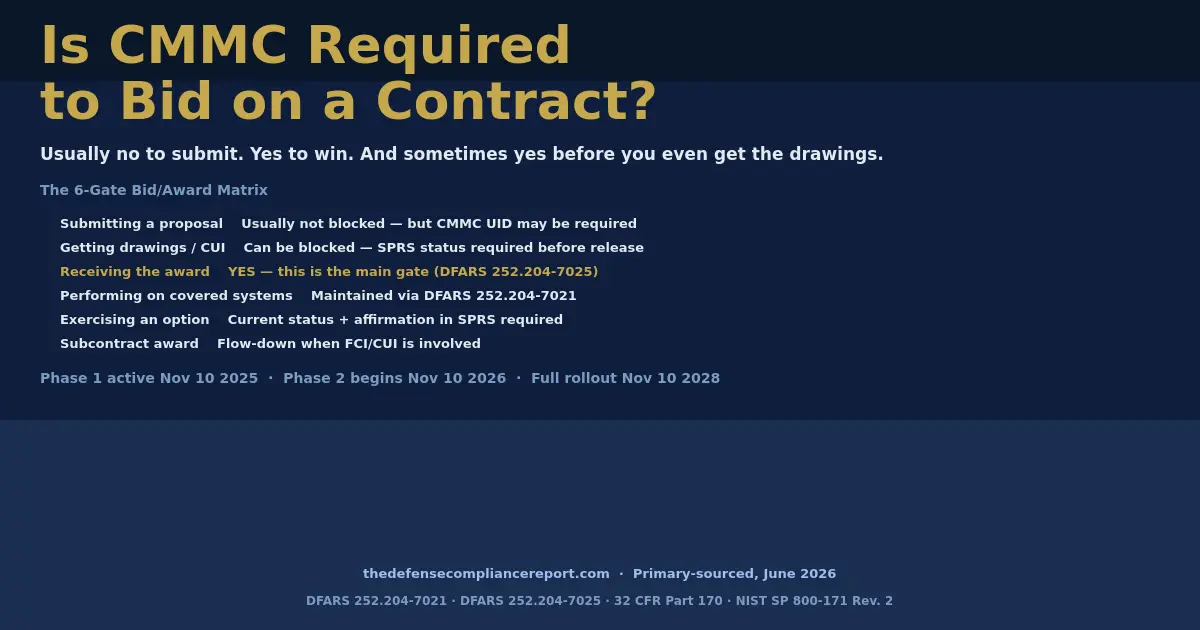
Eligibility for award generally requires the proper CMMC status in SPRS at the required level or higher, plus a current affirmation, as described in 32 CFR 170.16(b) and 170.17(b). Confirm the specific timing and any phase-in treatment with your contracting officer or prime. Also see: is CMMC required to bid on a contract?
What is a CMMC UID?
A CMMC unique identifier (UID) is a 10-character alphanumeric identifier assigned to each CMMC assessment and tied to a specific information-system scope in SPRS. You report it to the contracting officer, and it must cover the scope of the system actually performing the work. (48 CFR 252.204-7021(a) and (e), eCFR; SPRS documentation.)
Is a SPRS score the same as CMMC status?
No. For CMMC, the record that matters includes the status type, the CMMC UID, the scope, the expiration, and the affirmation. A SPRS score alone is not the full picture, and pending-affirmation statuses may not be visible to government users.
Does CMMC replace DFARS 252.204-7012 incident reporting?
No. CMMC is an assessment framework and is separate from the cyber incident reporting and CUI safeguarding obligations under DFARS 252.204-7012. If you handle CUI, both apply.
Does COTS-only work avoid DFARS 252.204-7021?
Contracts solely for COTS items are treated differently under the clause prescription, but don’t assume the exclusion applies unless the work is truly solely COTS and no FCI or CUI processing changes the analysis. If FCI is involved, Level 1 may still apply. (DFARS 204.7504; 32 CFR Part 170, eCFR.)
Can we use a POA&M or conditional status?
Level 1 does not permit POA&Ms — every requirement must be MET. Conditional Level 2 and Level 3 statuses can exist with open POA&M items but last no more than 180 days, and you must close them to reach Final. A conditional status that expires mid-performance can trigger contractual remedies and award ineligibility. (48 CFR 252.204-7021(a), (d)(5); 32 CFR 170.16–170.18 and 170.21, eCFR.)
Can the same company prepare us and assess us?
Don’t assume so. The Cyber AB CMMC Assessment Process requires C3PAOs to manage impartiality and conflicts of interest, and a C3PAO cannot proceed if a conflict can’t be sufficiently mitigated. Keep readiness work and formal assessment appropriately separated. See: gap assessment vs C3PAO assessment.
Is NIST SP 800-171 Rev. 3 required for CMMC Level 2?
Not under the current rule. CMMC Level 2 maps to NIST SP 800-171 Revision 2 unless DoD amends the program rule. Track Rev. 3 as a future watch item. (32 CFR Part 170, eCFR.)
What should I never submit through a matching form?
Never submit CUI, drawings, technical data, export-controlled files, contract attachments, source code, or sensitive contract details. Use sanitized facts only: clause number, level, assessment type, deadline, company size, environment type, and whether you handle FCI or CUI.
Your next step
You found the clause. You now know what it requires, which version governs you, where your level is hiding, what counts as in scope, what SPRS has to show, and which category of help fits your situation. The last move is the one that saves the most money: decide who to call before you call them.
Need help deciding what type of CMMC provider you need? Tell us your level, scope, and timeline, and we’ll match you with source-checked CMMC provider options.
Find My CMMC Path →Primary sources (expand)
- 48 CFR 252.204-7021, Contractor Compliance With the CMMC Level Requirements (NOV 2025) — eCFR
- DFARS 204.7504, Contract Clauses — eCFR
- DFARS 252.204-7025, Notice of CMMC Level Requirements — Acquisition.gov
- Federal Register: DFARS Case 2019-D041 (Sept. 10, 2025) — federalregister.gov
- 32 CFR Part 170, CMMC Program Rule — eCFR
- DoD CIO, About CMMC — dodcio.defense.gov
- NIST SP 800-171 Revision 2 — NIST CSRC
- NIST SP 800-172 — NIST CSRC
- SPRS Awardee User Guide — DISA
- Cyber AB CMMC Assessment Process v2.0 — Cyber AB