Prime Contractor Requiring CMMC Certification? What You Actually Owe — and What to Do First
The Defense Compliance Report is the independent trade publication and decision resource for CMMC and Defense Industrial Base compliance — explaining the CMMC Final Rule with primary-source citation on every claim and mapping a contractor’s level, CUI scope, assessment type, and timeline to the right provider category, so DIB contractors choose the right CMMC path before they spend six figures.
A prime contractor requiring CMMC certification just changed your week — so let’s make the next move the right one.
Here’s the bottom line. Don’t assume the prime’s level is your level, and don’t assume “certified” means a third-party audit. What you owe starts with one question — will you handle Federal Contract Information (FCI) or Controlled Unclassified Information (CUI)? — and is finalized by the clause, the CMMC status, and the assessment type your prime flows down. Under 32 CFR 170.23, the subcontractor section of the CMMC Program Rule: if you’ll process, store, or transmit FCI or CUI, the flow-down clause attaches. If you won’t, it doesn’t — regardless of what a blanket prime email says.
That’s the answer. Now the catch — and it’s the reason most suppliers overspend in the first two weeks: the rule is only the floor.A prime can contractually require more than 32 CFR 170.23 demands, and many do. Below, we’ll show you how to tell the difference, the exact email to send your prime today, what evidence is safe to hand over, what you must never put in a supplier form, and which type of help to line up before you spend a dollar.
Your prime’s demand, decoded in one screen
| What the prime says | Don’t assume | Verify first | Your safest first move |
|---|---|---|---|
| “You need to be CMMC certified.” | That you need a C3PAO audit. | The required level, the assessment type, FCI vs CUI, the clause, the deadline. | Send the clarification email before you buy anything. |
| “You need Level 2.” | That Level 2 always means a third-party assessment. | Whether it’s Level 2 self-assessment or Level 2 C3PAO. | Map what CUI actually touches your systems. |
| “Send your SPRS score.” | That a screenshot alone settles it. | Which system, which CAGE code, which status, and whether your affirmation is current. | Confirm your status and affirmation in SPRS. |
| “Send your SSP and POA&M.” | That you should email the full documents. | The minimum evidence required, and a secure way to share it. | Offer a controlled summary — not the raw files. |
| “All our suppliers must be Level 2.” | That a blanket policy is the same as the regulatory floor. | Whether FCI or CUI actually flows to you at all. | Document, in writing, why you’re in or out of scope. |
| “Be Level 2 by [date].” | That the date means full final certification. | Whether Final status, Conditional status, or just readiness evidence is required by then. | Triage the deadline against assessor lead times. |
The right help depends on your situation — here’s how to find it
The right CMMC provider isn’t the same for every contractor — the category you need (a C3PAO, an RPO, an MSSP, a GRC platform, or a CUI enclave) depends on your required CMMC level, whether you handle FCI or CUI, your assessment type, your cloud and IT environment, and your contract timeline. The contract clause sets your level, not a checklist. Because a general answer can’t resolve those for you, use The Defense Compliance Report’s Find My CMMC Path tool to map your situation to the right provider category before you request quotes.
Start here, not at a vendor’s door.
Before you price tools or call an assessor, map the demand: your data type, required level, assessment type, environment, and deadline.
Map My CMMC Path →What “a prime contractor requiring CMMC certification” actually means
A prime contractor requirement usually means one of two things: the prime is flowing down a CMMC obligation it received from the government, or it’s screening suppliers before award. But “CMMC certification” is too vague to act on until you know the information being flowed down, the contract clause, the required level, and the assessment type — because “certified” can describe four very different outcomes that cost wildly different amounts.
Defense primes are not lawyers writing to other lawyers. They’re supply-chain teams sending a lot of emails fast. So “get CMMC certified” is shorthand, and shorthand is where panic and overspending start.
The Cybersecurity Maturity Model Certification (CMMC) program lives in two regulations. The policy sits in 32 CFR Part 170, effective . The contract mechanics — the clauses that actually appear in your paperwork — arrived in the DFARS final rule, effective . Between those two rules, “certification” can mean any of these:
- CMMC Level 1 (Self) — you self-assess against the 15 basic safeguarding requirements in FAR 52.204-21, and affirm it. This protects FCI.
- CMMC Level 2 (Self) — you self-assess against the 110 security requirements in NIST SP 800-171 Revision 2, organized into 14 control families, score it, and post it to SPRS.
- CMMC Level 2 (C3PAO) — a Certified Third-Party Assessment Organization assesses you against the same 110 requirements. This is what most people mean by “certified.”
- CMMC Level 3 (DIBCAC) — Level 2 plus 24 selected enhanced requirements assessed by the government’s Defense Contract Management Agency Defense Industrial Base Cybersecurity Assessment Center (DCMA DIBCAC).
There’s also a fifth possibility that isn’t a CMMC status at all: an internal supplier-readiness milestone or a portal requirement the prime set on its own, ahead of any clause landing in your subcontract.
Why the word “certification” is costing you money
Here’s the distinction the rest of the internet keeps blurring, so we’ll be blunt: a self-assessment is a CMMC status, not a certification.A certification is a third-party (C3PAO) or government (DIBCAC) assessment. The difference isn’t pedantic — it’s the difference between roughly $40,000 and well past $100,000 (we break the numbers down later). If your prime says “get certified,” your first job is to find out whether they mean a C3PAO assessment or simply a posted self-assessment. That single question might save you $60,000 or more.
| What the prime might say | What it technically is | Who confirms it | A true “certification”? |
|---|---|---|---|
| “Get CMMC Level 1.” | Annual self-assessment of 15 FAR 52.204-21 safeguards, affirmed in SPRS | You | No — a self-attested status |
| “Get Level 2 self-assessment.” | Self-assessment of 110 NIST SP 800-171 Rev. 2 requirements, scored in SPRS | You | No — a self-attested status |
| “Get certified” / “Level 2 C3PAO.” | Third-party assessment of all 110 requirements | A C3PAO (results flow through eMASS to SPRS) | Yes |
| “Level 3.” | Level 2 plus 24 selected enhanced requirements | DCMA DIBCAC | Yes |
Data flow comes before tooling — every time
The single most expensive mistake we see is buying infrastructure before mapping data. Your CMMC path is driven by whether FCI or CUI lands on your systems. 32 CFR 170.23 is explicit that requirements apply to contractors and subcontractors “at all tiers” that process, store, or transmit FCI or CUI on their information systems. No covered information on your systems, no flow-down trigger from the information itself. So before you price a single license, you map the data. See our CMMC scope reduction guide for how to do this correctly.
Does CMMC actually flow down to you as a subcontractor?
Yes, CMMC can flow down to subcontractors — but not simply because you sell something to a defense prime. Under 32 CFR 170.23, flow-down depends on whether you’ll process, store, or transmit FCI or CUIin performing the subcontract, and on the CMMC status the prime’s own contract requires. Subcontracts solely for commercially available off-the-shelf (COTS) items are excluded from the flow-down clause.
The flow-down rule is short, and we’ll give it to you straight from the regulation. 32 CFR 170.23 says prime contractors “shall comply and shall require subcontractors to comply with and to flow down CMMC requirements” throughout the supply chain. Then it lays out exactly what you owe:
| Your situation on the subcontract | The minimum you owe | Source |
|---|---|---|
| No FCI or CUI touches your systems | CMMC isn’t triggered by the information flow; confirm the contract terms anyway | 32 CFR 170.23(a) |
| You’ll handle only FCI (not CUI) | Level 1 (Self) | 32 CFR 170.23(a)(1) |
| You’ll handle CUI, prime’s contract is Level 2 (Self) | Level 2 (Self) — the minimum | 32 CFR 170.23(a)(2) |
| You’ll handle CUI, prime’s contract is Level 2 (C3PAO) | Level 2 (C3PAO) | 32 CFR 170.23(a)(3) |
| You’ll handle CUI, prime’s contract is Level 3 (DIBCAC) | Level 2 (C3PAO) — not Level 3, unless DoD gives specific guidance | 32 CFR 170.23(a)(4), (b) |
Three things in that table end most of the search:
- The switch is FCI vs CUI. FCI-only work points to Level 1. CUI points to at least Level 2.
- For CUI, your assessment type follows the prime’s Level 2 requirement — Self or C3PAO. The one exception: under a Level 3 prime, your minimum is Level 2 (C3PAO), not Level 3.
- Flow-down never forces a subcontractor up to Level 3. Even under a Level 3 prime, your minimum is Level 2 (C3PAO). You’d only need Level 3 if your own contract independently required it — a government determination, not a flow-down.
The COTS exclusion — and why it might not save you
DFARS 252.204-7021— the contract clause that carries CMMC into your subcontract — says at paragraph (f)(1) that the clause flows into subcontracts “excluding commercially available off-the-shelf items.” So if you sell pure, unmodified COTS products, the CMMC flow-down clause shouldn’t attach. We confirmed that language directly in the clause text on Acquisition.gov.
The caution: most supplier relationships aren’t clean COTS. The moment you add configuration, integration, engineering, support, or any service that involves FCI or CUI, you may be back in scope. If your relationship is mixed, confirm it with counsel rather than assuming the exclusion applies.
“All our suppliers must be Level 2” is broader than the rule
Plenty of primes send a blanket notice that every supplier needs Level 2. They’re allowed to set supplier-qualification standards — but a company-wide policy is not the same thing as the regulatory floor. Regulatory flow-down depends on the information type and the contract requirement. If no CUI flows to you and the contract requirement is Level 1, the rule points to Level 1, even if the prime’s general policy says otherwise. That gap between “the rule” and “the prime’s policy” is the whole game, and we tackle it head-on next. (For the full prime-to-sub mechanics, see our CMMC flow-down requirements guide.)
What CMMC level and assessment type do you actually owe?
Your level is set by the contract clause and the information that flows to you, not by a generic checklist and not automatically by the prime’s level.FCI-only work points to Level 1 (self-assessment). CUI work points to Level 2 at minimum, with the assessment type — self-assessment or C3PAO certification — set by the contract requirement. Level 3 is for the most sensitive CUI and is not the default subcontractor outcome.
Level 1 — FCI only
Fifteen basic safeguarding requirements from FAR 52.204-21. It’s a self-assessment with an annual affirmation in the Supplier Performance Risk System (SPRS). Per 32 CFR 170.21, POA&Ms are not allowed at Level 1— you either meet all 15 or you don’t. Don’t let anyone sell you a third-party “Level 1 certification”; that’s not how Level 1 works.
Level 2 (Self) — CUI, where self-assessment is permitted
All 110 NIST SP 800-171 Rev. 2 requirements, scored and posted to SPRS, re-done every three years, with an annual affirmation. This is a status you attest to. It is not the same as a C3PAO certification, and treating every “Level 2” demand as a third-party audit is exactly how small suppliers talk themselves into a six-figure panic that wasn’t required. See also: CMMC self-assessment vs C3PAO.
Level 2 (C3PAO) — CUI, where a certification assessment is required
Same 110 requirements, but assessed by an authorized or accredited C3PAO. In practice, DoD expects most Level 2 CUI work to run through the third-party C3PAO route rather than self-assessment, especially once Phase 2 begins — but the controlling answer is the CMMC status written into your solicitation or flowed down in your subcontract. If the prime just says “Level 2,” ask whether it means Self or C3PAO before you budget. (More in our CMMC Level 2 requirements guide.)
Level 3 (DIBCAC) — the most sensitive CUI
Level 2 plus 24 DoD-selected enhanced requirements from NIST SP 800-172 — specifically the February 2021 version incorporated by 32 CFR Part 170 — assessed by the government. (NIST published SP 800-172 Revision 3 in May 2026, but it isn’t the CMMC-controlling version unless DoD amends the rule.) Level 3 applies to a small slice of programs, and even a Level 3 prime only has to flow Level 2 (C3PAO) down to you.
Use this decoder when the prime is vague
| Phrase from the prime | Could mean | The clarifying question to ask |
|---|---|---|
| “Level 2 required” | Level 2 Self or Level 2 C3PAO | “Is the required status Level 2 (Self) or Level 2 (C3PAO)?” |
| “Certification required” | Usually C3PAO — but confirm | “Which CMMC status must be current in SPRS before award?” |
| “Send your SPRS score” | An existing self-assessment/status | “Which system, CAGE code, and status level do you need?” |
| “Provide your CMMC UID” | Solicitation or award evidence | “Which information system and security boundary should the CMMC unique identifier correspond to?” |
| “Be compliant” | Could be policy, not a clause | “Which DFARS clause and flowed-down information type creates this requirement?” |
The one thing the other guides won’t tell you: the rule is the floor, not the ceiling
Here’s our editorial read, and the regulation backs it. 32 CFR 170.23 sets a minimumfor flow-down. But three different things can be driving your prime’s demand, and they aren’t the same:
- the CMMC status the contracting officer inserted in the solicitation or contract — that’s regulatory, through DFARS 252.204-7025 and 252.204-7021;
- the terms of your specific subcontract — contractual; and
- the prime’s own supplier-qualification policy — commercial.
A prime is free to require more than the regulatory floor: a higher level, a specific SPRS score, a “green” questionnaire rating, or proof you’ve booked an assessment. The DFARS final rule’s preamble in the Federal Register states plainly that a higher CMMC level than required is permissible. None of that is the prime overstepping — it’s usually their own liability talking. So the real question isn’t “are they allowed to?” (usually yes). It’s “is this the regulatory requirement, my subcontract’s terms, or the prime’s policy?” Getting that answer in writing is how you avoid buying a Cadillac when the contract calls for a Camry.
Can a prime require CMMC before you win — or keep — the work?
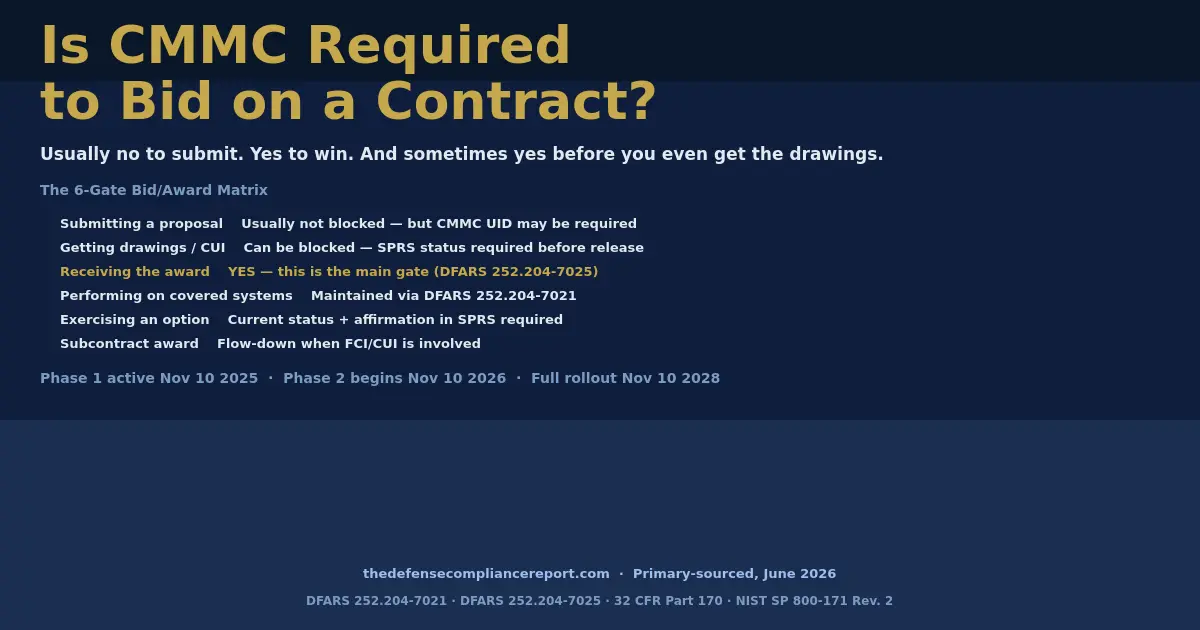
Yes. When the solicitation or contract requires it, your CMMC status becomes an eligibility issue before award, not a nice-to-have. DFARS 252.204-7025 makes a current CMMC status in SPRS — at the required level, with a current affirmation — a condition of award. DFARS 252.204-7021 then requires the prime to verify your status before it awards you a subcontract.
DFARS 252.204-7025 — “Notice of CMMC Level Requirements”
This is a solicitation provision (we pulled the November 2025 text from Acquisition.gov). The contracting officer fills in the required level — Level 1 (Self), Level 2 (Self), Level 2 (C3PAO), or Level 3 (DIBCAC) — and the provision states that an offeror is not eligible for award unless, for each information system that will process, store, or transmit FCI or CUI, it has (1) the current CMMC status entered in SPRS at the required level, and (2) a current affirmation of continuous compliance. Seeing 7025 in a solicitation is your early warning that the 7021 clause is coming in the contract.
DFARS 252.204-7021 — the contract clause
This lands after award and governs ongoing compliance. Its flow-down paragraph (f)(2) requires a contractor, prior to awarding a subcontract, to ensure the subcontractor “has a current CMMC certificate or current CMMC status at the CMMC level that is appropriate for the information that is being flowed down,” based on 32 CFR 170.23. Translation: your prime has a regulatory duty to check you before it hands you the work.
One relief valve worth knowing: the final rule defines “current” so that, for Levels 2 and 3, a Conditional status counts for up to 180 days (32 CFR 170.21; DFARS 252.204-7021). That means you may be eligible for award with a Conditional CMMC status— not only a Final one — while you close out a compliant plan.
The phased timeline — and the date you should actually circle
CMMC rolled out starting with Phase 1 tied to the effective date (32 CFR 170.3(e); DoD CIO’s CMMC page). On July 13, 2026, the Department suspended the Phase II transition and all pending milestones. The table below shows the original 32 CFR schedule; Phase 2 and later are suspended with no replacement dates announced:
| Phase | Begins | What changes |
|---|---|---|
| Phase 1 | DoD includes Level 1 (Self) or Level 2 (Self) as a condition of award for applicable contracts, and may require Level 2 (C3PAO) at its discretion. | |
| Phase 2 | DoD intends to include Level 2 (C3PAO) certification for applicable solicitations and contracts as a condition of award; it may delay a Level 2 (C3PAO) requirement to an option period, or include Level 3 at its discretion. | |
| Phase 3 | DoD intends to include Level 2 (C3PAO) for all applicable solicitations and contracts (and on option exercise), and to include Level 3 (DIBCAC) for applicable contracts. | |
| Phase 4 | Full implementation of CMMC requirements across all applicable DoD solicitations and contracts. |
The July 13, 2026 implementation suspension left Phase 1 active, limited new procurement designations to Level 1 (Self) and Level 2 (Self), and suspended new Level 2 (C3PAO), Level 3, and later-phase designations with no replacement Phase II date announced. If a current solicitation or contract still lists Level 2 (C3PAO) or Level 3, verify the required amendment or modification before acting — the Department directed contracting officers to make those changes, not you to strike the clause yourself.
The honest part: what we can’t do for you
We can’t make your prime keep you in the bid, waive its requirement, or accept your reading of the rule.A prime’s demand can be commercially real even when the regulatory language is vague, and sometimes the genuinely honest answer is that a given piece of CUI work isn’t worth the spend for a company your size. We’re not going to pretend otherwise.
But that’s exactly why this page exists. The expensive mistakes — responding before scope is defined, buying GCC High before mapping data, overstating your SPRS status, hiring an assessor before you’re ready — almost all happen in the first two weeks, out of panic. The fastest safe move is to turn a vague demand into a documented decision: what information flows, which clause applies, what level and assessment type, what evidence is needed, and by when.
The DFARS clauses in your prime’s email, decoded
If your prime’s notice cites a string of DFARS clauses, here’s what each one means for you.The first three — 7012, 7019, and 7020 — are the older NIST SP 800-171 self-assessment regime that has been in force for years. The last two — 7021 and 7025 — are the CMMC layer. Many prime emails reference both, and confusing them is a common source of panic.
| If the prime cites this clause | What it is | What it means for you |
|---|---|---|
| DFARS 252.204-7012 | Safeguarding Covered Defense Information and Cyber Incident Reporting | Implement NIST SP 800-171 to protect CUI, and report cyber incidents to DoD within 72 hours. In effect since 2017 — it predates CMMC. |
| DFARS 252.204-7019 | Notice of NIST SP 800-171 DoD Assessment Requirements (solicitation provision) | To be eligible for award, you need a current NIST SP 800-171 DoD Assessment score — not more than three years old — posted in SPRS for each relevant system. Note: retired from new solicitations as of Feb 1, 2026 (Class Deviation 2026-O0025). |
| DFARS 252.204-7020 | NIST SP 800-171 DoD Assessment Requirements (clause) | You must give DoD access for its assessments. You can’t award a sub subject to NIST SP 800-171 unless the sub has at least a current Basic Assessment in SPRS. Note: renumbered to 252.240-7997 in new solicitations as of Feb 1, 2026. |
| DFARS 252.204-7021 | Contractor Compliance With the CMMC Level Requirements (clause) | The CMMC layer: hold the required CMMC status for the contract’s level, maintain it through performance, and flow it down per 32 CFR 170.23. |
| DFARS 252.204-7025 | Notice of CMMC Level Requirements (solicitation provision) | The CMMC level required for award. You’re not eligible without the required current CMMC status and a current affirmation in SPRS. |
What should you send back to the prime today?
The goal of your first response is simple: turn a vague demand into a documented decision. Not to prove compliance (you can’t prove it for a requirement you haven’t scoped), not to buy time (that starts a bad dynamic), and not to volunteer evidence you haven’t thought through. Your first move is eight questions, sent in writing. Here’s exactly what to ask.
8-question clarification email to your prime
Subject: CMMC Requirement Clarification — [Your Company] — [Subcontract / RFQ Reference]Dear [Prime Contracts / Supply Chain Contact],Thank you for your notice regarding CMMC certification requirements. To scope our compliance path and avoid under- or over-investing, we need to confirm the following eight points in writing:1. Which DFARS clause or contract provision creates this requirement? (e.g., DFARS 252.204-7021, 252.204-7025, or an internal policy)2. What type of government information — Federal Contract Information (FCI) or Controlled Unclassified Information (CUI) — will flow to our systems under this subcontract?3. What CMMC level is required? (Level 1 Self, Level 2 Self, Level 2 C3PAO, or Level 3 DIBCAC)4. Which of our information systems does the requirement attach to? (i.e., what is the scope of the CMMC boundary)5. What is the deadline? (award gate, option exercise, task-order award, or subcontract award)6. Does this requirement flow down to our lower-tier subcontractors? If so, at what level and assessment type?7. What evidence do you require from us? (e.g., SPRS status verification, CMMC UID(s), written affirmation, C3PAO certificate letter)8. Is a Conditional CMMC status acceptable while we finalize our POA&M, or is a Final status required before subcontract award?We’ll respond with our compliance posture and a proposed path once we have this information. Thank you.
What’s safe to share — and what never to send in a supplier form
Once the prime sends answers, you’ll need to provide evidence. Here’s where people make expensive security mistakes: they email raw system security plans, network diagrams, or assessment reports in response to a supplier portal prompt. The rule doesn’t require that, and doing it creates its own risk.
Safe to share
- Your CAGE code and legal entity name
- Your CMMC status type and level (Final or Conditional) as shown in SPRS
- Your CMMC UID(s) for the applicable systems
- Date of most recent assessment and expiry
- Whether your affirmation is current
- A high-level, non-sensitive description of your CUI system boundary
- A written attestation letter from a senior official (not a raw SSP)
Never send unsecured
- Full System Security Plan (SSP)
- Plan of Action & Milestones (POA&M) raw documents
- Network diagrams with IP addressing, topology, or credentials
- Export-controlled technical data (EAR/ITAR controlled)
- CUI or FCI of any kind
- Security assessment reports or audit findings
- Penetration test results or vulnerability scan data
- Passwords, tokens, or access credentials of any kind
Which type of CMMC provider do you need?
Once you know your level and assessment type, the question becomes: who helps you get there? The CMMC provider ecosystem has five distinct categories, and matching to the wrong one wastes time and money:
RPO / RP (Registered Practitioner Organization / Registered Practitioner)
Consulting, scoping, and implementation help. The right starting point for most subcontractors who need to scope, build, or document their environment before assessment. Not an assessor.
C3PAO (Certified Third-Party Assessment Organization)
The only firm that can issue a formal CMMC Level 2 certification via the C3PAO assessment pathway. Engagement required only when Level 2 (C3PAO) is the required status. Cannot consult on the same work it assesses within the same engagement (three-year prohibition window per Cyber AB).
MSP / MSSP (Managed Service / Security Provider)
Ongoing IT or security operations. Appropriate when your CUI environment needs managed controls, monitoring, or endpoint management. Not a substitute for compliance scoping.
GRC Platform
Software for policy management, evidence collection, and SPRS scoring. Useful when you have competent internal staff but need structure and documentation. Not a compliance path on its own.
CUI Enclave / Managed Enclave
A pre-built, pre-assessed environment that handles CUI for you. Appropriate when reducing scope is more cost-effective than building out. See our guide to the CMMC managed enclave.
The conflict-of-interest rule that trips up half of first-time buyers: the Cyber AB’s Code of Professional Conduct bars a C3PAO from assessing an organization it provided consulting, advisory, or implementation services to — with a three-year prohibition window. If a firm offers to both fix and certify you in the same engagement, that’s a red flag and a conflict. Hire your remediation support and your assessor separately. See: RPO vs C3PAO.
Check your SPRS status before you do anything else
Before you plan, budget, or engage a provider, check your current SPRS status. You may already have a status from a prior self-assessment, and that status — or its gap — is the foundation of everything else. What to look for:
- Status type: Final or Conditional? (Conditional gives you up to 180 days to close the POA&M.)
- CMMC level: Is it the level — or higher — that the prime requires?
- Affirmation date: Is the annual affirmation current?
- System boundary: Does the UID correspond to the system that will perform this subcontract?
- Assessment age: For Level 2, does the assessment need to be refreshed (three-year cycle)?
Prime contractor CMMC certification FAQ
Can a prime contractor require CMMC certification?
Yes. When the contract or solicitation requires it and FCI or CUI will be processed, stored, or transmitted, a prime can require a specific CMMC status, and must verify it before subcontract award under DFARS 252.204-7021. A prime may also set supplier-qualification standards that exceed the regulatory floor. Ask for the clause, information type, level, assessment type, deadline, and evidence.
Does CMMC flow down to subcontractors?
Yes, under 32 CFR 170.23, but only to subcontractors at any tier that will process, store, or transmit FCI or CUI in performing the work. The level depends on the information type and the prime contract requirement. Subcontracts solely for COTS items are excluded from the flow-down clause.
Does a subcontractor need the same CMMC level as the prime?
Not necessarily. Your level is set by the data that flows to you: FCI-only points to Level 1; CUI points to at least Level 2. Your assessment type matches the prime’s, except a Level 3 prime flows down only Level 2 (C3PAO), not Level 3 (32 CFR 170.23). For more: CMMC for subcontractors.
Do all subcontractors need CMMC Level 2?
No. A blanket 'all suppliers need Level 2' is a prime policy, not the regulatory floor. If only FCI flows to you, the rule points to Level 1; Level 2 applies when CUI is involved. Confirm the clause and information type before treating Level 2 as mandatory.
If the prime's contract is Level 3, do I need Level 3?
No. Under 32 CFR 170.23(a)(4), a subcontractor handling CUI under a Level 3 prime requirement owes Level 2 (C3PAO) at minimum, unless DoD gives specific guidance. You would only need Level 3 if your own contract independently required it.
Is a CMMC self-assessment the same as certification?
No. A self-assessment (Level 1 or Level 2 Self) is a CMMC status you attest to and post in SPRS. A certification is a third-party (C3PAO) or government (DIBCAC) assessment. The cost difference is large — confirm which one your prime means. See: CMMC self-assessment vs C3PAO.
Do I need to be certified before award, or can I win the work first?
When DFARS 252.204-7025 applies, you must have the required current CMMC status in SPRS and a current affirmation before award, for each system that will handle FCI or CUI. For Levels 2 and 3, a Conditional status counts as “current” for up to 180 days.
Can I use a POA&M to get there?
Sometimes, but not at Level 1 and not without limits. Under 32 CFR 170.21, a Conditional Level 2 requires a score of at least 88 of 110, a POA&M can only cover eligible lower-weighted requirements, and some requirements cannot go on a POA&M. You have 180 days to close it or the Conditional status expires.
Who verifies my CMMC status — the prime, the DoD, or both?
The prime verifies the required status in SPRS before subcontract award, and your status and affirmations live in SPRS. DoD also reserves the right to conduct a DCMA DIBCAC assessment under DFARS 252.204-7020, and those results can take precedence over a pre-existing CMMC status.
Should I hire a C3PAO first?
Only if you are assessment-ready and need a formal certification. If you still need scoping, implementation, evidence, or managed operations, start with an RPO/RP, MSP, or MSSP — and keep your assessor separate from whoever helps you get ready. See: RPO vs C3PAO.
Can my readiness consultant also be my C3PAO?
No, not for the same engagement. The Cyber AB’s Code of Professional Conduct bars a C3PAO from assessing an organization it provided consulting, advisory, or implementation services to, with a three-year prohibition window. If a firm offers to both fix and certify the same work, treat it as a conflict and a red flag.
Does buying GCC High make me CMMC compliant?
No. Microsoft 365 GCC High, AWS GovCloud, or on-prem can support a compliant path, but compliance depends on your full system boundary, configuration, identities, endpoints, logging, policies, evidence, and shared-responsibility model. The cloud is a foundation, not the finished house.
What if the prime's request doesn't mention FCI, CUI, or any DFARS clause?
Ask for clarification in writing before you spend anything. A vague supplier demand can still matter commercially, but you cannot determine your level, assessment type, or evidence without the clause and the information-flow facts. Use the eight-question email above.
What if the deadline is under 30 days?
Treat it as a status-and-evidence triage deadline first, not a from-scratch build. Clarify what the prime actually needs by that date, confirm what evidence you already have, ask whether a Conditional status or a credible plan is acceptable, and get scoping help immediately. Nobody builds a compliant CUI environment in a few weeks.
Is CMMC affiliated with NIST, the DoD, or the Cyber AB — and is it 'Department of War' now?
CMMC is a U.S. Department of Defense program built on NIST SP 800-171; the Cyber AB is the CMMC accreditation body. The Defense Compliance Report is independent of all of them. A 2025 executive order (EO 14347) authorizes 'Department of War' as a secondary title, but 'Department of Defense' remains the legal name used in the regulations, so that's the term we use.
Is this page legal or compliance advice?
No. This is independent educational research from The Defense Compliance Report, an independent trade publication on CMMC 2.0 and DIB compliance. Confirm scope and applicability with a CMMC Registered Practitioner (RP/RPO) or a qualified federal-contracts attorney. The contract clause and your CUI handling set your level, not a checklist. See our editorial standards and corrections policy.
Your next step
You came here because a prime contractor requiring CMMC certification put real money and a real relationship on the line. You now know what you actually owe, what the prime can and can’t demand, what to send back today, and what to never put in a form. The last move is matching your situation to the right kind of help — before you request quotes.
Need help deciding what type of CMMC provider you need? Tell us your level, scope, and timeline, and we’ll match you with source-checked CMMC provider options.
Find My CMMC Path →Primary sources (expand)
- CMMC Program Rule, 32 CFR Part 170 (eCFR) — §170.3(e) phases; §170.14 model; §170.16/17 Level 2; §170.21 POA&M; §170.22 affirmation; §170.23 subcontractors; §170.24 scoring.
- 32 CFR 170.23, Application to subcontractors (Cornell LII)
- DFARS 252.204-7012, Safeguarding Covered Defense Information (Acquisition.gov)
- DFARS 252.204-7019, Notice of NIST SP 800-171 DoD Assessment Requirements (Acquisition.gov)
- DFARS 252.204-7020, NIST SP 800-171 DoD Assessment Requirements (Acquisition.gov)
- DFARS 252.204-7021, Contractor Compliance With the CMMC Level Requirements (Acquisition.gov)
- DFARS 252.204-7025, Notice of CMMC Level Requirements (Acquisition.gov)
- CMMC Program final rule, Federal Register (Oct 15, 2024) — Regulatory Impact Analysis; cost estimates
- DFARS CMMC acquisition final rule, Federal Register (Sept 10, 2025)
- DoD CIO — About CMMC (phase timing)
- Cyber AB — Code of Professional Conduct v2.0; CMMC Assessment Process (CAP); Marketplace
- Supplier Performance Risk System (SPRS)
- U.S. Department of Justice — Civil Cyber-Fraud Initiative (Aerojet Rocketdyne 2022; Penn State 2024)
- NIST SP 800-171 Revision 2 — NIST CSRC