CMMC vs FedRAMP: Which One Applies to You (and When You Need Both)
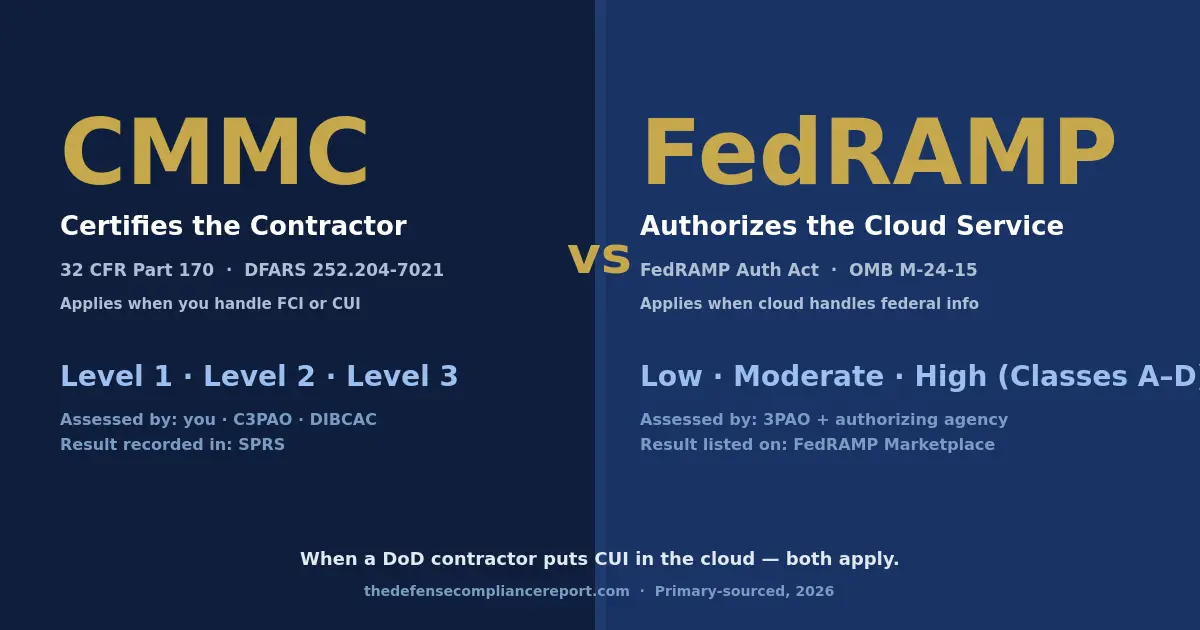
If you’ve heard “CMMC” and “FedRAMP” thrown around like they’re the same thing — or like one cancels out the other — you’re in good company, and the confusion gets expensive fast. So here’s the bottom line on CMMC vs FedRAMP: they are not interchangeable, and one does not replace the other. CMMC (Cybersecurity Maturity Model Certification) applies to defense contractors that handle Federal Contract Information (FCI) or Controlled Unclassified Information (CUI). FedRAMP (Federal Risk and Authorization Management Program) applies to cloud services used by federal agencies. Most companies need only one. Both come into play in two situations: when a DoD contractor uses a cloud service to handle CUI, and when a single organization wears two hats — a defense contractor anda cloud provider selling to the government. One of these blindsides people. We’ll get to it.
Who this page is for: DoD prime contractors, subcontractors, MSPs, MSSPs, SaaS vendors, FSOs, IT directors, compliance leads, and small-business owners trying to figure out whether CMMC, FedRAMP, or both apply before they spend six figures on the wrong thing.
What this page is not:a generic “what is CMMC” explainer, a step-by-step FedRAMP authorization guide, or a provider ranking. It answers the upstream question everyone actually has — is this a CMMC problem, a FedRAMP problem, or both? — and points you to the right next move.
Not sure which applies to your situation?
Tell us your contract role, data type, and cloud setup — we’ll map you to the right provider category before you spend a dollar.
Find My CMMC Path →CMMC vs FedRAMP at a glance
| Question | CMMC | FedRAMP |
|---|---|---|
| Who must comply? | DoD contractors and subcontractors whose covered information systems process, store, or transmit FCI or CUI in performance of a contract | Cloud service offerings used by federal agencies — the IaaS, PaaS, and SaaS products that create, process, store, or maintain federal information on an agency’s behalf |
| What it protects | FCI and CUI across the contractor’s assessed environment | Federal information inside a specific cloud service offering |
| Governing authority | 32 CFR Part 170 (program) + DFARS 252.204-7021 (contract clause) | FedRAMP Authorization Act + OMB Memo M-24-15; run by the FedRAMP PMO at GSA |
| Underlying NIST standard | NIST SP 800-171 Rev. 2 (Level 2); selected NIST SP 800-172 controls (Level 3) | NIST SP 800-53 Rev. 5 |
| Structure | 3 levels (1, 2, 3) | Baselines — Low, Moderate, High — set by FIPS 199 (transitioning to FedRAMP Certification Classes A–D) |
| Who assesses you | You (self), a C3PAO, or DIBCAC (Level 3) | A 3PAO, plus an authorizing agency (or FedRAMP directly via the Program path) |
| What you walk away with | A CMMC status for the assessed scope, recorded in SPRS | A FedRAMP authorization (being renamed “FedRAMP Certification”) listed on the FedRAMP Marketplace |
| Scope | The assessed environment, wherever FCI/CUI lives | Only the specific cloud offering, scoped to the agency use case |
| Does it replace the other? | No | No |
That table answers the surface question. The rest of this page answers the one underneath it: which of these is actually your problem?
What’s the difference between CMMC and FedRAMP?
CMMC certifies the contractor; FedRAMP authorizes the cloud service. CMMC is the Department of Defense’s program requiring contractors that handle FCI or CUI to implement and prove cybersecurity controls. FedRAMP is the federal program that authorizes a cloud service offering for agency use. CMMC follows your company and the system it assesses. FedRAMP follows the cloud product.
The cleanest way to keep them straight: CMMC is about you, the contractor. FedRAMP is about a cloud service.
CMMC is contractor-scope driven. Under 32 CFR Part 170 — the CMMC Program Rule, effective December 16, 2024 — CMMC applies to DoD contractors and subcontractors whose covered information systems process, store, or transmit FCI or CUI in the performance of a contract. It has three levels. Level 1 maps to the 15 basic safeguarding requirements in FAR 52.204-21 and is met by an annual self-assessment. Level 2 maps to the 110 security requirements in NIST SP 800-171 Revision 2, organized into 14 control families, and is met by either a self-assessment or a certification assessment by a C3PAO (Certified Third-Party Assessment Organization), depending on what the contract requires. Level 3 adds 24 selected requirements from NIST SP 800-172 and is assessed by the government — specifically DCMA’s Defense Industrial Base Cybersecurity Assessment Center (DIBCAC). One precision point that trips readers up: a CMMC status attaches to the assessed system or scope and is recorded in SPRS — it is not a blanket, company-wide stamp.
And a detail we see wrong on competing pages: CMMC Level 1 is 15 requirements, not 17.That number comes straight from FAR 52.204-21(b)(1). If a page tells you Level 1 has 17 practices, it’s running on pre-final-rule language.
FedRAMP is cloud-service-offering driven.FedRAMP standardizes how a cloud service is security-assessed, authorized, and continuously monitored for federal agency use. It’s built on NIST SP 800-53 Revision 5, with Low, Moderate, and High baselines assigned by FIPS 199 impact categorization, and a 3PAO (Third-Party Assessment Organization) does the independent assessment. The whole point is “authorize once, use many times” — one agency authorizes a cloud service, and others can reuse that work. Per OMB Memo M-24-15, agencies must obtain and maintain a FedRAMP authorization for a cloud product or service when it falls within FedRAMP scope; it does not apply to every internet service an agency happens to use.
They’re cousins, not twins. Both descend from NIST. FedRAMP uses NIST SP 800-53 directly; CMMC Level 2 uses NIST SP 800-171 Rev. 2, which is itself a CUI-focused subset derived from 800-53. That shared DNA creates real overlap in the controls — but, and this matters, overlap is not reciprocity. Holding one does not earn you the other.
The overlap exists for one reason: contractors use the cloud.When a DoD contractor uses an external cloud service to store, process, or transmit CUI, the two worlds touch. They do not merge. That single sentence is the source of nearly every “CMMC vs FedRAMP” headache, so we built the next section around it.
Do you need CMMC, FedRAMP, or both?
You need CMMC if your DoD contract requires protection of FCI or CUI on your systems. You need FedRAMP if you offer a cloud service used by a federal agency. You need both in two cases: you’re a DoD contractor using a cloud to handle CUI (CMMC for your company, plus a FedRAMP Moderate cloud), or you’re one organization that is both a defense contractor and a cloud provider to the government — two separate hats, two separate obligations. What you need is set by what you do and what your contract says — not by a checklist.
Start with one question, depending on who you are:
- Defense contractor? Start with your contract clause and your data flow. Where does FCI or CUI actually live and move?
- Cloud or SaaS provider? Start with who buys your service and whose information it handles.
- MSP, MSSP, GRC platform, or enclave provider? Start with function: do you process CUI, handle only Security Protection Data, or operate as a cloud service provider?
Then find your row. This is the asset we built that you can’t get from a single competing page — we combined the contract role, the data handled, the cloud-service role, the evidence to gather, the provider category to talk to, the common wrong move, and the primary source in one place. (One term you’ll see below: CDI, or covered defense information — the DFARS 252.204-7012 term that, for DoD contractor cloud use, overlaps heavily with CUI.)
The CMMC vs FedRAMP Applicability Matrix
| Your situation | CMMC applies? | FedRAMP applies? | Evidence / record to verify or produce | Category to talk to | Common wrong move | Primary source |
|---|---|---|---|---|---|---|
| DoD contractor/sub handles FCI only on its own systems | Yes — usually Level 1, annual self-assessment | Not from CMMC alone | Contract clause, FCI flow, Level 1 scope | RPO/RP if scoping is unclear | Buying a FedRAMP tool before confirming whether any CUI exists | 32 CFR 170; FAR 52.204-21 |
| DoD contractor handles CUI on its own systems, no external cloud stores/processes/transmits that CUI | Yes — Level 2 (self or C3PAO, per the contract) | Not directly | Clause, CUI flow, SSP, SPRS posting | RPO/RP, MSP/MSSP, GRC platform; C3PAO later | Assuming every Level 2 environment requires FedRAMP | 32 CFR 170; NIST SP 800-171 Rev. 2 |
| DoD contractor uses an external cloud (CSP) to store/process/transmit CUI | Yes — you still need your CMMC path | Yes — the cloud must be FedRAMP Moderate authorized or equivalent | Marketplace listing or equivalency Body of Evidence (BoE), Customer Responsibility Matrix (CRM), incident-response terms | CUI enclave, GCC High/GovCloud implementer, MSP/MSSP | Thinking the cloud’s FedRAMP status certifies you for CMMC | DFARS 252.204-7012; 32 CFR 170 |
| Contractor uses a FedRAMP-authorized cloud, but the tenant is misconfigured or endpoints are unmanaged | Yes — fully | Helps at the cloud layer, not your layer | CRM, tenant config, identity, endpoints, logging, boundary diagram | MSP/MSSP, enclave/GCC High implementer, GRC | Treating “FedRAMP cloud” as a full CMMC pass | 32 CFR 170 (scoping, CRM) |
| Cloud/SaaS provider sells a cloud service to federal agencies | Not from FedRAMP alone (only if it is also a DoD contractor/sub handling FCI/CUI on its own systems) | Yes, when the offering is within FedRAMP scope | FedRAMP authorization status, impact level/class, agency path | FedRAMP advisor, 3PAO | Pursuing CMMC when the buyer actually needs FedRAMP | OMB M-24-15 |
| DIB-facing SaaS stores contractors’ CUI but doesn’t sell directly to agencies | Possibly, if it is also a DoD contractor/sub | FedRAMP Moderate authorization or DoD equivalency is often required by the contractor’s DFARS flow-down | Marketplace listing or equivalency BoE, CRM, incident-reporting terms | CUI enclave / secure collaboration; FedRAMP evidence specialist | Saying “we’re CMMC aligned” instead of producing cloud evidence | DFARS 252.204-7012 |
| MSP/MSSP handles CUI inside the customer’s scope (not as a cloud provider) | Likely in scope as an External Service Provider; not automatically required to hold its own CMMC certificate | Not unless the MSP is functioning as a CSP | Service description, CRM, SSP references, CUI/SPD handling | CMMC-focused MSP/MSSP, RPO/RP | Assuming every MSP must be separately CMMC certified | 32 CFR 170; DoD CMMC FAQ |
| Security tool handles only Security Protection Data (logs, alerts), not CUI | In scope as a Security Protection Asset if it protects CUI assets | Not automatically triggered | SPD flow, service description, SSP | MSSP, GRC, RPO/RP | Treating “no CUI” as “out of scope” | 32 CFR 170 (Security Protection Assets) |
| Commercial company, no federal or DoD work, no FCI/CUI | No | No | Nothing — for now | — | — | — |
Find your row, then find your next step
Still not sure which row describes you? The answer turns on facts only your contract and environment hold. The right CMMC provider isn’t the same for every contractor — the category you need (C3PAO, RPO, MSSP, GRC platform, or CUI enclave) depends on your level, scope, assessment type, and cloud setup.
Use the CMMC Path Checker →One honest pointer before you go further. If you only sell cloud to civilianagencies and never touch a DoD contract or CUI, this site isn’t built for you — your path is FedRAMP, and you should start at fedramp.gov and with a FedRAMP 3PAO. We focus on the CMMC and DIB side. We’d rather send you to the right place than waste your time.
When does CMMC actually require FedRAMP?
CMMC doesn’t make every system FedRAMP-bound. The trigger appears when a DoD contractor uses an external cloud service provider to store, process, or transmit CUI. Per DFARS 252.204-7012, the contractor must require and ensure that cloud meets security requirements equivalent to the FedRAMP Moderate baseline. A cloud that is already FedRAMP Moderate authorized satisfies that CSP requirement automatically — though your own environment stays in scope.
Here’s the rule in plain English, and it’s the one most people get tangled in.
A file server in your office holding CUI is a CMMC and NIST SP 800-171 problem. The moment that CUI moves into a cloud service — email, file sharing, CAD, ERP, ticketing, backup — it becomes a CMMC and a FedRAMP-evidence problem. The clause that governs this is DFARS 252.204-7012, and it has been in DoD contracts since 2016. Paragraph (b)(2)(ii)(D) says that if a contractor uses an external cloud service provider to store, process, or transmit covered defense information, the contractor must “require and ensure” that the provider meets security requirements equivalent to the FedRAMP Moderate baseline, and complies with the clause’s cyber-incident-reporting obligations in paragraphs (c) through (g).
The CMMC Program Rule reinforces this and, helpfully, draws a bright line on who owns the risk. Per 32 CFR Part 170, if you’re using a FedRAMP Authorized cloud at the Moderate baseline or higher, you are not responsible for the cloud provider’s own compliance — the authorization speaks for itself. But if the cloud is not FedRAMP authorized, you become responsible for determining whether it meets FedRAMP Moderate equivalency.That’s a meaningful shift in burden, and it’s the difference between “check the Marketplace listing and move on” and “collect, review, and stand behind an evidence package.” Either way, the cloud’s status never covers your tenant configuration, endpoints, identity, documentation, or the controls you own.
A few clarifications that save real money:
- Encryption alone doesn’t get you out of it.You can’t just encrypt CUI, drop it in any commercial cloud, and call it compliant. DoD’s CMMC FAQ states a non-FedRAMP-Moderate cloud service offering cannot store encrypted CUI for contract performance unless the provider meets FedRAMP Moderate–equivalent requirements. The encryption helps you protect the data; it does not remove the cloud requirement.
- Not every tool is a cloud-CUI problem. A security tool that touches only Security Protection Data — logs, alerts, telemetry — and never handles CUI is treated under 32 CFR Part 170 as a Security Protection Asset. It can still be in scopefor your assessment, but it doesn’t automatically drag a FedRAMP requirement along with it. This is why a CMMC Level 2 environment doesn’t require every single tool to be FedRAMP authorized — a point a lot of vendors conveniently blur.
- This is why GCC High, GovCloud, and Azure Government exist.Standard Microsoft 365 Commercial does not meet the requirement for CUI. Microsoft built GCC High specifically to satisfy these DoD and FedRAMP obligations, and AWS GovCloud and Azure Government exist for similar reasons. But product-family names aren’t enough — before you put CUI anywhere, verify the exactoffering’s status and class on the FedRAMP Marketplace, confirm it covers the services where CUI will live, and get the CRM.
And the stakes here aren’t theoretical. In September 2025, the Department of Justice’s Civil Cyber-Fraud Initiative settled with Georgia Tech Research Corporation for $875,000 over alleged False Claims Act violations on Air Force and DARPA contracts. The government’s allegations: no system security plan for the lab in question, antivirus tools that weren’t installed or run, and a summary-level cybersecurity assessment score submitted to DoD that was allegedly based on a “fictitious” environment rather than the actual systems handling the data. Those are allegations, resolved without a determination of liability — but the message to contractors is plain. Getting your security plan, your controls, and your reported scores wrong isn’t just an assessment delay; it can become a legal exposure.
Map the cloud evidence to your scope before you migrate
If CUI is heading into a cloud tool, the product label matters far less than your scope, your tenant configuration, and the evidence you can produce. Before you migrate, identify whether your next conversation should be with an RPO/RP, a GCC High or GovCloud implementer, a CUI enclave provider, an MSP/MSSP, or — when you’re assessment-ready — a C3PAO. Map first, buy second.
Find My CMMC Path →Does FedRAMP replace CMMC?
No. FedRAMP can support the cloud layer of your CMMC environment, but it does not certify your company, your endpoints, your tenant configuration, your identity controls, your documentation, or your full assessment scope. A FedRAMP-authorized cloud is an input to your CMMC evidence — not a substitute for your CMMC status.
This is the most common and most expensive misread on the topic, so let’s be blunt: a FedRAMP authorization is not a CMMC certificate. It is one piece of cloud evidence sitting inside a much larger assessment boundary.
A FedRAMP-authorized cloud can let you inherita set of controls — the provider’s data-center security, infrastructure controls, certain platform capabilities, and a Marketplace-backed authorization you can point to. That’s genuinely valuable. It shrinks your work. But inheritance has limits, and the limits are exactly where contractors fail.
| FedRAMP does not automatically prove… | Why it still matters for CMMC |
|---|---|
| Your users and access are configured correctly | Identity and access controls stay in your scope |
| Your endpoints are protected | Laptops and servers can process, store, or transmit CUI |
| Your System Security Plan (SSP) is accurate | Your assessment depends on documented scope and evidence |
| Your shared-responsibility duties are implemented | Gaps in the Customer Responsibility Matrix (CRM) fail assessments |
| Your MSP/MSSP is correctly scoped | External Service Provider treatment must be documented |
| Your CUI stays inside authorized boundaries | Data flow has to be mapped and justified |
The shared-responsibility piece deserves emphasis. Every cloud authorization comes with a Customer Responsibility Matrix — the list of controls the cloud provider handles versus the controls youstill own. FedRAMP covers the provider’s side. The CRM is where your side lives, and a C3PAO will look right at it. Treating the cloud’s authorization as the whole story is how organizations walk into an assessment confident and walk out with findings.
The one-line version, worth taping to your monitor: FedRAMP is not your CMMC certificate; it’s one piece of cloud evidence inside your CMMC assessment boundary.
Is FedRAMP Moderate enough for CMMC Level 2?
For a DoD contractor using an external cloud to handle CUI, FedRAMP Moderate authorization — or DoD-recognized Moderate equivalency — is the baseline most often discussed in the CMMC and DFARS context. FedRAMP High may be required for separate contractual, agency, mission, or export-control reasons, but High is not the universal CMMC Level 2 requirement. The contract and the data decide.
We want to be careful here, because this is a place where well-meaning pages overstate things. The named baseline for cloud handling of CUI in the CMMC and DFARS conversation is FedRAMP Moderate or equivalent. Some environments end up on FedRAMP High— because of a specific agency requirement, the sensitivity of the data, export-control considerations, or a customer mandate. But you should not assume FedRAMP High is automatically required for CMMC Level 2. It usually isn’t.
| Question | FedRAMP Moderate | FedRAMP High |
|---|---|---|
| Is it the named baseline in the DFARS/CMMC cloud context? | Yes — Moderate or equivalent is the core requirement for clouds handling CUI here | Not the default Level 2 requirement |
| Can it support CMMC Level 2 cloud use? | Yes, when the offering and your use match the scope | Yes, but it may exceed what CMMC alone requires |
| Does it make the contractor CMMC compliant? | No | No |
| Who decides if High is needed? | The contract, agency, data sensitivity, or risk requirements | Same |
Before you accept any vendor’s “FedRAMP Moderate” claim, verify these six things:
- Is the exact product or service offering listed — not just the parent company?
- Is that offering Moderate or higher (or the equivalent Certification Class — see the next section)?
- Is it the same environment and version you’ll actually use?
- Does the listing cover the services where CUI will live?
- Will the provider give you a Customer Responsibility Matrix?
- Is your assessor asking for Marketplace proof, a CRM, SSP references, or an equivalency Body of Evidence — and can the vendor produce them?
If a vendor can’t answer those crisply, that’s your signal to slow down and verify before you commit budget or data.
What is FedRAMP Moderate equivalency, and how is it different from “authorized”?
FedRAMP Moderate equivalency is a DoD pathway for a cloud service that lacks a FedRAMP authorization to demonstrate it meets equivalent FedRAMP Moderate security for DoD contractor use. It does not confer FedRAMP authorization, and it shifts evidence-validation responsibility onto the contractor.“Authorized” is a status on the FedRAMP Marketplace; “equivalent” is an evidence package you have to review and stand behind.
This distinction is where a lot of money and a lot of timeline get lost, so here’s exactly how it works.
On December 21, 2023, the DoD Chief Information Officer issued a memo titled FedRAMP Moderate Equivalency for Cloud Service Providers’ Cloud Service Offerings — and made it effective immediately. Per that memo and the assessors who work with it daily, a cloud service offering is FedRAMP Moderate equivalent only if it meets all three of these:
- It achieves 100% of the FedRAMP Moderate security control baseline (no open gaps at the conclusion of the assessment).
- That compliance is assessed by a FedRAMP-recognized 3PAO.
- The provider produces a Body of Evidence (BoE) and presents it to the contractor.
Now the part competitors muddle: a cloud with a valid FedRAMP Moderate (or higher) authorization listed on the Marketplace automatically satisfies DFARS 252.204-7012.There’s no separate Body of Evidence for you to validate, and no need for a C3PAO or DIBCAC to re-check it. The equivalency pathway exists only for clouds that have not completed full FedRAMP authorization but still want to serve the DIB.
| FedRAMP Moderate Authorized | FedRAMP Moderate Equivalent | |
|---|---|---|
| Listed as authorized on the FedRAMP Marketplace | Yes | Not necessarily |
| Confers FedRAMP authorization | Yes | No |
| Can support DoD contractor use for CUI | Yes, if the offering and scope match | Potentially, if the equivalency evidence is complete |
| Evidence basis | Authorization package + continuous monitoring | 3PAO Body of Evidence against Moderate-equivalent criteria |
| Your verification burden | Low — confirm the listing | High — review and rely on the BoE |
| What to request | Marketplace listing, CRM, SSP references | 3PAO BoE, SAR, SAP, POA&M, CRM, incident-response evidence |
If a vendor claims equivalency, ask for the Body of Evidenceand confirm it includes: a FedRAMP-recognized 3PAO’s involvement, the System Security Plan (SSP), the Security Assessment Plan (SAP) and Report (SAR), the Plan of Action and Milestones (POA&M), continuous-monitoring materials, the Customer Responsibility Matrix, an incident-response plan, and confirmation that the 100% compliance bar was met at the conclusion of the 3PAO assessment.
Here’s the honest catch — the one trade-off we won’t paper over. FedRAMP equivalency is legitimate, and for plenty of contractors it’s the right call. But it is genuinely harder for a buyer to verifythan a live FedRAMP Marketplace authorization. With an authorized cloud, you confirm a listing and you’re done. With equivalency, you’re relying on a Body of Evidence you have to actually review — and if your CMMC clock is already running, that review can create more friction than you budgeted for. That doesn’t make equivalency wrong. It means you get the evidence package reviewed beforeyour assessment is scheduled, not during it. And if your timeline is tight and you’d rather not carry that verification burden at all, that’s a strong reason to look at a FedRAMP-authorized CUI enclave or a GCC High environment instead — same protection, far less evidence ambiguity.
Have a vendor claiming “FedRAMP equivalent”?
Don’t find out at your assessment whether the evidence package holds up. Flag it as a cloud/CUI evidence question — we’ll route you toward the right category of source-checked help, whether that’s an enclave provider, a GCC High implementer, or an evidence specialist. Get the package reviewed before the clock starts.
Find My CMMC Path →Is FedRAMP changing? FedRAMP 20x, the 2026 rules, and why old “CMMC vs FedRAMP” guides are wrong
Yes — significantly. FedRAMP is modernizing through “FedRAMP 20x” and the 2026 Consolidated Rules (CR26), and it is renaming a FedRAMP authorization to “FedRAMP Certification” with Certification Classes A–D. The Joint Authorization Board that older comparison pages still reference has been dissolved.The DFARS still says “FedRAMP Moderate,” and Class C maps to that historical Moderate baseline.
If you’ve read a few “CMMC vs FedRAMP” articles and noticed them mentioning the Joint Authorization Board (JAB)as a way to get FedRAMP authorized — stop trusting those pages on the FedRAMP side. The JAB was dissolved and replaced by the FedRAMP Board under the FedRAMP Authorization Act, and OMB Memo M-24-15 (2024) set the current policy. Authorization now runs through an Agency path or a Program path. A surprising number of ranking pages still describe a “JAB P-ATO” route that no longer exists.
What’s actually happening now, confirmed in FedRAMP’s own public notices (NTC-0004, NTC-0007, NTC-0008, published February–March 2026):
- A FedRAMP authorization is being renamed “FedRAMP Certification” (or “FedRAMP Certified”). FedRAMP says this is to stop the constant confusion between a FedRAMP authorization (done by FedRAMP) and an authorization to operate (done by an agency).
- Impact levels are becoming Certification Classes. Class A is a time-limited pilot tier; Class B maps to the historical Low/Li-SaaS baselines, Class C maps to the historical Moderate baseline, and Class D maps to the historical High baseline.
- The Consolidated Rules for 2026 (CR26) will formalize all of this. FedRAMP says CR26 will publish by the end of June 2026, apply to all cloud providers by December 31, 2026, and stay in effect through December 31, 2028.
- FedRAMP Ready retires July 28, 2026.No FedRAMP Ready submissions will be accepted after that date; existing ones convert to a Class A path or become “Legacy FedRAMP Ready.”
- FedRAMP 20xis the engine behind the speed: machine-readable evidence (OSCAL) and Key Security Indicators (KSIs) instead of long control-by-control narratives. FedRAMP’s stated goal is to make agency authorization decisions simple enough to complete “within days or weeks.”
Here’s the terminology snapshot — verified June 2026:
| Old / historical term | New FedRAMP term (per the 2026 rules) | What it means for you |
|---|---|---|
| “FedRAMP Authorized” | FedRAMP Certification / FedRAMP Certified | Same thing — the label is changing to reduce confusion with an agency ATO |
| FedRAMP Moderate (baseline) | FedRAMP Certification Class C | DFARS 252.204-7012 still names “FedRAMP Moderate”; Class C maps to it |
| FedRAMP High (baseline) | FedRAMP Certification Class D | Maps to the historical High baseline |
| FedRAMP Low / Li-SaaS | FedRAMP Certification Class B | Historical Low and Li-SaaS baselines |
| (new) pilot / testing tier | FedRAMP Certification Class A | Time-limited initial/pilot tier (starting with SOC 2 Type II); not a substitute for Class B/C/D |
| FedRAMP Ready | Retiring July 28, 2026 | No new submissions after that date; converting to a Class A path |
| JAB / JAB P-ATO | Obsolete | The Joint Authorization Board was dissolved; use the Agency or Program path |
Two things this means for the CMMC vs FedRAMP question. First, a FedRAMP Certification (or any FedRAMP authorization, by any name) is not a government-wide authorization to operate. FedRAMP is explicit: an agency still has to review the package and make its own risk decision under the NIST Risk Management Framework. Second, there is no FedRAMP-to-CMMC reciprocity— and FedRAMP has been clear that even its new path for leveraging external frameworks (starting with SOC 2 Type II) grants no reciprocity. Do not treat a FedRAMP status as a substitute for CMMC Level 2 evidence. Because the labels are mid-transition, verify any cloud’s status and class against the FedRAMP Marketplace at the time you make your decision.
3PAO vs C3PAO: same four letters, different jobs
A 3PAO assesses cloud services for FedRAMP. A C3PAO assesses defense contractors for CMMC.They’re accredited by different bodies and produce different outputs. Some firms hold both authorizations — which is exactly why the acronyms get confused.
| 3PAO (FedRAMP) | C3PAO (CMMC) | |
|---|---|---|
| Full name | Third-Party Assessment Organization | CMMC Third-Party Assessment Organization |
| What it assesses | A cloud service offering against FedRAMP / NIST SP 800-53 | A defense contractor against CMMC / NIST SP 800-171 Rev. 2 |
| Accredited/authorized by | The FedRAMP PMO / GSA process | The Cyber AB (the CMMC Accreditation Body) |
| What it produces | Support for a FedRAMP authorization | A CMMC Level 2 certificate, recorded in SPRS |
| Where you verify status | FedRAMP Marketplace | Cyber AB Marketplace |
Same overlapping letters, completely different programs. And yes, several large firms are botha 3PAO and a C3PAO — useful if you genuinely need both kinds of work, but it’s a big reason the terms blur. When a vendor says “we’re an authorized assessor,” ask: authorized for which program?
A note on independence, because it directly affects your money: under the Cyber AB’s Code of Professional Conduct, a C3PAO that provided consulting, implementation, or readiness/remediation services to an organization generally cannot perform that organization’s Level 2 certification assessment for three years.Don’t let a single vendor sell you “we’ll fix you and then certify you” as one tidy package — that conflict is prohibited, not a preference. Use an RPO or RP (Registered Provider Organization / Registered Practitioner) for readiness, and a separate C3PAO for the assessment.
How do MSPs, MSSPs, GRC platforms, and CUI enclaves fit?
Provider category matters, but function matters more.An MSP isn’t automatically a cloud service provider, an MSSP handling only Security Protection Data isn’t automatically storing CUI, and a CUI enclave can shrink your scope without erasing your CMMC responsibilities. The right question is always: what does this provider process, store, transmit, protect, administer, or resell?
| Provider category | What it can help with | What it does not automatically solve | What to verify |
|---|---|---|---|
| RPO / RP | Scoping, gap assessment, SSP/POA&M readiness, provider-category planning | A formal C3PAO certification assessment | Cyber AB listing, independence, scope experience |
| MSP | Implementation, tenant management, endpoint and security operations | FedRAMP (unless it acts as a CSP); the assessment itself | Whether it handles CUI, SPD, or operates as a CSP/ESP |
| MSSP | Monitoring, logging, incident support, security operations | Full CMMC readiness on its own | Whether logs/SPD/CUI enter its platform |
| GRC platform | Evidence tracking, SSP/POA&M workflow, control mapping | Technical implementation; a certification result. Software alone does not make you compliant. | Where evidence, CUI, or SPD is stored |
| CUI enclave | Scope reduction, secure collaboration, controlled CUI workflow | Whole-company compliance | FedRAMP status/class or equivalency, boundary fit, CRM |
| C3PAO | The formal Level 2 certification assessment, when required | Remediation for the same engagement (the three-year conflict rule) | Cyber AB authorization/status; your assessment readiness |
| FedRAMP 3PAO | FedRAMP assessment work for a cloud offering | CMMC certification | FedRAMP recognition and scope |
Two function-not-label distinctions that come straight from DoD guidance:
- An MSP is not automatically a CSP. Per the DoD CMMC FAQ, if your customer licenses or subscribes to the cloud and the MSP only administers the tenant, the MSP may not be the cloud service provider. But if the MSP contracts for the cloud service, modifies it, and resells it as its own offering, it may itself be treated as a CSP — which pulls FedRAMP/equivalency into the picture. Check the contract relationship before you label anyone.
- An External Service Provider that handles only Security Protection Data can still be in scopeas a Security Protection Asset under 32 CFR Part 170 — even without touching CUI. “We don’t store your CUI” is not the same as “we’re out of scope.” Document it in the SSP and the service description either way.
Before you buy anything: the pre-purchase checklist
Before you buy a tool, a consulting package, or an assessment, map your contract clause, your FCI/CUI/CDI flow, your system boundary, your external providers, your cloud offerings, and your assessment type. The expensive mistake is buying a FedRAMP-labeled tool or scheduling a C3PAO before you know which environment is actually in scope.
Work these seven steps first:
- Identify whether the contract involves FCI, CUI, CDI, or none. (A DFARS 252.204-7012 reference is a strong signal CUI is in play; FAR 52.204-21 signals FCI.)
- Find the clause or flow-down language — and look for DFARS 252.204-7025, the solicitation provision that puts you on notice of the required CMMC level before award.
- Determine the CMMC level and assessment type the contract requires (Level 1 self, Level 2 self, Level 2 C3PAO, or Level 3 DIBCAC).
- Map where CUI is processed, stored, or transmitted.
- List every CSP, ESP, MSP, MSSP, GRC platform, and enclave in the environment.
- Request FedRAMP Marketplace proof or an equivalency Body of Evidence for any cloud handling CUI/CDI.
- Decide what you actually need: readiness help, implementation, evidence software, enclave strategy, or a formal assessment.
And before you sign with any vendor, ask them this — copy it straight into your notes:
- Are you a CSP, ESP, MSP, MSSP, GRC platform, CUI enclave, RPO/RP, C3PAO, or FedRAMP 3PAO?
- Will you process, store, or transmit our CUI? Or only Security Protection Data?
- Is your exact offering FedRAMP Moderate authorized, FedRAMP High authorized (Class C/D), or claiming Moderate equivalency?
- Can you provide a Customer Responsibility Matrix?
- Can your evidence be used by a C3PAO or DIBCAC assessor?
- Are you independent from the organization that would perform our certification assessment?
- Are you making a certification claim, an authorization claim, or a readiness claim?
That last question is the tell. Vendors blur “certified,” “authorized,” and “ready” constantly. Make them pick a word.
Turn your answers into a path
Save this checklist and run the seven steps before you talk to anyone. Once you have your answers, map them to the right provider category — readiness, implementation, enclave, evidence workflow, or assessment — so your first vendor conversation is the right one.
Find My CMMC Path →The most common CMMC vs FedRAMP mistakes
The costliest CMMC vs FedRAMP mistakes come from treating labels as outcomes— “FedRAMP cloud” as CMMC compliance, “CMMC ready” as FedRAMP authorization, “GCC High” as a finished assessment, or “encrypted CUI” as out of scope. Assessors look at data flow, scope, evidence, and responsibilities — not marketing.
Mistake 1 — “We bought FedRAMP, so we’re CMMC compliant.” FedRAMP supports the cloud layer of your evidence. CMMC still evaluates your whole assessment scope — endpoints, identity, documentation, and the controls you own in the CRM.
Mistake 2 — “We’re CMMC Level 2, so our SaaS is FedRAMP-ready.” A CMMC status doesn’t authorize a cloud service offering. Those are different programs with different assessors.
Mistake 3 — “The parent company is FedRAMP authorized.” Verify the specific offering, environment, version, and impact level/class on the FedRAMP Marketplace. A parent company’s authorization doesn’t automatically cover the product you’ll use.
Mistake 4 — “Encrypted CUI can sit anywhere.”Per DoD’s CMMC FAQ, a non-FedRAMP-Moderate cloud can’t store encrypted CUI for contract performance unless the provider meets Moderate-equivalent requirements. Encryption protects the data; it doesn’t waive the cloud requirement.
Mistake 5 — “Our MSP has to be CMMC certified.”Not always. Under the final rule, an External Service Provider like an MSP isn’t required to hold its own CMMC certificate — though if it doesn’t, its in-scope assets fall into your assessment, which can complicate your timeline.
Mistake 6 — “FedRAMP equivalency is the same as FedRAMP authorization.”It isn’t. DoD materials are explicit that equivalency does not confer FedRAMP authorization — and equivalency puts the evidence-verification burden on you.
Mistake 7 — “NIST says 800-171 Rev. 2 is withdrawn, so this page is out of date.” Understandable, but no. NIST published SP 800-171 Rev. 3 in May 2024 and now marks Rev. 2 as superseded at the publication level — yet CMMC Level 2 still maps to Rev. 2under 32 CFR Part 170. Until DoD amends the rule, Rev. 2 is the controlling version for CMMC. Don’t let the NIST “withdrawn” banner fool you into building to the wrong revision.
What we verified for this guide
We treat primary-source citation as the job, not a footnote. Here’s exactly what we checked, and what we recommend you re-confirm because it’s moving.
| Source we read | What it confirmed |
|---|---|
| 32 CFR Part 170 (eCFR) | CMMC applicability; the three levels; Level 2 mapping to NIST SP 800-171 Rev. 2; CSP/ESP scoping; the FedRAMP-authorized-vs-equivalent responsibility line |
| DFARS 252.204-7012 (Acquisition.gov) | The external-cloud requirement: FedRAMP Moderate–equivalent security plus incident-reporting obligations for covered defense information |
| DFARS 252.204-7021 and 252.204-7025 (Acquisition.gov) | The CMMC contract clause and solicitation provision; flow-down via 32 CFR 170.23; effective Nov 10, 2025. Phase 1 began Nov 10, 2025 and remains active. The July 13, 2026 suspension paused the Phase II transition (originally set for Nov 10, 2026) with no replacement date announced. |
| DoD CIO FedRAMP Moderate Equivalency memo (Dec 21, 2023) | Equivalency vs authorization; the 100% baseline + FedRAMP-recognized 3PAO + Body of Evidence bar |
| FedRAMP public notices NTC-0004, NTC-0007, NTC-0008 + OMB M-24-15 | The move to “FedRAMP Certification” and Certification Classes A–D (Class C = historical Moderate); FedRAMP Ready retiring July 28, 2026; CR26 timing; no reciprocity for the external-framework path |
| Cyber AB Code of Professional Conduct | The C3PAO three-year consulting/assessment conflict-of-interest rule |
| NIST CSRC | NIST SP 800-171 Rev. 2 (the controlling version for CMMC Level 2; Rev. 3 published May 2024 and Rev. 2 now marked superseded at the publication level), NIST SP 800-53 Rev. 5, NIST SP 800-172 |
| U.S. Department of Justice | The Georgia Tech Research Corporation Civil Cyber-Fraud settlement ($875,000, Sept 2025) and the nature of the allegations |
CMMC vs FedRAMP: FAQ
Is CMMC the same as FedRAMP?
No. CMMC is the DoD program that assesses defense contractors handling FCI or CUI on their own systems. FedRAMP is the federal program that authorizes a cloud service offering for agency use. They overlap when a defense contractor uses a cloud service to store, process, or transmit CUI — but holding one does not satisfy the other. (Source: 32 CFR Part 170; OMB M-24-15.)
Does FedRAMP replace CMMC?
No. FedRAMP can provide cloud-service evidence and let you inherit some controls, but the contractor still has to meet the CMMC requirements for its full assessment scope, including endpoints, identity, documentation, and shared-responsibility controls. (Source: 32 CFR Part 170.)
Does CMMC Level 2 require FedRAMP Moderate?
Not for every system. The FedRAMP Moderate requirement is triggered when a contractor uses an external cloud service provider to store, process, or transmit CUI in contract performance. A purely on-premises CUI environment doesn’t trigger it. (Source: DFARS 252.204-7012.)
Is FedRAMP Moderate enough for CMMC Level 2?
For cloud handling of CUI, FedRAMP Moderate authorization or DoD-recognized Moderate equivalency is the baseline most often discussed in the CMMC and DFARS context. FedRAMP High may be required for separate contractual, agency, or data-sensitivity reasons, but it is not the universal Level 2 requirement. (Source: DFARS 252.204-7012; DoD CMMC FAQ.)
Is GCC High enough for CMMC?
No. Microsoft GCC High can support a CMMC architecture for CUI, but it does not make your company CMMC compliant by itself. Your tenant configuration, endpoints, identity controls, documentation, evidence, and the rest of your assessment scope still matter. Verify the exact offering’s status on the FedRAMP Marketplace. (Source: 32 CFR Part 170; FedRAMP Marketplace.)
Is AWS GovCloud enough for CMMC?
No. AWS GovCloud can provide an authorized cloud foundation, but the contractor still owns its configuration, data flow, endpoints, identity, policies, evidence, and assessment scope. The cloud is one input, not the whole answer. (Source: 32 CFR Part 170.)
Can a non-FedRAMP cloud store encrypted CUI?
For DoD contract performance using an external cloud, DoD’s CMMC FAQ says no — unless the cloud meets security requirements equivalent to the FedRAMP Moderate baseline. Encryption protects the data; it does not remove the cloud requirement. (Source: DoD CMMC FAQ; DFARS 252.204-7012.)
Is FedRAMP Moderate equivalency the same as FedRAMP Moderate authorization?
No. DoD materials state that equivalency does not confer FedRAMP authorization. An authorized cloud is listed on the FedRAMP Marketplace; an equivalent cloud relies on a Body of Evidence the contractor must review and stand behind. (Source: DoD CIO FedRAMP Moderate Equivalency memo, Dec 21, 2023.)
What's the difference between a 3PAO and a C3PAO?
A 3PAO assesses cloud services for FedRAMP and is recognized through the FedRAMP program at GSA. A C3PAO assesses defense contractors for CMMC and is authorized by the Cyber AB. Some firms hold both, which is why the terms get confused. (Source: 32 CFR Part 170; FedRAMP program; Cyber AB.)
Does an MSP need its own CMMC assessment?
Not automatically. Under the final rule, an External Service Provider such as an MSP is not required to hold its own CMMC certificate. If it doesn’t, its in-scope assets are evaluated within the contractor’s assessment, which can affect your timeline. Whether the MSP needs its own assessment depends on what it handles. (Source: 32 CFR Part 170; DoD CMMC FAQ.)
How do an SPRS score, a CMMC Status, and FedRAMP evidence interact?
SPRS holds NIST SP 800-171 DoD Assessment summary scores under DFARS 252.204-7019/-7020, and it holds CMMC Status, CMMC Unique Identifiers, and annual affirmations under DFARS 252.204-7021/-7025. FedRAMP evidence for a cloud service does not replace either SPRS obligation. (Source: DFARS 252.204-7019/-7020/-7021/-7025.)
Why does NIST say SP 800-171 Rev. 2 is withdrawn?
NIST published Rev. 3 in May 2024 and marks Rev. 2 as superseded at the publication level. But CMMC Level 2 currently maps to NIST SP 800-171 Rev. 2 under the CMMC Program Rule. Do not treat Rev. 3 as the controlling CMMC version unless DoD changes the rule. (Source: NIST CSRC; 32 CFR Part 170.)
Should we hire a C3PAO or an RPO first?
If you’re still unsure about scope, cloud evidence, your SSP, your POA&M, and provider responsibilities, start with readiness and scoping help — an RPO/RP — before scheduling a formal assessment. A C3PAO is the right call when you’re assessment-ready or specifically required to obtain a Level 2 certification assessment. Note the three-year conflict rule: the firm that consults can’t also certify you. (Source: Cyber AB Code of Professional Conduct.)
Your next step
You came here to find out whether CMMC, FedRAMP, or both apply to you. If you read one thing twice, make it this: CMMC follows your company; FedRAMP follows a cloud service; and when a DoD contractor puts CUI in the cloud, both are in play — your CMMC obligation doesn’t disappear, and your cloud has to be FedRAMP Moderate authorized or equivalent.Verify the exact cloud status on the Marketplace, document the controls you still own, and don’t let a vendor sell you one word (“certified,” “authorized,” “ready”) when you need another.
Need help deciding what type of CMMC provider you need?Tell us your level, scope, and timeline, and we’ll match you with source-checked CMMC provider options.
Find My CMMC Path
The right provider category — a C3PAO, an RPO, an MSSP, a GRC platform, or a CUI enclave — depends on your required CMMC level, FCI vs CUI handling, assessment type, IT/cloud environment, and contract timeline. Use The Defense Compliance Report's Find My CMMC Path tool to map your situation to the right provider category before you request quotes. Educational triage only: free · 2-minute assessment · no obligation · do not submit CUI, drawings, or sensitive contract details.
Find My CMMC Path →- FedRAMP Equivalency for CMMC Cloud Providers (2026 Proof Guide)
- FedRAMP Moderate for CMMC Cloud Services: What Counts [2026]
- DFARS 252.204-7012 Explained: What the Clause Actually Requires
- CMMC Secure Enclave Options
- CUI Enclave Providers Compared
- CMMC vs NIST 800-171: Same Controls, Different Job
- CMMC vs ISO 27001: What Counts, What Doesn’t
- What Is an SPRS Score and How Is It Calculated?
- CMMC vs SOC 2: Does SOC 2 Satisfy CMMC?