CMMC vs ISO 27001: What Counts, What Doesn't, and What to Do Next
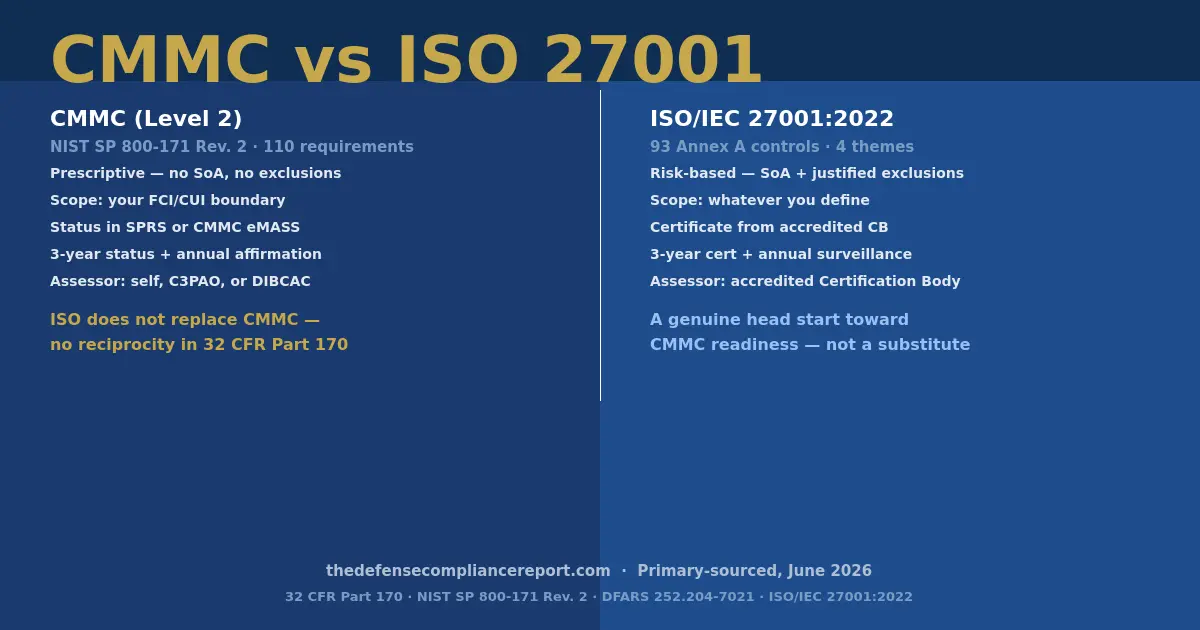
CMMC vs ISO 27001 comes down to one fact: ISO/IEC 27001 does not satisfy CMMC, and there is no reciprocity — nothing in 32 CFR Part 170 reduces your CMMC obligation because you hold ISO 27001. It is a genuine head start toward the NIST SP 800-171 Revision 2 baseline behind CMMC Level 2, but it is not a substitute.
If you came here hoping your ISO certificate counts as a CMMC status, the honest answer is no — and we’ll show you exactly why, with the rule text to back it. But here’s the part most comparison pages skip, and the one that quietly sinks “we’re already ISO certified” the moment an assessment starts: it is usually not your controls that fail you. It’s your scope. Give us two minutes and you’ll know what actually carries over, what still has to be built and proven, what it costs in 2026, and which kind of provider to call next.
That’s the whole decision in three parts — does ISO count, what’s the gap, and what do I do about it.Let’s resolve each one.
- Who this is for: DIB contractors, subcontractors, MSPs, CISOs, IT directors, FSOs, contracts officers, and CEOs of small defense suppliers who already hold — or are weighing — ISO/IEC 27001 and need to know what it does for CMMC.
- Who this is not for: anyone looking for a generic ISO 27001 how-to, a “best provider” ranking, or legal advice on a specific contract.
- The key qualifier: if a contract clause or prime flow-down requires CMMC, your ISO certificate is not the CMMC status. Your path depends on whether you handle FCI or CUI, your required level and assessment type, your IT and cloud environment, and your contract timeline.
The Defense Compliance Report is the independent trade publication and decision resource for CMMC and Defense Industrial Base compliance — explaining the CMMC Final Rule with primary-source citation on every claim and mapping a contractor’s level, CUI scope, assessment type, and timeline to the right provider category, so DIB contractors choose the right CMMC path before they spend six figures.
CMMC vs ISO 27001 at a glance
| CMMC (Level 2 focus) | ISO/IEC 27001:2022 | What it means for you | |
|---|---|---|---|
| What it protects | FCI and CUI for DoD contracts — and the in-scope systems, people, and external service providers that process, store, transmit, or protect it | Any information assets you choose to put in scope | ISO protects what you define; CMMC protects the government’s data |
| Mandate | Required when your DoD contract says so (DFARS 252.204-7021) | Voluntary — sometimes a customer asks for it | A contract can require CMMC even if you already hold ISO |
| Source of requirements | NIST SP 800-171 Rev. 2 — 110 requirements in 14 families at Level 2 | Annex A — 93 controls in 4 themes, plus management-system Clauses 4–10 | Different requirement sets; one does not convert to the other |
| Approach | Prescriptive — every applicable requirement is mandatory | Risk-based — you select controls and may exclude some | ISO lets you tailor; CMMC Level 2 does not |
| Scoring | Met / not met against the objectives in NIST SP 800-171A, plus the DoD scoring methodology | Audit against your ISMS; nonconformities noted | “Mostly compliant” doesn’t clear a CMMC assessment |
| Tailoring | No Statement of Applicability; a limited POA&M only | Statement of Applicability with justified exclusions | You can’t exclude a CMMC requirement because it’s inconvenient |
| Who assesses | Self-assessment, an authorized C3PAO, or DIBCAC — by level and contract | An accredited Certification Body (e.g., under ANAB or UKAS) | Different assessors, different artifacts |
| Cycle | 3-year status plus an annual affirmation in SPRS | 3-year certificate plus annual surveillance audits | Both are ongoing, not one-and-done |
| Reciprocity with the other | None | n/a | Holding one earns you no formal credit toward the other |
The right CMMC provider isn’t the same for every contractor — the category you need (a C3PAO, an RPO, an MSSP, a GRC platform, or a CUI enclave) depends on your required CMMC level, whether you handle FCI or CUI, your assessment type, your cloud and IT environment, and your contract timeline. The contract clause sets your level, not a checklist. Because a general answer can’t resolve those for you, use The Defense Compliance Report’s Find My CMMC Path tool to map your situation to the right provider category before you request quotes — and do not submit CUI, drawings, or sensitive contract details.
Not sure whether your ISO scope even covers the systems where CUI lives?
Find My CMMC Path maps your level, scope, assessment type, and timeline to the right provider category — no CUI required.
Map my ISO scope to CMMC →Try this first — the ISO-to-CMMC Scope Check (6 questions, no CUI). Answer six quick questions — your ISO scope, whether you handle FCI or CUI, what triggered the requirement, the CMMC status you’ve been asked for, your cloud environment, and your timeline — and get your likely first provider category (RPO/RP, MSP/MSSP, GRC platform, CUI enclave, or C3PAO) plus a short evidence checklist. It takes about a minute, and it won’t ask you for anything sensitive. Run the Scope Check →
Does ISO 27001 count for CMMC?
No. ISO/IEC 27001 does not count as a CMMC certification, and there is no reciprocity — 32 CFR Part 170, the CMMC Program Rule, contains no provision that reduces your CMMC obligation because you hold another certification. If your contract requires CMMC, you must achieve the specific status it names — Level 1 or Level 2 by self-assessment, Level 2 by an authorized C3PAO, or Level 3 by DIBCAC. Your ISO work still matters, but as evidence and a head start, not a substitute.
Let’s be plain about it, because the cost of getting this wrong is a failed assessment and a lost award. We read the CMMC Program Rule (32 CFR Part 170) and the DoD’s contract clause (DFARS 252.204-7021). Neither one says an ISO 27001 certificate satisfies the requirement. The contract or solicitation specifies the CMMC status you have to meet — Level 1 (Self), Level 2 (Self), Level 2 (C3PAO), or Level 3 (DIBCAC) — and you have to hold that status at the level required (DFARS 252.204-7021; -7025). An ISO certificate is not one of those statuses. Practitioners across the industry land in the same place: there is no reciprocity mechanism that converts an ISO 27001 certificate into a CMMC status. (For the mechanics of how a status is earned, see our CMMC certification process walkthrough.)
So if a prime flowed down CMMC language and you were planning to wave your ISO certificate at them — that won’t close it.
It helps to separate what the rule states from what you actually have to checkin your own shop. This is where “we’re certified” and “we’ll pass” drift apart:
| What the rule states | What an ISO-certified contractor must actually verify | Primary source |
|---|---|---|
| Level 2 is assessed against NIST SP 800-171 Rev. 2 | Does your ISO scope cover the CUI system boundary? | 32 CFR Part 170; DoD CIO |
| Level 2 can be Self or C3PAO, set by the contract | Which status does your solicitation or flow-down require? | DFARS 252.204-7021 / -7025 |
| C3PAO results post to CMMC eMASS and a score transmits to SPRS; self-assessments post to SPRS | Are you assessment-ready, or still mid-remediation? | 32 CFR Part 170 (final rule) |
| A senior official must affirm compliance annually in SPRS | Who is your affirming official and CMMC status owner? | DFARS final rule |
Now the part that actually saves you money. Here is the one honest admission we’ll make on this page, and it’s the most useful sentence in it: if your ISO certificate’s scope excludes the systems, people, and processes where CUI actually lives, your ISO work may help far less than you hoped.Plenty of ISO certificates are scoped to a product line, a SaaS platform, or a data center — not to the email, file shares, engineering tools, and endpoints where CUI really moves. When the certified ISMS scope and the CUI boundary don’t overlap, the head start shrinks fast.
That’s not a reason to regret ISO. It’s the reason this is a scoping and evidence question, not a certificate-label question — and scoping is the cheapest lever you have. Get the CUI boundary right and you can shrink the controls, the evidence, and the bill. Get it wrong and every line item grows.
Not certain your ISO scope maps to your CUI boundary?
Don’t guess — map it before you request a single quote.
Map my ISO scope to CMMC →CMMC vs ISO 27001 comparison: what actually changes for a defense contractor
For a defense contractor, the practical difference isn’t “which framework is better.” It’s that CMMC is tied to DoD contract eligibility and the safeguarding of FCI and CUI, while ISO/IEC 27001 is a broader information security management system (ISMS) standard that can support — but not replace — the CMMC requirement. ISO is the management engine; CMMC is the federal wiring bolted to your contract.
We built the table below as a decision tool, not a glossary. Each row is a question you’re actually asking, with the answer for each standard and the primary source behind it.
| Decision point | CMMC | ISO/IEC 27001 | Primary source |
|---|---|---|---|
| Core purpose | Verifies you’ve implemented safeguarding requirements for FCI and CUI under the CMMC Program | Specifies requirements for an information security management system (ISMS) | 32 CFR Part 170 · ISO/IEC 27001:2022 |
| What triggers it | A contract clause, solicitation, or prime flow-down | A business, customer, market, or risk decision | DFARS 252.204-7021 |
| Data in focus | FCI and CUI; your level is set by the contract and the data you handle | Whatever you put inside your defined ISMS scope | 32 CFR Part 170 · ISO/IEC 27001:2022 |
| Level model | Level 1, 2, 3. Level 2 uses NIST SP 800-171 Rev. 2 | No CMMC-style levels; one certification against the standard | 32 CFR Part 170 |
| Control set | 110 requirements (Level 2) across 14 families | 93 Annex A controls across 4 themes + Clauses 4–10 | NIST SP 800-171 Rev. 2 · ISO/IEC 27001:2022 |
| How you’re scored | Met / not met against the objectives in NIST SP 800-171A, plus the DoD scoring methodology | Audit against the ISMS; nonconformities and corrective actions | NIST SP 800-171A · ISO/IEC 27001:2022 |
| Tailoring | No exclusions; a limited Plan of Action & Milestones (POA&M) only | Statement of Applicability (SoA) with justified exclusions | 32 CFR Part 170 |
| Proof of status | Self-assessment, authorized C3PAO assessment, or DIBCAC assessment; results in SPRS or CMMC eMASS, with an annual affirmation | A certificate from an accredited Certification Body | DoD CIO CMMC materials · Acquisition.gov |
| Who can help | RPO/RP, MSP/MSSP, GRC platform, CUI enclave, or C3PAO depending on stage | ISO consultant and certification body | Cyber AB assessment rules |
| The bottom line | ISO helps; it does not replace CMMC | A strong ISMS supports CMMC readiness | Combined primary-source synthesis |
Read in one breath: ISO is usually the broader management-system layer. CMMC is the contract-specific FCI/CUI compliance-and-assessment layer. The smart move isn’t picking a label — it’s aligning the management system you already run with the CMMC scope, evidence, and assessment path your contract requires.
How much of ISO 27001 actually transfers to CMMC Level 2?
A mature ISO/IEC 27001:2022 ISMS gives the strongest head start in the governance-heavy families — Access Control, Awareness & Training, Personnel Security, Physical Protection, and Risk Assessment — and the least in the prescriptive, evidence-heavy, CUI-specific families, especially System & Communications Protection (which requires FIPS-validated cryptography and boundary protection). The map below rates all 14 NIST SP 800-171 Rev. 2 families and names the specific gap you still owe.
This is the asset we couldn’t find anywhere else, so we built it. Most pages tell you “there’s significant overlap” or quote a single number — we’ve seen “80%,” “81%,” “60–70 of the 110.” We don’t repeat those as fact, because overlap isn’t uniform and a single percentage hides where the real work is. Here’s our family-by-family read instead.
A note on method, because you should be able to check us: the ratings below are The Defense Compliance Report’s editorial mapping, built by comparing the published control structures of ISO/IEC 27001:2022 (Annex A) against NIST SP 800-171 Rev. 2 and the assessment objectives in NIST SP 800-171A. It’s an orientation tool, not an official crosswalk, and not compliance advice. Your real coverage depends on your evidence and your scope.
| NIST SP 800-171 Rev. 2 family (requirements) | Closest ISO/IEC 27001:2022 area | Our coverage rating | The gap you still owe for CMMC |
|---|---|---|---|
| Access Control — 22 | A.5.15–5.18, A.8.2–8.5 | Strong | Binary objectives for controlling CUI flow (3.1.3), external systems (3.1.20), public content (3.1.22), session lock and limits |
| Awareness & Training — 3 | A.6.3 | Strong | Insider-threat awareness (3.2.3); role-based training tied to CUI; dated training records |
| Audit & Accountability — 9 | A.8.15–8.17 | Partial | Prescriptive log content, retention, review, protection, alerting on audit failure, and time synchronization |
| Configuration Management — 9 | A.8.9, A.8.19, A.8.32 | Partial | Baseline configurations, least functionality, allow/deny-listing, and control of user-installed software |
| Identification & Authentication — 11 | A.5.16–5.17, A.8.5 | Partial → gap | Multifactor authentication for privileged and network access (3.5.3), FIPS-validated crypto for stored passwords, replay-resistant authentication |
| Incident Response — 3 | A.5.24–5.28 | Partial → gap | DFARS 252.204-7012: report cyber incidents to DoD within 72 hours via DIBNet, a medium-assurance certificate, and malicious-software submission |
| Maintenance — 6 | A.7.13 | Partial | Controls on maintenance tools, media sanitization before off-site maintenance, supervision of maintainers, MFA for nonlocal maintenance |
| Media Protection — 9 | A.7.10, A.7.14, A.8.10 | Partial → gap | CUI media marking, sanitization, removable-media control, encryption of CUI on portable devices |
| Personnel Security — 2 | A.6.1, A.6.5 | Strong | Screening before CUI access; protecting CUI during transfers and terminations |
| Physical Protection — 6 | A.7.1–7.4, A.7.9 | Strong | Visitor escort and physical access logs, control of physical access devices, alternate work sites |
| Risk Assessment — 3 | Clause 6.1, A.5.7, A.8.8 | Strong (ISO’s home turf) | Periodic vulnerability scanning and remediation on a defined cadence (3.11.2 / 3.11.3), with evidence |
| Security Assessment — 4 | Clause 9, A.5.35 | Strong process, artifact gap | A System Security Plan (SSP) in NIST format (3.12.4) and a POA&M (3.12.2) as specific federal artifacts |
| System & Communications Protection — 16 | A.8.20–8.24, A.8.26 | Weak — your biggest gap | FIPS-validated cryptography (3.13.11), boundary protection, CUI encryption in transit, deny-by-default, CUI separation, VoIP and mobile-code controls |
| System & Information Integrity — 7 | A.8.7, A.8.8, A.8.16 | Partial | Flaw-remediation timelines, malicious-code protection at entry/exit points, monitoring security alerts and advisories, detecting unauthorized use |
The one-paragraph takeaway:a real ISMS does the heavy lifting on governance, training, personnel, physical security, and risk — the families where you’ve already built the muscle. The work concentrates in the prescriptive technical and CUI-specific families, and it bunches hardest in System & Communications Protection, where CMMC demands FIPS-validated cryptography (validated modules, not just “we encrypt things”) and engineered boundary protection. Add CUI media marking, multifactor authentication everywhere in scope, and the DFARS 72-hour reporting capability, and you have most of an ISO-certified shop’s real punch list.
Want this map turned into your actual to-do list?
Download the CMMC Level 2 Readiness Checklist, organized by the 14 NIST SP 800-171 families, and check your own coverage family by family.
Get the Readiness Checklist →What you can reuse from ISO 27001 — and what you still have to build
You can reuse ISO 27001 governance, policies, risk processes, internal-audit discipline, supplier controls, and security evidence — but only for the systems and people inside your CMMC scope, and only after you map each artifact to the matching NIST SP 800-171 Rev. 2 requirement. The certificate itself proves nothing to an assessor; the underlying evidence, re-pointed at CUI scope, is what carries over.
Think of it as a salvage operation, not a teardown. Here’s what’s worth pulling forward, what still has to be proven, the artifact you’ll need to produce, and the kind of provider that typically helps.
| If your ISO program already has… | What it does for CMMC | What you still must prove | Artifact to create | Provider category that helps |
|---|---|---|---|---|
| An ISMS scope statement | Defines a governance boundary | Whether that boundary includes the FCI/CUI systems | A CMMC scope diagram + asset inventory | RPO/RP or CMMC-focused MSP |
| A risk assessment process | Demonstrates risk governance | That required safeguards are implemented, not just risk-accepted | A gap assessment mapped to NIST SP 800-171 Rev. 2 | RPO/RP, GRC platform |
| Access control policy | A strong starting policy | Requirement-level evidence for in-scope users and systems | An access-control evidence package | MSP/MSSP, GRC platform |
| An asset inventory | A useful baseline | CUI assets, security-protection assets, and external service-provider relationships | A CMMC asset inventory | RPO/RP, MSP/MSSP |
| Internal audit habits | Evidence discipline | Coverage of the CMMC assessment objectives in scope | An evidence calendar + control-owner map | GRC platform, RPO/RP |
| Supplier management | Vendor governance | Contract-specific flow-down and CUI/FCI handling | A supplier / CUI-handling matrix | RPO/RP + contracts counsel |
| Cloud security governance | Cloud control awareness | Whether CUI cloud handling meets the applicable bar | A cloud inheritance & responsibility matrix | CUI enclave / GCC High provider, MSP |
One caution we’ll repeat because it’s where good programs trip: don’t hand ISO artifacts to a CMMC assessor without confirming scope, mapping each one to a NIST SP 800-171 Rev. 2 requirement, assigning an owner, and checking that the evidence is current and actually covers the assessment objective. A clean ISO binder is a head start, not a finish line.
The reuse question is really a routing question.
Readiness, implementation, evidence software, an enclave, or assessment — Get matched to the right provider category before you request quotes.
Find my provider category →Where ISO 27001 falls short for CMMC Level 2
ISO 27001 most often falls short for CMMC in three ways: the certified ISMS scope doesn’t match the CUI environment, the controls aren’t mapped requirement-by-requirement to NIST SP 800-171 Rev. 2, and the contractor hasn’t built the CMMC-specific obligations — scoping, CUI handling, DFARS 72-hour reporting, FIPS-validated cryptography, SPRS, the SSP, the POA&M, and the annual affirmation. It’s a scope-and-evidence problem far more than an ISO-quality problem.
We pulled these out of the rule text so you can pressure-test your own program. Here are the seven CMMC obligations that have essentially no ISO 27001 equivalent — the ones that catch ISO-certified shops off guard.
- A required CMMC assessment, with no ISO reciprocity. Nothing in 32 CFR Part 170 lets ISO substitute for CMMC. If your contract requires Level 2 (C3PAO), ISO doesn’t replace the C3PAO assessment; if it allows Level 2 (Self), ISO doesn’t replace the self-assessment, the SPRS submission, or the annual affirmation. Your ISO artifacts are evidence, not a credential.
- Scope is your FCI/CUI boundary, not your whole company. ISO scopes an org-wide ISMS you define; CMMC scopes the systems that process, store, or transmit FCI/CUI, plus the assets and external service providers that protect them — which you can deliberately shrink, often with a CUI enclave, to cut cost (32 CFR Part 170).
- CUI marking and handling per the National Archives CUI Registry and 32 CFR Part 2002 — identification, marking, and dissemination controls. ISO has no concept of CUI.
- DFARS 252.204-7012 cyber-incident reporting — “rapidly report” to DoD, defined as within 72 hours via DIBNet, hold a DoD-approved medium-assurance certificate, and submit malicious software (DFARS 252.204-7012). ISO incident management does not require reporting to the government.
- FIPS-validated cryptography. CMMC requires validated modules (FIPS 140) to protect CUI — for example, requirement 3.13.11 (NIST SP 800-171 Rev. 2). ISO requires “cryptography” chosen by risk, with no validation mandate.
- Requirement-objective scoring, recorded in federal systems. You’re scored met/not-met against the objectives in NIST SP 800-171A, plus the DoD scoring methodology — no risk-based exclusions and no Statement of Applicability. Level 2 self-assessment scores are posted to SPRS; Level 2 C3PAO results are recorded in CMMC’s instance of eMASS (the Enterprise Mission Assurance Support Service) and a score is transmitted to SPRS (32 CFR Part 170).
- The federal artifacts plus affirmation: an SSP in NIST format, a POA&M, and an annual affirmation by a senior official in SPRS. A Conditional CMMC status from open POA&M items lasts a maximum of 180 days before it must be closed out (DFARS final rule).
And one more that bites cloud-heavy shops: if you process CUI in the cloud, DFARS 252.204-7012 requires the cloud service to meet FedRAMP Moderate (or equivalent) — a federal-specific bar ISO doesn’t impose. This is where Microsoft GCC High, AWS GovCloud, or a managed CUI enclave usually enter the conversation.
If you read that list and several items are genuinely missing — say, no FIPS-validated cryptography today, or CUI scattered across email, endpoints, and a half-dozen file shares — that’s not a verdict, it’s a scoping signal. The fastest, cheapest fix is usually to reduce the boundary: move CUI into an enclave so fewer systems carry the controls. That’s a category decision, and it’s exactly what the matching tool is for.
CMMC or ISO 27001 — which do you need, and in what order?
If your DoD contract or flow-down requires CMMC for systems that handle CUI, expect a Level 2 path — self-assessed or C3PAO-assessed, depending on the status the contract specifies — regardless of ISO. If the contract only involves FCI and specifies CMMC Level 1, the Level 1 path applies. If you sell only commercially or internationally and touch no DoD FCI/CUI, ISO 27001 (or SOC 2) is your fit and CMMC may not apply at all. Many DIB contractors maintain both. The contract clause sets your level, not a checklist.
Find your row. This is The CMMC Path Framework applied to the ISO question — and remember, it routes you to a category, not a named provider, and it isn’t a score or compliance advice.
| Your situation | Best sequence | Why |
|---|---|---|
| A DoD contract or flow-down already requires CMMC | CMMC first, with ISO alignment in parallel | The clause and your FCI/CUI scope set the deadline |
| You handle CUI and expect a Level 2 status | CMMC Level 2 gap map first | NIST SP 800-171 Rev. 2 evidence and scoping drive everything |
| You handle FCI only and the contract specifies Level 1 | CMMC Level 1 first; ISO optional | Level 1 is the 15 basic safeguards in FAR 52.204-21, not an ISO certificate |
| You’re already ISO certified | ISO-to-CMMC gap map first | Reuse what applies in scope, then build the CMMC-only gaps |
| You sell commercially now, defense later | ISO first — but design for CMMC | So you don’t rebuild the ISMS when the clause arrives |
| You need commercial trust and DoD eligibility | One program, two outputs | Shared governance, with CMMC-specific evidence kept separate and traceable |
The rule of thumb: if the contract is real, CMMC leads. If commercial trust is the main driver, ISO can lead. If both matter, design the ISMS so ISO supports CMMC instead of creating a parallel paperwork universe.
One disqualifier, stated honestly: if you genuinely don’t handle DoD FCI or CUI — no DoD contracts, no flow-downs, no CUI on your systems — then CMMC may not apply to you, and ISO 27001 or SOC 2 is likely the better use of your budget. Confirm that with a CMMC Registered Practitioner (RP/RPO) or a federal-contracts attorney before you spend either way; the contract clause and your CUI handling decide this, not a blog.
Unsure which sequence fits you?
Use Find My CMMC Path to map your contract status, FCI/CUI handling, assessment type, environment, and timeline to the category you should talk to first.
Map my CMMC path →What CMMC vs ISO 27001 costs in 2026 — and how long each takes
ISO/IEC 27001 certification commonly runs in the low five figures for the audit, plus implementation, over roughly three to twelve months. For CMMC Level 2, DoD’s own rule estimates the certification assessment plus three years of affirmations at about $104,670 for a small entity and $117,768 for a larger one — and DoD is explicit that figure excludes the cost of implementing the underlying NIST SP 800-171 requirements. Real-world readiness, remediation, and documentation push first-year totals higher, and a strong ISO program can shrink them.
We’ll give you numbers you can budget against — with their sources, so you know what’s a government estimate and what’s a market range. Treat the market ranges as planning figures, not a quote.
| Path | What DoD and 2026 market figures show | Timeline | Assessment / outcome |
|---|---|---|---|
| ISO/IEC 27001:2022 certification (market estimate — verify with certification bodies) | ~$15k–$50k+ for the Stage 1 + Stage 2 audit; implementation extra | ~3–12 months | Accredited Certification Body; 3-yr certificate + annual surveillance |
| CMMC Level 1 (FCI only) | ~$5k–$15k (market estimate) | Weeks–months | Annual self-assessment in SPRS (legally binding) |
| CMMC Level 2 — self-assessment | DoD models the assessment + 3 years of affirmations in the tens of thousands; your readiness work is extra | 6–18 months | Triennial self-assessment + annual affirmation; results in SPRS |
| CMMC Level 2 — C3PAO | DoD estimate ≈ $104,670 (small) / $117,768 (larger) over 3 years, excluding implementation. Market readiness add-ons: C3PAO fee ~$30k–$75k, SSP ~$12k–$70k, remediation ~$20k–$150k+ | 6–18 months; 4–6 if you’re already mature | Authorized C3PAO; results in CMMC eMASS, score to SPRS; 3-yr status + annual affirmation |
| CMMC Level 3 | Substantially higher; DoD models Level 3 for roughly 1% of contractors; budget six to seven figures by scope | Longest | DIBCAC-led, after a Level 2 (C3PAO) assessment |
What actually moves your number? Five things, in order: the size of your CUI scope (more systems and users, more controls and evidence); whether your ISO scope overlaps your CUI scope (if it doesn’t, the reuse discount evaporates); your current technical maturity (gaps in MFA, logging, encryption, and vulnerability management drive remediation); your cloud architecture (commercial cloud vs GCC High vs an enclave changes the path); and your evidence maturity(assessors grade objective evidence, not policy binders). This is the honest reason the same “Level 2” costs one firm $80,000 and another $280,000.
Here’s the encouraging half, and it’s why this whole exercise pays off: several 2026 cost analyses estimate that organizations already holding ISO 27001 or SOC 2 spend meaningfully less on CMMC remediation — on the order of a quarter to a half less — but only when the ISO scope actually overlaps the CUI boundary.That condition is the whole game. Your ISO investment isn’t wasted; it’s a down payment you collect on by getting the scope right.
The clock you’re actually racing
There’s one real source of scarcity here, and it isn’t manufactured. CMMC moves in phases. Phase 1 began November 10, 2025 and remains active following the July 13, 2026 implementation suspension, which suspended new Level 2 (C3PAO), Level 3, and later-phase designations with no replacement Phase II date announced. Phase 2, originally scheduled for November 10, 2026 as the point at which Level 2 (C3PAO) certification becomes a standard condition of award, is now suspended. Behind that suspension sits a genuine bottleneck. DoD’s regulatory analysis estimates roughly 118,000 contractors will eventually need a Level 2 certification (about 80,000 of them small businesses), and the assessor workforce is far behind. Todd Gagnon, who leads the assessor-credentialing program (the CAICO) at ISACA, told DefenseScoopin late 2025 that the pool of qualified assessors is “nowhere near adequate,” and has estimated that a mature program will need roughly 40,000 third-party assessments a year. Industry reporting in early 2026 counted fewer than 100 authorized C3PAOs; you can check the current number on the Cyber AB Marketplace. Slots are already booking months out, and waiting doesn’t lower your cost — it raises it and pushes your award eligibility into a queue.
If your CMMC requirement is coming before your next ISO surveillance audit, don’t wait for the cycle.
Map your path now and see whether readiness, implementation, an enclave, or assessment planning is your real first move.
Map my path now →How CMMC assessments differ from ISO 27001 audits
CMMC assessment type depends on your required status: Level 1 is self-assessed, Level 2 is self-assessed or assessed by an authorized C3PAO depending on the contract, and Level 3 is assessed by DIBCAC. ISO/IEC 27001 certification is issued by an accredited Certification Body against the ISMS standard. They are different assurance models, and a certificate from one is not a status in the other.
The mechanics matter because they explain why “we passed our ISO audit” doesn’t transfer.
ISO 27001 runs in two stages — a documentation review (Stage 1) and an implementation audit (Stage 2) — leading to a three-year certificate with annual surveillance audits, and your Statement of Applicability sits at the center, justifying which controls you included and excluded.
CMMC runs differently: you scope the environment, run a gap assessment, remediate, write your SSP and POA&M, then either self-assess or undergo an authorized C3PAO assessment, and your result lands in SPRS (self) or CMMC eMASS with a score to SPRS (C3PAO), with an annual affirmation. You’re graded met/not-met against the objectives in NIST SP 800-171A under the DoD scoring methodology — there’s no SoA and no “we accepted that risk.” (For the requirement set itself, see CMMC Level 2 requirements.)
| Question | CMMC | ISO/IEC 27001 |
|---|---|---|
| Who sets the requirement? | A DoD contract clause / flow-down under the CMMC rule | A customer, market, internal risk, or contract |
| What’s assessed? | FCI/CUI safeguarding in your CMMC scope | Your ISMS against ISO/IEC 27001 |
| Who assesses? | You (self), an authorized C3PAO, or DIBCAC — by status | An accredited Certification Body |
| Where does status live? | SPRS (self) or CMMC eMASS + SPRS (C3PAO), with an annual affirmation | The certificate and audit file |
| Can one replace the other? | No | No |
One ecosystem update worth knowing, because it changed in 2026: as of April 1, 2026, ISACA serves as the CAICO — the body that trains and credentials CMMC assessors and instructors — while the Cyber AB remains the CMMC accreditation bodythat authorizes C3PAOs and runs the Marketplace. If you’re vetting an assessor or a readiness firm, that’s the current chain of authority.
Can one consultant do both ISO 27001 and CMMC?
A qualified readiness consultant can help you build a security program that supports both ISO 27001 and CMMC, but readiness help and the formal CMMC assessment must stay separate. The Cyber AB’s Code of Professional Conduct makes the conflict explicit: a C3PAO cannot perform a Level 2 certification assessment where it served as your consultant to prepare for a CMMC assessment within the prohibited window (Cyber AB Code of Professional Conduct v2.0). Keep readiness and assessment in different hands.
This trips up buyers who assume “one firm, one invoice” is simpler. It can cost you a clean assessment. Here’s the buyer-safe way to think about the roles:
- RPO/RP — readiness, scoping, gap assessments, documentation, implementation guidance.
- MSP/MSSP — technical implementation and operations: identity, endpoints, logging, monitoring, cloud.
- GRC platform — evidence management, control ownership, SSP/POA&M workflows (a supporting layer, not the whole solution — software alone does not make you compliant).
- CUI enclave — scope reduction by isolating CUI in a managed environment.
- C3PAO — the formal Level 2 assessment, used only when you’re assessment-ready and independence is preserved.
A clean sequence that keeps you out of trouble: use an RPO/RP or qualified advisor to scope and gap-assess; use an MSP/MSSP or enclave provider to implement; use a GRC platform to manage evidence; and bring in an authorized C3PAO only for the assessment. The specific rule to respect: don’t ask a C3PAO (or its assessment team) to assess an engagement where it previously served as your CMMC readiness, advisory, or implementation consultant inside the prohibited conflict window. Before you sign with anyone, confirm a C3PAO’s status on the Cyber AB Marketplace, ask how they manage conflicts of interest, and ask whether they’ve sold you consulting, products, or implementation that could compromise their independence as your assessor.
Which kind of provider do you need? It depends on whether your problem is scoping, implementation, evidence, environment design, or assessment.
| Provider category | Use it when | Don’t use it when | Verify before you hire | Mistake to avoid |
|---|---|---|---|---|
| RPO/RP | You need scoping, a gap assessment, SSP/POA&M planning, or ISO-to-CMMC mapping | You need the formal C3PAO assessment | Cyber AB listing where relevant, methodology, who does the work | Treating an RPO listing as a C3PAO authorization |
| MSP/MSSP | You need technical implementation and ongoing operations | You only need an ISO certificate | CMMC/CUI experience, GCC High / cloud inheritance, evidence support | Assuming “managed IT” automatically equals CMMC scope coverage |
| GRC platform | You need evidence workflows, control ownership, SSP/POA&M tracking | You expect software alone to make you compliant | NIST SP 800-171 Rev. 2 mapping, evidence export, SPRS-workflow support | Buying the tool before you’ve scoped the boundary |
| CUI enclave | You need to shrink scope by isolating CUI | Your CUI is already sprawled with no migration plan | Boundary, FedRAMP posture, shared-responsibility model | Calling it an “enclave” while CUI still flows outside it |
| C3PAO | You’re assessment-ready and the contract requires it | You still need remediation from the same firm | Cyber AB Marketplace status, conflict handling, scope, timeline | Hiring your remediation firm to also assess you |
Don’t pick a brand before you pick a category.
Compare provider categories with Find My CMMC Path — it routes to the right category for your stage, not a ranking, and helps you avoid asking a C3PAO to do work that belongs in readiness.
Compare provider categories →A real edge case: enterprise-wide ISO, but CUI lives in an enclave
This works, but only if you document the two scopes separately and connect them clearly. ISO can govern the broader ISMS while CMMC focuses on the assets and processes that handle CUI, plus the related asset categories and any external service providers. The risk is assuming your enterprise ISO certificate automatically covers a CUI enclave it was never scoped to include.
We see a few recurring patterns. The good one: an enterprise ISO certificate paired with a tight CMMC enclave, where CUI workflows are genuinely contained — that’s efficient. The dangerous ones: an ISO certificate that explicitly excludes the CUI systems (your maturity helps less than the certificate implies), or CUI smeared across email, endpoints, ERP, and file shares with no boundary (expect either major remediation or an enclave migration). If your CUI collaboration runs through GCC High or a similar managed environment, that centralizes a lot — but you still have to align identity, endpoints, processes, and evidence to the CMMC objectives.
To make an enclave defensible at assessment, document: your CMMC assessment scope, an asset inventory, a network diagram, the SSP, a data-flow diagram, your CUI-handling process, external service-provider roles, cloud inheritance, evidence ownership, and how the ISO scope relates to the CMMC scope. That paperwork is what turns “we think CUI is contained” into “here’s the boundary, and here’s the proof.”
Your next step if you have ISO 27001 and need CMMC
Start with scope, not software. Read the contract clause or flow-down, determine whether you handle FCI or CUI, confirm the required level and assessment status, map your ISO artifacts to NIST SP 800-171 Rev. 2, separate readiness from assessment, and choose the provider category that matches your gap. Don’t rebuild your program around NIST SP 800-171 Rev. 3 — Rev. 2 is the current CMMC Level 2 baseline.
Here’s the ten-step path we’d hand a contractor who already has ISO 27001 and just saw a CMMC requirement:
- Pull the solicitation, contract clause, or prime flow-down.
- Determine whether the work involves FCI, CUI, or both.
- Confirm the required CMMC level and assessment status (Self or C3PAO).
- Define your CMMC scope — the boundary around FCI/CUI.
- Compare your ISO scope against the systems where FCI/CUI actually lives.
- Build or update your asset inventory and your network and data-flow diagrams.
- Map your ISO artifacts to NIST SP 800-171 Rev. 2, requirement by requirement.
- Identify the gaps that need technical remediation (FIPS-validated crypto, MFA, logging, CUI marking, 72-hour reporting).
- Choose your provider category: RPO/RP, MSP/MSSP, GRC, CUI enclave, or C3PAO.
- Prepare your SPRS posting (or eMASS path), affirmation, and assessment plan.
And what not to do: don’t assume ISO certification means CMMC readiness; don’t ask one firm to both remediate and assess the same engagement; don’t upload CUI into a matching form, a software demo, or any public intake; don’t pick a provider by brand before you’ve picked the category; and don’t treat NIST SP 800-171 Rev. 3 as the controlling standard. NIST finalized Rev. 3 in 2024, and it supersedes Rev. 2 in NIST’s own catalog — but DoD’s CMMC alignment materials confirm that CMMC assessments remain against Rev. 2until Rev. 3 is adopted into CMMC through future rulemaking, at which point DoD will publish a new scoring methodology. Building your documentation around Rev. 3 today creates gaps against the standard you’ll actually be graded on (32 CFR Part 170; DoD CIO, “CMMC Alignment to NIST Standards”).
Ready to move?
Tell us your level, scope, and timeline with Find My CMMC Path and we’ll match you with source-checked provider options — readiness, GRC/enclave, or assessment. Do not submit CUI, drawings, or sensitive contract details.
Find My CMMC Path →What we actually verified for this guide
This comparison is built on primary and authoritative sources, not vendor claims, and we dated every regulatory fact. The headline check: CMMC Level 2 remains tied to NIST SP 800-171 Revision 2 — not Revision 3 — as of mid-2026, confirmed against 32 CFR Part 170 and the DoD CIO’s “CMMC Alignment to NIST Standards” materials.
| What we verified | Source type | Last verified |
|---|---|---|
| CMMC Program Rule effective December 16, 2024, and its structure | Federal Register / eCFR (32 CFR Part 170) | |
| Level 2 maps to NIST SP 800-171 Rev. 2 (110 requirements, 14 families) | 32 CFR Part 170 + DoD CIO “CMMC Alignment to NIST Standards” | |
| Rev. 2 — not Rev. 3 — remains the controlling CMMC L2 standard | DoD CIO materials; NIST CSRC publication status | |
| Level 2 can be self-assessed or C3PAO-assessed; reporting via SPRS / CMMC eMASS | 32 CFR Part 170; DoD CIO CMMC materials | |
| DFARS final rule effective November 10, 2025; Phase 1 (Nov 10, 2025–Nov 9, 2026) → Phase 2 (Nov 10, 2026) | Federal Register; DoD CIO CMMC materials | |
| DFARS 252.204-7021 clause and annual affirmation language | Acquisition.gov | |
| “Rapidly report” = within 72 hours; FedRAMP Moderate/equivalent for cloud handling CUI | DFARS 252.204-7012 (Acquisition.gov) | |
| ISO/IEC 27001:2022 — 93 Annex A controls in 4 themes + Clauses 4–10 | ISO/IEC 27001:2022 (ISO) | |
| DoD Level 2 cost estimates (~$104,670 / $117,768, 3-yr, excl. implementation) | Federal Register (2024 Program Rule; 2025 DFARS rule) | |
| ISACA as CAICO (full transition April 1, 2026); Cyber AB as accreditation body | ISACA / Cyber AB materials |
A word on our method and our judgment. The family-by-family coverage map above is our editorial mapping, built on the published control structures of both standards — it’s an orientation tool, not an official crosswalk, and not compliance advice. The market cost ranges are compiled from multiple 2026 published analyses for planning, distinct from DoD’s primary-source estimates, which we’ve labeled as such. Our editorial conclusion is straightforward: ISO 27001 is genuinely valuable for CMMC readiness, but it is not a CMMC status, because the governing sources tie CMMC to your contract, your FCI/CUI scope, your level, your assessment type, your SPRS/eMASS posting, and NIST SP 800-171 Rev. 2 at Level 2. We re-verify this page quarterly and on any DoD rulemaking, and update the date above when we do. See our editorial standards and corrections policy.
CMMC vs ISO 27001 FAQ
Most CMMC vs ISO 27001 confusion comes from a single mistake: treating control overlap as certification or assessment reciprocity. ISO 27001 can support the security program behind CMMC, but DoD contractors still have to satisfy the CMMC status that applies to their contract, data, scope, and assessment type.
Is ISO 27001 enough for CMMC?
No. ISO 27001 can support CMMC readiness, but it is not a CMMC status and does not replace the assessment your contract requires. You still have to satisfy NIST SP 800-171 Rev. 2 in your CUI scope and post your status to SPRS (or, on the C3PAO track, to CMMC eMASS, with a score to SPRS).
Does ISO 27001 satisfy NIST SP 800-171?
Not automatically. ISO controls overlap with NIST SP 800-171 Rev. 2 in many areas, but you still need requirement-level mapping, implementation, and evidence inside the CMMC scope. Overlap is not satisfaction.
Does SOC 2 count for CMMC any more than ISO 27001 does?
No. SOC 2, like ISO 27001, can support evidence discipline and security maturity, but it is not a CMMC status and does not replace the CMMC level, assessment type, SPRS submission, or annual affirmation required by the contract.
Is CMMC harder than ISO 27001?
For DIB contractors it often feels harder, because CMMC is tied to a specific FCI/CUI scope, scored met/not-met against NIST SP 800-171A, recorded in SPRS or CMMC eMASS, and — for many contracts — assessed by an authorized C3PAO. ISO’s risk-based flexibility doesn’t exist in CMMC.
Is CMMC Level 2 based on NIST SP 800-171 Rev. 2 or Rev. 3?
Revision 2. CMMC Level 2 is anchored to NIST SP 800-171 Rev. 2 under 32 CFR Part 170 as of 2026. NIST finalized Rev. 3 in 2024, but DoD’s CMMC alignment materials confirm assessments stay against Rev. 2 until Rev. 3 is adopted through future rulemaking.
Can ISO 27001 help with CMMC Level 2?
Yes. ISO often pre-builds governance, policies, risk management, control ownership, evidence discipline, and management review — strongest in the Access Control, Awareness & Training, Personnel Security, Physical Protection, and Risk Assessment families. The work still has to be mapped to NIST SP 800-171 Rev. 2 in CUI scope.
Do we need a C3PAO if we already have ISO 27001?
If your contract requires a Level 2 (C3PAO) status, yes — ISO certification does not remove that requirement. If your contract allows a Level 2 (Self) status, you still owe the self-assessment, SPRS submission, and annual affirmation. The contract decides which path applies.
Can one company do ISO consulting, CMMC readiness, and the CMMC assessment?
A readiness firm can help with both ISO and CMMC preparation, but C3PAO assessment independence must be preserved. A C3PAO can’t assess an engagement where it served as your CMMC consultant within the prohibited conflict window (Cyber AB Code of Professional Conduct). Keep the assessment in separate, conflict-free hands.
Is ISO 27001 required for DoD contractors?
Generally not as a CMMC requirement. A customer may ask for ISO, and it can be valuable commercially, but CMMC requirements flow from the defense contract and the governing CMMC and DFARS sources — not from holding ISO.
Should we get ISO 27001 or CMMC first?
If you have an active or near-term DoD requirement, do CMMC first and align ISO in parallel. If your primary driver is commercial trust and defense work is future-state, ISO can come first — but design the ISMS so it can later support CMMC scope and NIST SP 800-171 Rev. 2 mapping.
Can we use our ISO 27001 GRC tool for CMMC evidence?
Possibly, if it maps to NIST SP 800-171 Rev. 2, supports SSP/POA&M workflows and evidence export, and tracks control ownership. Confirm that before you rely on it — and never upload CUI into a tool or environment that isn’t approved for it.
Need help deciding what type of CMMC provider you need?
Tell us your level, scope, and timeline, and we’ll match you with source-checked CMMC provider options.
Find My CMMC Path →Disclosure
The Defense Compliance Report is an independent trade publication on CMMC 2.0 and DIB compliance. We may receive compensation for qualified introductions, sponsorships, or partner referrals when disclosed. Compensation does not control our regulatory analysis, provider-category recommendations, or Cyber AB status verification.
Important
This is educational research, not legal, contractual, cybersecurity, export-control, or compliance advice. The Defense Compliance Report is not affiliated with the Cyber AB, the Department of Defense, DCMA DIBCAC, NIST, or any U.S. government agency. Confirm scope and applicability with a CMMC Registered Practitioner / Registered Provider Organization (RP/RPO) or a qualified federal-contracts attorney. The contract clause and your CUI handling set your level — not a checklist.
Keep going
- CMMC self-assessment vs C3PAO assessment — the mechanics, risk, and cost of each path
- The CMMC certification process — walkthrough of every stage from scoping to SPRS posting
- CMMC Level 2 requirements — the 110 NIST SP 800-171 Rev. 2 controls, organized by family
- What CMMC actually costs — DoD estimates, market ranges, and what drives your number
- CMMC provider categories: who to hire first — RPO/RP, MSP/MSSP, GRC, enclave, or C3PAO
- GCC High for CMMC — when a Microsoft GCC High environment is the right move
- CUI enclaves explained — how to shrink scope by isolating CUI
- Your SPRS score and annual affirmation — how scoring works and what to post
- CMMC vs FedRAMP — how the two programs differ, who each applies to, and when you need both
- CMMC vs SOC 2 — if your prime questionnaire also asks for a SOC 2 report
Sources we read
- CMMC Program Rule — 32 CFR Part 170 (eCFR): ecfr.gov
- CMMC Program final rule (Federal Register, Oct 15, 2024): federalregister.gov
- DFARS final rule (Federal Register, Sept 10, 2025): federalregister.gov
- DFARS 252.204-7012, Safeguarding Covered Defense Information and Cyber Incident Reporting: acquisition.gov
- DFARS 252.204-7021, CMMC Level Requirements: acquisition.gov
- DFARS 252.204-7019 / -7020 / -7025: acquisition.gov
- FAR 52.204-21, Basic Safeguarding of Covered Contractor Information Systems: acquisition.gov
- DoD CIO — CMMC (program hub): dodcio.defense.gov
- DoD CIO — About CMMC (levels and assessment types): dodcio.defense.gov
- DoD CIO — “CMMC Alignment to NIST Standards”: dodcio.defense.gov
- NIST SP 800-171 Rev. 2: csrc.nist.gov
- NIST SP 800-171A: csrc.nist.gov
- National Archives — CUI Registry (32 CFR Part 2002): archives.gov
- Cyber AB — Code of Professional Conduct (v2.0): cyberab.org
- ISACA — CMMC (CAICO): isaca.org
- ISO/IEC 27001:2022: iso.org