CMMC vs SOC 2: Does Your SOC 2 Report Count Toward CMMC?
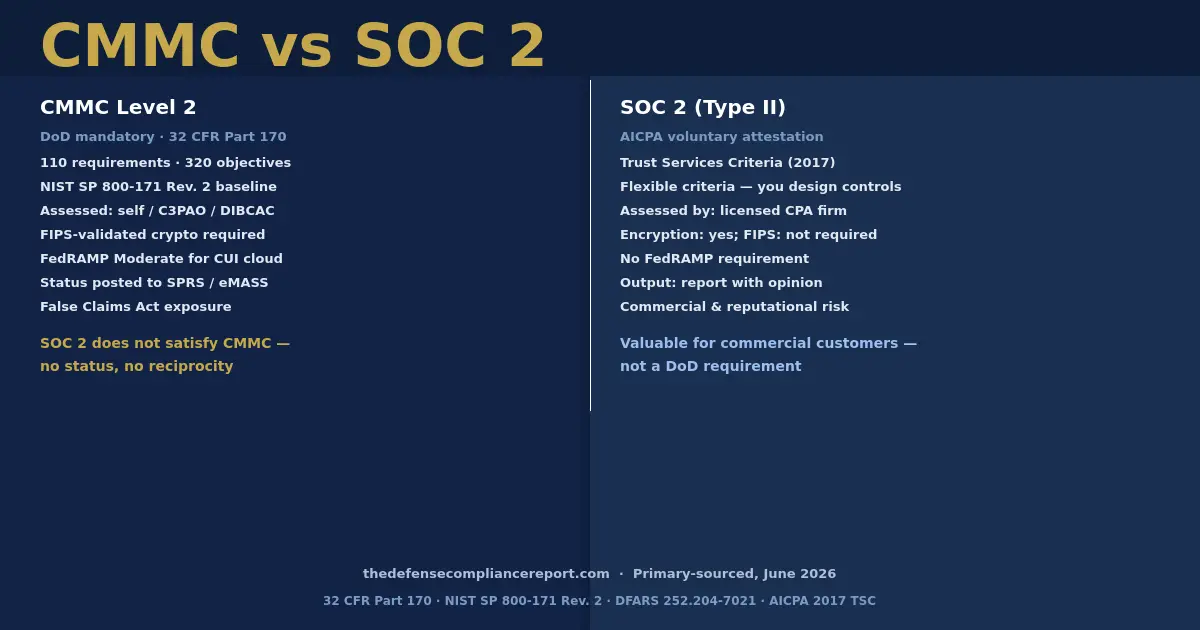
CMMC vs SOC 2 comes down to one hard fact: a SOC 2 report does not satisfy CMMC and does not create a CMMC status. CMMC (the Cybersecurity Maturity Model Certification) is a mandatory U.S. Department of Defense program for protecting Federal Contract Information (FCI) and Controlled Unclassified Information (CUI). At Level 2 it is built on NIST SP 800-171 Revision 2 — 110 security requirements measured against 320 assessment objectives in NIST SP 800-171A, scored prescriptively, and recorded in SPRS (the Supplier Performance Risk System) or CMMC eMASS. SOC 2 is a voluntary AICPA attestation against the flexible Trust Services Criteria, signed by a CPA firm, and it produces a report — not a status.
Here’s the part that surprises people, and the reason this page exists: your SOC 2 work is not wasted — but the part that carries over isn’t the part most companies assume.A mature SOC 2 program genuinely reduces your CMMC effort in access control, monitoring, and risk assessment. It does almost nothing for the requirements that actually fail unprepared contractors — FIPS-validated cryptography, FedRAMP-authorized cloud for CUI, CUI identification and handling, and the SSP, POA&M, SPRS, and affirmation obligations. We’ll map that precisely below.
The answer also shifts with your situation. Whether you handle FCI only or CUI, which CMMC level your contract names, your cloud environment, and whether you also sell commercially — all of it changes the next move. We’ll resolve each of those.
Which framework fits your situation — and which doesn’t
- You need CMMC if you’re a DoD prime or subcontractor that will process, store, or transmit FCI or CUI, and a solicitation or prime flow-down requires it.
- You need SOC 2 if commercial or enterprise customers ask for it in vendor security reviews or RFPs. The DoD does not.
- You likely need both if you sell to commercial customers and to the Defense Industrial Base (DIB).
- SOC 2 alone is not enough for the DoD. And CMMC alone won’t satisfy a commercial buyer who’s asking for a SOC 2 report.
CMMC vs SOC 2 at a glance
| Dimension | CMMC (Level 2) | SOC 2 (Type II) |
|---|---|---|
| What it is | A DoD certification/verification program for safeguarding FCI and CUI | An attestation report (not a certification) on a service organization’s controls |
| Governing authority | DoD — CMMC Program Rule, 32 CFR Part 170; contract clause DFARS 252.204-7021 | AICPA — 2017 Trust Services Criteria |
| Mandatory or voluntary | Mandatory once the contract clause applies; no required status = ineligible for award | Voluntary; typically driven by customer, vendor-risk, or RFP requirements, not by law |
| What it protects | FCI and CUI on contractor information systems | Whatever you commit to under your chosen Trust Services Categories |
| Who assesses you | Level 1: self-assessed; Level 2: self-assessed or C3PAO (accredited via the Cyber AB), depending on the contract; Level 3: DCMA DIBCAC | An independent, licensed CPA firm |
| What you get | A CMMC status stored in SPRS — Conditional or Final; for C3PAO and DIBCAC assessments, also a Certificate of CMMC Status | A report with the auditor’s opinion — not pass/fail; may note exceptions |
| Control basis | 110 requirements from NIST SP 800-171 Rev. 2, scored against 320 assessment objectives (NIST SP 800-171A) | Flexible criteria; you design controls to meet them — two companies can pass with very different setups |
| Cryptography | FIPS-validated cryptography required (e.g., SC.L2-3.13.11) | Encryption expected, but no FIPS-validation mandate |
| Cloud handling sensitive data | A cloud offering that processes, stores, or transmits CUI must be FedRAMP Authorized at Moderate (or higher), or meet FedRAMP Moderate-equivalent requirements, per DFARS 252.204-7012(c)–(g) | No FedRAMP requirement |
| Validity / cadence | Level 1: annual self-assessment + affirmation. Level 2 (Self): self-assessment every 3 years + affirmation at assessment and annually after. Level 2 (C3PAO): assessment every 3 years + annual affirmation. Level 3: DIBCAC every 3 years + annual affirmation | Report covers a window (typically 3–12 months); renewed annually as best practice |
| Legal exposure if you misrepresent it | False Claims Act liability via the DOJ Civil Cyber-Fraud Initiative — federal | Commercial and reputational — lost deals, failed vendor reviews |
| Typical all-in cost (2026, market-observed) | ~$50K–$200K+ first cycle for Level 2; Level 1 lower | ~$20K–$35K first year (small/mid SaaS); $50K–$250K+ for large enterprise |
| Who needs it | DoD contractors/subcontractors handling FCI/CUI once the clause applies (COTS-only contracts exempt) | SaaS, cloud, and service organizations whose customers require it |
What we actually verified for this page (June 2026)
We don’t ask you to take our word for it. Here’s what we read and cross-checked, with the primary source for each.
| What we verified | Primary source | Why it matters |
|---|---|---|
| CMMC Program Rule, effective Dec 16, 2024 | 32 CFR Part 170 (Federal Register, 89 FR 83092) | Defines CMMC applicability, levels, and scope |
| Acquisition rule effective Nov 10, 2025; phase dates | DFARS final rule (Federal Register); clause DFARS 252.204-7021 | Determines when CMMC enters contracts and how fast |
| Level 2 = 110 requirements / 320 objectives; Rev. 2 (not Rev. 3) | NIST SP 800-171 Rev. 2 and 800-171A; DoD class deviation, May 2024 | The exact control basis, and the version that applies |
| Assessment types by level | DoD CIO — About CMMC | Level 1 self, Level 2 self or C3PAO, Level 3 DIBCAC |
| SOC 2 = AICPA attestation on the 2017 Trust Services Criteria | AICPA TSP Section 100 | Defines SOC 2 correctly — it is a report, not a certification |
| DoD cost estimates by level | DoD CMMC regulatory analysis (Federal Register) | Anchors the cost section in official figures |
| A real enforcement outcome | DOJ press release, Sept 30, 2025 (Georgia Tech Research Corporation, $875,000) | Shows why a false self-attestation is a federal matter |
Does a SOC 2 report satisfy CMMC? No — and here’s exactly why
No. A SOC 2 report does not satisfy CMMC, does not create a CMMC status, and is not one of the DoD assessment paths recognized for CMMC status under 32 CFR Part 170. SOC 2 is a voluntary AICPA attestation against the flexible Trust Services Criteria, signed by a CPA firm; CMMC is a mandatory DoD program against the 110 prescriptive requirements of NIST SP 800-171 Revision 2. A clean SOC 2 report carries no CMMC standing, even where the underlying security work overlaps.
The cleanest way to see the difference is to ask what each one is actually testing.
SOC 2 is flexible by design. You pick which Trust Services Categories apply (Security is the only mandatory one; Availability, Processing Integrity, Confidentiality, and Privacy are optional), and you design your own controls to meet the criteria. Two companies with completely different control implementations can both walk away with a clean SOC 2 Type II report. That flexibility is the whole point — it lets the framework fit different business models. Your customers read the report and form a judgment; the CPA firm renders an opinion. Exceptions can be noted and a report can still be issued.
CMMC offers far less latitude. Each of the 110 requirements in NIST SP 800-171 Rev. 2 maps to specific assessment objectives in NIST SP 800-171A — 320 of them in total. At Level 2, how those objectives get checked depends on your contract: if it requires Level 2 (Self), your organization conducts the self-assessment and posts the results in SPRS; if it requires Level 2 (C3PAO), an authorized C3PAO performs the certification assessment and submits results into CMMC eMASS, which then transmits a score to SPRS. The scoring methodology is binary — met or not met against each objective. There is no equivalent of a "noted exception." A not-met objective is either corrected, deferred to a POA&M (where eligible, and for no more than 180 days), or it blocks the status.
The outputs aren’t interchangeable either. SOC 2 produces a report with an opinion — a narrative an auditor signs, which can include noted exceptions and still be useful. CMMC produces a status in SPRS (Conditional or Final), and for C3PAO or DIBCAC assessments a Certificate of CMMC Status as well. A SOC 2 report never becomes a CMMC status, and it is never entered into SPRS. (There is a narrow DoD path where a recent, perfect DIBCAC High assessment can count toward a Level 2 (C3PAO) status — but that is a DIBCAC-to-DIBCAC path, not a SOC 2 path, and it applies to virtually no contractor reading this page.)
One honest caveat, because you’ll hear the opposite from compliance-software ads: CMMC and SOC 2 overlap less than “map your controls across both frameworks” marketing implies. If your only goal is a DoD contract, this page cannot shortcut the work — there is no version of CMMC that your SOC 2 report satisfies, and treating it as a shortcut is exactly how contractors fail assessments and expose themselves to the False Claims Act.
But “not a shortcut” is not “not useful.” Your SOC 2 investment did real work that transfers straight into CMMC. The trick is knowing which parts — so you spend your CMMC budget only on what’s genuinely new. That’s what the rest of this page is for.
CMMC vs SOC 2: the real differences that change your decision
CMMC is mandatory, DoD-governed, NIST 800-171-based, and backed by federal False Claims Act exposure; SOC 2 is voluntary, AICPA-governed, Trust-Services-Criteria-based, and backed by commercial risk only.The “at a glance” table above is the fast version; below are the three differences companies misjudge most — and two of them quietly drive your cost.
1. Who’s driving it — the contract clause, or your customer.CMMC shows up because a DoD solicitation or a prime’s flow-down put it there. The clause sets the level; you don’t get to pick it, and a checklist doesn’t override it. SOC 2 shows up because an enterprise customer’s procurement team asked for it. Confusing “a customer wants assurance” with “the government requires eligibility” is the root mistake behind most CMMC-vs-SOC-2 confusion.
2. What happens if the paperwork is wrong — and this is the one that should get a CEO’s attention. A SOC 2 misstatement costs you a deal or a failed vendor review. A CMMC misstatement is a federal matter. On September 30, 2025, the Department of Justice announced that Georgia Tech Research Corporation agreed to pay $875,000 to resolve False Claims Act allegations tied to DoD cybersecurity requirements. According to the DOJ, the company submitted a summary self-assessment score to the government that was allegedly false because it was based on a “fictitious” or “virtual” environment that didn’t apply to any actual system processing covered defense information, and the relevant lab allegedly lacked a System Security Plan and ran without required anti-malware tools. The case turned on the alleged false score and control deficiencies — not on any data breach. Two former employees filed the underlying whistleblower suit and received a $201,250 share of the settlement. The DOJ stated that the resolved claims were allegations only and that there had been no determination of liability.The lesson for anyone thinking “we have SOC 2, we’ll just self-attest we’re fine” is blunt: a knowingly false or unsupported self-attested score can become False Claims Act exposure, not a paperwork shortcut.
3. Cryptography and cloud — where SOC 2 has no equivalent. SOC 2 expects you to encrypt sensitive data. CMMC expects FIPS-validatedcryptography (the requirement at SC.L2-3.13.11 points to validated cryptographic modules, not just “encryption turned on”). And if a cloud offering stores, processes, or transmits CUI, it must be FedRAMP Authorized at Moderate or higher — or meet FedRAMP Moderate-equivalent requirements per DoD policy — and your connecting on-premises systems stay in the assessment scope. A SOC 2-compliant SaaS stack clears neither bar automatically. These two items are why CMMC budgets balloon, and they’re the first things we flag in the carryover map.
Map your situation before you spend
You’ve now seen how different these two really are. The next question — which provider category you actually need — depends on your level, your FCI/CUI scope, your cloud environment, and your timeline, and a general article can’t resolve that for you. Use Find My CMMC Path to map your situation to the right category in a few minutes. It’s free, and it routes you to a category — not a sales list. Do not submit CUI or sensitive contract details.
Map my situation →What carries over from SOC 2 to CMMC — and what doesn’t
A mature SOC 2 program gives you real carry-over in access control, logging and monitoring, risk assessment, and change management — often most of the governance-and-visibility work. It gives you little to nothing on the CMMC-specific requirements that surprise SOC 2 holders: FIPS-validated cryptography, FedRAMP-authorized cloud for CUI, CUI identification and handling, and the SSP, POA&M, and SPRS artifacts. Use it as a head start, not a substitute.
Read this before the tables. What follows is our independent analytical comparison: we read NIST SP 800-171 Rev. 2 and its 800-171A assessment objectives against the AICPA’s Trust Services Criteria. It is not an official crosswalk from the DoD, the Cyber AB, NIST, or the AICPA, and no SOC 2 report creates a CMMC status, satisfies a CMMC clause, or proves a CMMC requirement on its own. The underlying evidence may still support specific CMMC objectives after scope-specific mapping. Confirm your actual scope with a CMMC Registered Practitioner (RP) or Registered Provider Organization (RPO), or qualified federal-contracts counsel.
Start with what you already have: the SOC 2 evidence reuse map
If you’ve been through SOC 2, you think in terms of the artifacts you already produced. Here’s what each one buys you toward CMMC — and, just as important, what it does not prove.
| SOC 2 evidence you already have | Useful for CMMC? | What it can support | What it does not prove | Your CMMC next step |
|---|---|---|---|---|
| Access-control policies and user access reviews | High | Access-control process maturity | That every NIST 800-171 access objective is met for the CUI boundary | Map to AC/IA objectives; test against actual configurations |
| Incident response plan + tabletop records | Medium–High | A documented, practiced IR process | CMMC-required handling across the CUI scope, plus DoD reporting | Test against CMMC objectives; add 72-hour DoD reporting under DFARS 7012 |
| Vendor/third-party risk records | Medium | Supplier governance discipline | DFARS/CUI flow-down completeness | Review contract flow-down and how subs handle CUI |
| Change-management tickets | Medium | Configuration and change discipline | Baseline configuration and least-functionality for the CUI boundary | Map to CM controls and document baselines |
| Logging and monitoring evidence | Medium | Operational visibility | CMMC-specific audit content, time-stamping, and retention | Compare against AU/SI/SC objectives |
| The SOC 2 report itself | Low–Medium | A customer-trust attestation and an organized evidence index | A CMMC status, an SPRS score, or a C3PAO result | Treat it as an input, not an outcome |
The one-line version: a clean SOC 2 Type II report is useful evidence, not a CMMC status.
The deeper view: SOC 2 → CMMC carryover map, by NIST family
This is the table you can’t get anywhere else in this form. It runs all 14 control families in NIST SP 800-171 Rev. 2 against the SOC 2 Common Criteria (CC1–CC9, plus any optional categories you scoped), and it flags the net-new work — the requirements with no real SOC 2 equivalent.
| NIST SP 800-171 Rev. 2 family (Level 2) | SOC 2 overlap (carry-over) | Net-new for CMMC — no real SOC 2 equivalent |
|---|---|---|
| Access Control (AC) — 22 reqs | High — maps to CC6 logical/physical access, least privilege | CUI-scoped access enforcement; remote/mobile-device controls tied to CUI; replay-resistant access to specific objectives |
| Awareness & Training (AT) — 3 reqs | High — maps to CC1.4 / CC2 security-awareness program | Insider-threat and CUI-specific handling training |
| Audit & Accountability (AU) — 9 reqs | Medium–High — maps to CC7.1–7.2 logging/monitoring | Prescribed audit-record content, time-stamp sourcing, defined review cadence, protected retention |
| Configuration Management (CM) — 9 reqs | Medium — maps to CC8.1 change management | Documented baseline configurations, least functionality, application allowlisting (CM.L2-3.4.8) |
| Identification & Authentication (IA) — 11 reqs | Medium — maps to CC6.1 identity/access | MFA scoped to CUI systems; FIPS-validated authenticators; specific authenticator rules |
| Incident Response (IR) — 3 reqs | Medium — maps to CC7.3–7.5 | 72-hour cyber-incident reporting to DoD under DFARS 252.204-7012(c) |
| Maintenance (MA) — 6 reqs | Low — mostly net-new | Controlled maintenance, media sanitization before off-site maintenance, MFA for nonlocal maintenance |
| Media Protection (MP) — 9 reqs | Low — net-new | CUI media marking and sanitization, removable-media controls, protected transport |
| Personnel Security (PS) — 2 reqs | Medium — partial tie to CC1.4 | Screening tied to CUI access; protecting CUI during transfers/terminations |
| Physical Protection (PE) — 6 reqs | Medium — maps to CC6.4 | CUI-specific facility safeguards, visitor escort/logging, alternate-work-site rules |
| Risk Assessment (RA) — 3 reqs | High — maps to CC3.1–3.4 + scanning (CC7.1) | Defined scan/remediation cadence tied to objectives |
| Security Assessment (CA) — 4 reqs | Medium — partial tie to CC4 | A System Security Plan (3.12.4) and POA&M (3.12.2) in NIST format; periodic self-assessment + scoring |
| System & Communications Protection (SC) — 16 reqs | Low–Medium — partial tie to CC6.6–6.7 | FIPS-validated cryptography (SC.L2-3.13.11) — the biggest surprise; boundary protection; CUI-at-rest; DNS, VoIP, mobile-code controls |
| System & Information Integrity (SI) — 7 reqs | Medium–High — maps to CC7.1 | Defined flaw-remediation timelines; malicious-code protection at entry/exit; monitoring DoD/US-CERT advisories |
The six net-new items that catch SOC 2 teams off guard:
- FIPS-validated cryptography. SOC 2 wants “encryption.” CMMC wants validated modules. No SOC 2 equivalent.
- FedRAMP-authorized cloud for CUI. Your SOC 2-compliant SaaS stack is not FedRAMP. This is the costliest surprise.
- CUI identification, marking, and handling. SOC 2 has generic “confidential data.” CMMC’s media-protection requirements — and the CUI program and your contract — require you to handle CUI specifically. (Note: broad CUI marking duties come from the CUI program and contract instructions, not from CMMC alone.)
- SSP + POA&M + an SPRS score. The artifacts and scoring methodology are new (max score 110; lowest possible −203).
- 320 assessment objectives, scored at the object level. Versus a SOC 2 report where management has latitude and exceptions can be noted without failing.
- An Affirming Official + False Claims Act exposure. A senior official affirms compliance to the government. Misstatement is a federal matter — see the Georgia Tech settlement above.
The biggest surprise gap: FIPS-validated cryptography and FedRAMP-authorized cloud
If you take one thing from this page, take this. SOC 2 cares that you encrypt; CMMC cares how. NIST SP 800-171 Rev. 2 points to FIPS-validated cryptographic modules, and a SOC 2 audit will happily pass a stack using perfectly good — but unvalidated — encryption. Worse, the moment CUI lives in a commercial cloud, you’ve inherited a FedRAMP-Authorized-Moderate-or-equivalent expectation that most SaaS environments don’t meet out of the box. That’s the fork that sends contractors toward a CUI enclave, Microsoft 365 GCC High, or AWS GovCloud — and it’s the single largest line item separating a SOC 2 budget from a CMMC budget. None of it shows up in a SOC 2 gap report, which is precisely why so many teams underestimate the jump.
What SOC 2 genuinely saves you
Now the good news, and it’s real. If you’ve built and operated SOC 2, you already have the muscle that makes CMMC less brutal: documented access control, monitoring and logging, risk assessment, vendor management, and — maybe most underrated — the discipline of producing evidence on a schedule and surviving an audit. Map that work to the NIST objectives and you’ve shortened your runway materially in several families. You didn’t waste the money. You built the foundation. The CMMC project is about pouring the specific, DoD-shaped concrete on top of it.
Can SOC 2 help with CMMC readiness?
Yes — SOC 2 can meaningfully help with CMMC readiness, but it cannot prove CMMC compliance.A mature SOC 2 program gives you a running start on access control, monitoring, risk assessment, vendor management, and audit discipline, and a well-organized SOC 2 evidence library shortens CMMC evidence collection. What it can’t do is define your CUI boundary, satisfy the net-new technical requirements, or stand in for the SSP, POA&M, SPRS score, and assessment your CMMC status depends on.
Two ways to take the next step
Do you need both SOC 2 and CMMC?
Many DIB companies need both — CMMC for defense-contract eligibility, SOC 2 for commercial customers who require it. If you sell only to the DoD, you may need only CMMC. If you sell only commercially, only SOC 2. Your customer base decides this, not the frameworks’ similarity. The matrix below tells you what likely applies to your situation, what your SOC 2 work can reuse, and which provider category to talk to first.
| Your situation | CMMC applies? | SOC 2 applies? | Does SOC 2 replace CMMC? | What SOC 2 may reuse | What’s still required for CMMC | Provider category to evaluate first |
|---|---|---|---|---|---|---|
| DoD contractor handling only FCI | Usually Level 1, if the contract requires it | Only if customers ask | No | Policies, access controls, IR evidence | FAR 52.204-21 safeguards (15 requirements), annual self-assessment, SPRS entry, affirmation | RP/RPO or readiness consultant |
| Handling CUI, contract allows Level 2 (Self) | Yes, Level 2 (Self) if specified | Optional / customer-driven | No | Access, logging, change, IR, vendor-risk evidence | 110 NIST 800-171 Rev. 2 requirements, SSP, a Level 2 self-assessment posted in SPRS every 3 years, affirmation at assessment and annually after, and a POA&M only where allowed under 32 CFR § 170.21 (closed within 180 days for a Conditional status) | RPO/RP, MSSP, GRC platform |
| Handling CUI, contract requires Level 2 (C3PAO) | Yes | Optional / customer-driven | No | Operating evidence and policy maturity | C3PAO assessment, objective-level evidence, POA&M closeout if conditional | Readiness provider first; C3PAO only when assessment-ready |
| Needs Level 3 | Yes, if required | Optional / customer-driven | No | Limited program maturity | Final Level 2 (C3PAO) prerequisite + 24 selected NIST SP 800-172 requirements (134 total) + DIBCAC assessment | Advanced CMMC readiness / vCISO / security engineering |
| SaaS selling to commercial customers only | No, unless a DoD/FCI/CUI trigger appears | Often yes if customers require it | Not applicable | — | — (unless DoD scope appears) | SOC 2 CPA firm / compliance platform |
| SaaS serving the DoD/DIB and handling CUI | Yes, if a contract/flow-down/scope triggers it | Often yes for commercial trust | No | SOC 2 evidence can reduce some readiness work | CUI scope, cloud/FedRAMP path, SSP, SPRS/assessment | CUI enclave / GCC High / AWS GovCloud + RPO/MSSP |
| MSP/MSSP supporting DIB clients | Maybe — especially if in scope as an external service provider | Often yes for customer trust | No | Security-operations evidence | CMMC scoping, ESP role, shared responsibility, CUI boundaries | CMMC-focused MSP/MSSP/RPO |
| Already has a current CMMC Status | Only for maintenance/renewal | Only if commercial buyers require SOC 2 | CMMC does not replace a buyer’s SOC 2 request | CMMC control maturity supports SOC 2 readiness | SOC 2 still requires CPA attestation against chosen criteria | SOC 2 CPA firm / platform |
This is what we call The CMMC Path Framework — the logic that maps your required level, FCI vs CUI handling, assessment type, cloud and IT environment, and contract timeline to the provider category you need. It routes to a category, never a named provider, and it is not a score, a ranking, or compliance advice.
One rule that trips people up if they’re running both programs: you can share a control library across SOC 2 and CMMC, but you cannot treat a SOC 2 control as if it isa CMMC control — the assessment objectives differ. And there’s a hard independence line on the CMMC side. To protect assessor impartiality, a C3PAO does not provide the readiness consulting or remediation for an engagement it will later assess. Keep readiness help and the formal certification assessment in separate lanes.
Cost and timeline: SOC 2 vs CMMC, with what’s actually included
SOC 2 (Type II) commonly runs around $20,000–$35,000 all-in for a small-to-mid SaaS company over roughly 3–12 months. CMMC Level 2 commonly runs $50,000–$200,000+ over 6–18 months. CMMC is the larger, longer, higher-stakes program — driven mostly by net-new technical and documentation work, not by assessor fees. But the headline numbers mislead, so read the inclusion labels.
Here’s the honest problem with every “CMMC costs X, SOC 2 costs Y” comparison you’ll find: they’re usually measuring different things. The DoD’s official CMMC cost estimates — the ones quoted everywhere — deliberately cover only assessment, certification, and affirmation, and they assume you’ve already implemented NIST SP 800-171. They exclude remediation, technology, and documentation, because the DoD treats NIST 800-171 as a pre-existing obligation under DFARS 252.204-7012 since 2017. As the DoD puts it in the rule, the estimate is what you pay to prove compliance, not to achieveit. SOC 2 market ranges, by contrast, often bundle readiness, tooling, and consulting. Compare them head-to-head and you’ll underbudget CMMC by six figures.
So we’ll separate the two.
DoD’s official CMMC estimates (assessment + affirmation only — not your full project):
| CMMC path | DoD estimate, small entity | DoD estimate, larger entity | What it covers |
|---|---|---|---|
| Level 1 (Self) | ~$5,977 | ~$4,000 | Annual self-assessment + affirmation |
| Level 2 (Self) | ~$37,000 (3-year) | ~$49,000 (3-year) | Triennial self-assessment + initial affirmation + two annual affirmations |
| Level 2 (C3PAO) | ~$104,670 (3-year) | ~$118,000 (3-year) | Triennial C3PAO assessment + initial affirmation + two annual affirmations |
| Level 3 (DIBCAC) | ~$12,800 (3-year) assessment/affirmation, on top of Level 2 (C3PAO) | Higher | Adds 24 selected NIST SP 800-172 requirements — see note below |
Two things to read carefully. First, those DoD figures cover only assessment, certification, and affirmation — not implementation. Second, Level 3 is different. Because its NIST SP 800-172 controls are genuinely new, the DoD separately estimates one-time and recurring engineering costs that dwarf the assessment — roughly $2.7 million one-time and $490,000 per year for a small entity, per the rule’s analysis. That’s why Level 3 is reserved for the roughly 1% of the DIB on the most sensitive programs, and why almost every SOC 2 holder reading this will never face it.
The real all-in picture (market-observed, 2026): the ranges below are compiled from current published pricing across SOC 2 audit firms and CMMC readiness/assessment providers, reviewed June 2026. They exclude outliers and are not official estimates; your number depends on scope, size, and starting maturity.
| Cost item | SOC 2 (Type II) | CMMC Level 2 | The catch |
|---|---|---|---|
| Readiness / gap assessment | ~$5K–$25K | ~$5K–$25K | Depends entirely on starting maturity |
| Core engagement fee | CPA audit ~$8K–$50K+ | C3PAO assessment ~$30K–$80K | Not apples-to-apples |
| Remediation / control build | Varies; often $10K–$80K | ~$20K–$150K+ | Usually the biggest variable on both sides |
| Documentation | Policies, procedures | SSP + POA&M (NIST format), commonly $12K–$60K+ | CMMC documentation is heavier |
| Cloud / environment | Standard SaaS | CUI enclave, GCC High, or AWS GovCloud if CUI is in scope | A CMMC-only cost with no SOC 2 analog |
| All-in, first cycle (small–mid) | ~$20K–$35K | ~$50K–$200K+ | The DoD’s small-business C3PAO estimate alone is ~$104,670 |
| Ongoing | Annual renewal ~75–90% of audit fee | Annual affirmation + 3-year recert + ongoing monitoring | Both are recurring, not one-and-done |
A real constraint worth planning around — and it’s genuine scarcity, not a sales tactic. Tens of thousands of DIB organizations are expected to need a Level 2 assessment across the phased rollout, served by fewer than ~100 authorized C3PAOs nationwide. (We re-verify this count against the Cyber AB CMMC Marketplace each quarter.) Phase 1 of the rollout began November 10, 2025 and remains active following the July 13, 2026 implementation suspension, which suspended new Level 2 (C3PAO), Level 3, and later-phase designations with no replacement Phase II date announced. The original Phase 2 start of November 10, 2026 — when Level 2 (C3PAO) certification was to appear as a standard condition of award — is not the current operative deadline. If your contract carries a written Level 2 (C3PAO) requirement, confirm the contracting officer has issued any required amendment before scheduling an assessment.
Get scoped quotes from the right category — after your scope is clear
The fastest way to waste money here is to quote-shop before you know what you need: paying an assessor to discover you needed remediation, or buying a tool that doesn’t solve your CUI boundary. Use Find My CMMC Path to compare provider categories by level, scope, cloud environment, and timeline, then request scoped quotes from matched categories. Do not submit CUI or sensitive contract details.
Compare provider categories →Should you do SOC 2 or CMMC first?
Do CMMC first if a current or near-term DoD contract, a prime flow-down, FCI/CUI handling, or a DFARS/CMMC clause puts contract eligibility at risk. Do SOC 2 first if the immediate blocker is a commercial customer’s vendor review and there’s no DoD/FCI/CUI trigger. If you already have SOC 2, don’t restart — lead your CMMC program with the net-new gaps and reuse the rest. Whichever deadline is binding wins.
| What just happened | Your first move |
|---|---|
| A solicitation includes a CMMC status requirement | CMMC first |
| A prime says CMMC flow-down is coming | Scope and start CMMC readiness now |
| You handle CUI today | Scope your CUI boundary first |
| An enterprise customer asked for a SOC 2 Type II | SOC 2 first — unless a CUI/DoD clause also exists |
| You serve both DIB and commercial customers | Scope CMMC/CUI first, then design a shared control program that feeds both |
| You already have SOC 2 Type II | Run a CMMC gap mapping before buying another audit |
| You have neither | Determine the contract/data trigger before choosing a framework |
The principle underneath all of it: shared evidence, separate attestations. Build your access, monitoring, and risk work once. Then attest to SOC 2 for your commercial customers and pursue CMMC status for the DoD — without pretending one output is the other.
What if a prime sends one questionnaire asking for CMMC, SOC 2, ISO 27001, and FedRAMP?
Treat the questionnaire as a demand map, not the legal source of the requirement. All four can appear in a single vendor security review, but only your contract clause, data type, cloud role, and customer requirement determine which one actually governs you. A questionnaire is often broader than your contractual obligation.
Sort the request into four buckets:
- A DoD contractual requirement → CMMC / DFARS. This is the one tied to award eligibility. The clause sets your level.
- A customer-trust report → SOC 2. Useful for commercial sales; not a DoD requirement.
- An information-security management certification → ISO 27001. Closer in spirit to SOC 2 than to CMMC; international, ISMS-based. See our CMMC vs ISO 27001 guide.
- A cloud authorization/security baseline → FedRAMP. Becomes directly relevant to CMMC the moment a cloud offering handles your CUI. See CMMC vs FedRAMP.
And a safety note that matters here: if CUI is involved, don’t answer security questionnaires casually, and don’t paste CUI, drawings, or sensitive contract details into vendor portals or forms. When the clause language or your CUI scope is ambiguous, that’s the moment to bring in a Registered Practitioner (RP/RPO) or federal-contracts counsel — not to guess.
For the mechanics behind each path, see our deeper guides: CMMC Level 2 requirements, CMMC for subcontractors, C3PAO vs RPO categories, CUI enclave options, GCC High for CMMC, and CMMC cost.
What SOC 2 teams underestimate when they move to CMMC
SOC 2-ready teams usually have controls. What they underestimate is CUI scoping, SSP depth, objective-level evidence, the SPRS and affirmation requirements, POA&M limits, and external service provider scope. The surprise isn’t that they have nothing — it’s that what they built wasn’t documented or evidenced for the CMMC assessment boundary. These are the breakpoints we see most.
CUI scope is not the same as your SOC 2 system scope. CMMC Level 2 scoping starts with the assets that process, store, or transmit CUI, and the rule expects you to document them in asset inventories, an SSP, and network diagrams. Your SOC 2 system boundary was drawn for a different purpose and rarely lines up.
The SSP and POA&M are core evidence, not optional paperwork. The System Security Plan (a document describing how you meet each requirement) and the Plan of Action and Milestones (your remediation plan for gaps) are foundational artifacts, and the assessment and reporting path expects them in a specific form.
POA&Ms have limits. Not every “not met” requirement can be deferred to a POA&M. POA&Ms aren’t permitted at Level 1 at all, and for eligible conditional statuses at Levels 2 and 3 you generally have 180 days to close them out — the clock starts when the results are loaded into SPRS (self-assessment) or eMASS (C3PAO), and missing the window can vacate a conditional status, putting eligibility and even existing contracts at risk.
External service providers can pull others into your scope. If you rely on an external service provider (ESP) or cloud service provider (CSP) that touches CUI or security protection data, that relationship and its shared-responsibility boundary have to be handled deliberately — including the FedRAMP expectation for a cloud offering that processes, stores, or transmits CUI.
If any one of those applies to you and it’s news, that’s a signal to scope carefully before you spend.
What to do next — whether or not you already have SOC 2
If you have SOC 2, don’t restart from zero — use the report and evidence as input, then run a CMMC-specific scope and gap assessment against your required level and CUI boundary. If you have neither, start with the business trigger, not the framework name. Either way, the goal is the same: know your scope before you hire.
If you already have SOC 2, in order:
- Identify the contract trigger and the required CMMC status.
- Confirm whether you handle FCI, CUI, or neither.
- Define your CMMC assessment scope (the CUI boundary).
- Inventory your SOC 2 evidence.
- Map that evidence to the NIST SP 800-171 Rev. 2 families and the 320 objectives.
- Build or update your SSP.
- Separate POA&M-eligible gaps from the ones you must fix before assessment.
- Choose the right provider category — readiness, enclave, GRC, or MSSP.
- Schedule a C3PAO only when you’re assessment-ready (if Level 2 C3PAO applies).
If you have neither, start here: read the clause or flow-down to confirm whether CMMC is actually required and at what level; determine whether you handle FCI or CUI; and only then decide whether your first dollar goes to CMMC scoping or to a SOC 2 program for a commercial customer. If both buyers are real, build a shared control program but sequence CMMC around the contract risk.
Need help deciding what type of CMMC provider you need?
Tell us your level, scope, and timeline, and we’ll match you with source-checked CMMC provider options.
How we verified this comparison
We built this page the way we build every page on The Defense Compliance Report: regulatory facts come from primary sources, cost figures are labeled by what they include, and our recommendations are clearly marked as editorial judgment.
We read the CMMC Program Rule at 32 CFR Part 170 (effective December 16, 2024) for applicability, levels, scope, and phase logic, and the DFARS final rule (effective November 10, 2025) for the contract clause at DFARS 252.204-7021 and the phased rollout. We confirmed the Level 2 control basis — 110 requirements across 14 families, 320 assessment objectives — against NIST SP 800-171 Revision 2 and NIST SP 800-171A, and we confirmed that CMMC currently maps to Revision 2, not Revision 3, per the DoD class deviation issued in May 2024. We confirmed SOC 2’s definition against the AICPA’s 2017 Trust Services Criteria. We anchored the cost section in the DoD’s own published estimates and labeled them against market-observed ranges. And we cited a real enforcement outcome — the DOJ’s September 30, 2025 announcementof Georgia Tech Research Corporation’s $875,000 False Claims Act settlement — directly from the Department of Justice, which stated the resolved claims were allegations only with no determination of liability.
Where we offer a judgment — which framework applies to a given situation, what to verify before you engage a provider — we’ve framed it as our editorial conclusion based on those verified facts, using The CMMC Path Framework. None of it is legal, contractual, or compliance advice. The contract clause and your CUI handling set your level — not a checklist — so confirm scope and applicability with a CMMC Registered Practitioner (RP/RPO) or a qualified federal-contracts attorney before you act. See our editorial standards and corrections policy.
CMMC vs SOC 2: frequently asked questions
Does SOC 2 Type 2 count for CMMC?
No. A SOC 2 Type II report may provide useful readiness evidence, but it does not create a CMMC status, satisfy the NIST SP 800-171 Rev. 2 assessment requirements, or meet a CMMC contract clause on its own.
Can I reuse my SOC 2 work for CMMC?
Partly. Access control, monitoring, risk assessment, and change management carry over with mapping effort. FIPS-validated cryptography, FedRAMP-authorized cloud for CUI, CUI identification and handling, and the SSP/POA&M/SPRS artifacts are net-new and have no real SOC 2 equivalent.
Is CMMC harder than SOC 2?
For most defense contractors, yes. CMMC is larger, longer, and higher-stakes — driven by 110 prescriptive requirements, 320 assessment objectives, and federal False Claims Act exposure, rather than by assessor fees.
Does CMMC require SOC 2?
No. CMMC does not require SOC 2. A company may pursue SOC 2 for commercial sales, but it is not a prerequisite for CMMC.
Do I need both SOC 2 and CMMC?
If you sell both commercially and to the DoD, usually yes. If you sell only to the DoD, you may need only CMMC. If you sell only commercially, only SOC 2.
Is SOC 2 enough for the DoD?
No. SOC 2 does not establish CMMC compliance or contract eligibility. Once the CMMC clause applies, you need the required CMMC status posted in SPRS.
Can a SOC 2 auditor perform a CMMC assessment?
Not by default. A SOC 2 audit is performed by a licensed CPA firm. A formal CMMC Level 2 certification assessment must be performed by an authorized C3PAO when that assessment type is required.
Can a C3PAO help us prepare and then assess us?
To protect assessor impartiality, a C3PAO does not provide the readiness consulting or remediation for the same engagement it will later assess. Keep readiness help and the formal certification assessment in separate lanes.
Which is more expensive, CMMC or SOC 2?
Usually CMMC Level 2, once remediation, CUI scope, cloud architecture, documentation, and assessment readiness are included. But headline numbers mislead — compare only quotes that include the same cost categories.
Do SaaS companies need CMMC?
Only if a DoD contract, subcontract, flow-down, or the handling of FCI/CUI triggers it. A commercial SaaS company with no DoD/FCI/CUI trigger may need SOC 2 for customer trust, but not CMMC.
If we use GCC High or AWS GovCloud, are we CMMC compliant?
No. A compliant cloud environment does not by itself make your organization CMMC compliant. You still have to define scope, implement the required controls, document responsibilities, and meet the required assessment path.
Does NIST SP 800-171 Revision 3 change CMMC?
Not yet. NIST has published Revision 3, but CMMC currently maps Level 2 to NIST SP 800-171 Revision 2, and C3PAOs are not authorized to assess against Revision 3 unless and until the DoD amends the rule.
What’s the first step if our prime asked for both SOC 2 and CMMC?
Determine which request is contractual (CMMC) and which is customer diligence (SOC 2). Then confirm whether you handle FCI or CUI, the required CMMC status, the SOC 2 report type requested, and whether one shared control program can feed both without confusing the outputs.
Keep going
- CMMC Level 2 requirements — the 110 NIST SP 800-171 Rev. 2 controls, organized by family
- CMMC for subcontractors — how flow-down requirements reach subs
- CMMC provider categories — RPO/RP, MSP/MSSP, GRC, CUI enclave, and C3PAO compared
- CUI enclave options — how to shrink CMMC scope by isolating CUI
- GCC High for CMMC — when a Microsoft GCC High environment is the right move
- CMMC cost — DoD estimates, market ranges, and what drives your number
- CMMC Readiness Checklist — self-map against the 14 NIST SP 800-171 Rev. 2 families
- CMMC vs ISO 27001 — if your prime is also asking for ISO 27001
- CMMC vs FedRAMP — if the question is about cloud authorization
- SPRS score and annual affirmation — how scoring works and what to post
Primary sources
- 32 CFR Part 170 (Federal Register, 89 FR 83092)
- DFARS final rule (Federal Register); DFARS 252.204-7021, DFARS 252.204-7012
- NIST SP 800-171 Rev. 2 and NIST SP 800-171A
- NIST SP 800-172 (Level 3)
- AICPA 2017 Trust Services Criteria
- SPRS — Supplier Performance Risk System
- DoD CIO — About CMMC
- U.S. Department of Justice press release, Sept 30, 2025 (Georgia Tech Research Corporation, $875,000 settlement)
- Cyber AB CMMC Marketplace (C3PAO count, re-verified quarterly)